

The manual lead management systems are slowly dying and in a world where customers expect high quality service and a smooth journey, a real estate lead management CRM becomes a necessity. The property management software has redefined the way real estate agencies manage leads.
Earlier when this data was managed through multiple mail chains and excel spreadsheets the client information was not only distorted and scattered but most of the time got missed altogether. Now when the lead was missed, it eventually turned to a closed loop. But with a real estate sales automation CRM, the complex process of lead management is simplified.
The system automatically converts every client query to a potential lead and then it is auto assigned to an agent. This reduces the chaotic process of transferring lead from one agent to another without context leading to a frustrated customer and a lost lead. The CRM software for real estate lead management ensures that no lead is missed and is safely stored with all the data in the CRM itself.
Understanding How the Real Estate Lead Generation System Has Changed
In earlier times when the CRM technologies were not that advanced, there was usually a single source of generating leads. However, with the changing business environment and changing dynamics the leads are now flowing from various sources like property portals, websites, and even social media platforms.
Without a centralised lead management system, the data often remains scattered and ultimately goes stale in the mail box. The leads that could have generated a generous amount of business are never reached out to and they shift to competitors. This fragmentation then results in delayed responses, duplicate efforts, missed follow-ups and poor visibility for the management.
In such mismanaged scenarios, a real estate CRM software comes out as the hero by centralising all leads giving a clear-cut visibility to the management on the client data and how far they have been nurtured. This also means improved customer experiences and a satisfying customer journey.
How does a Lead Management Software in Real Estate Brings Stability in Business Workflows?
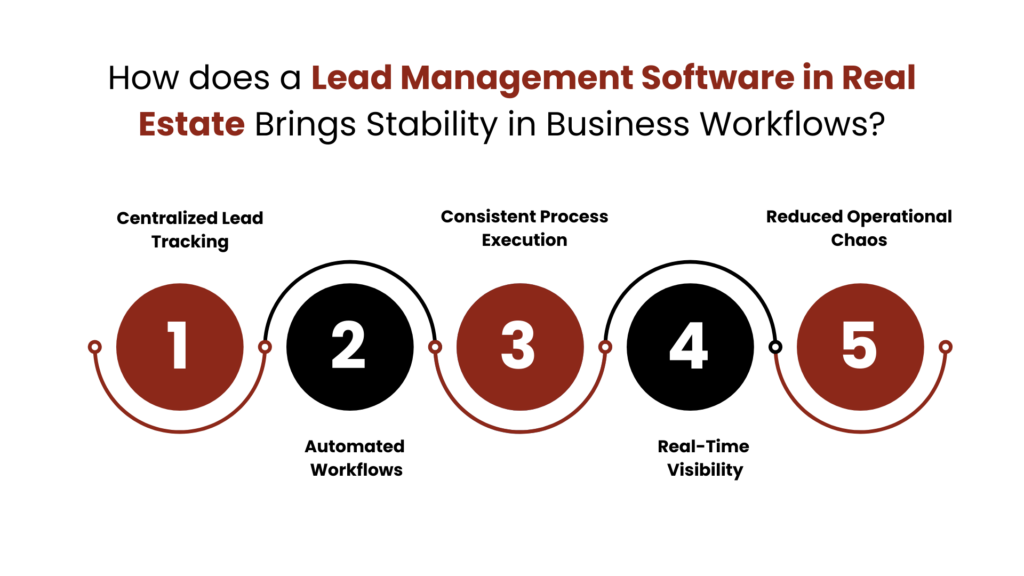
A well executed lead management software aims to bring stability in the business workflows by eliminating long approval processes, scattered data workflows, and manual efforts to maintain data in spreadsheets and mail chains.
Lead management software ensures that real estate businesses operate in a structured and predictable manner. By organizing enquiries, automating tasks, and centralizing information, it minimizes errors and streamlines operations.
Centralized Lead Tracking
A lead management software captures all enquiries from websites, portals, social media, and offline sources in a single platform. This ensures that no lead is missed and all customer information is stored systematically, eliminating scattered data and missed opportunities.
Automated Workflows
The software automates critical tasks such as lead assignment, follow-ups, reminders, and notifications. By reducing manual intervention, agents can focus on engaging prospects rather than administrative work, ensuring a smoother workflow.
Consistent Process Execution
Every lead moves through predefined stages i.e., qualification, follow-up, site visit, negotiation, and closure. This standardized process ensures that every opportunity is handled consistently, improving accountability and reducing errors.
Real-Time Visibility
Managers and teams gain instant insights into lead status, agent performance, and pipeline health. This visibility allows for quick corrective actions, ensuring that bottlenecks are addressed and opportunities are not lost.
Reduced Operational Chaos
By organizing data, automating repetitive tasks, and maintaining a structured pipeline, lead management software reduces confusion, miscommunication, and delays. Teams can operate efficiently, creating a stable and predictable business workflow.
Does a Real Estate Lead Management CRM Enable Business Growth and Scalability?
A real estate client management CRM software definitely enables business growth and provides great room for scalability. As enquiry volumes increase, the CRM ensures every lead is captured, prioritized, and followed up without adding operational complexity.
By automating workflows, improving visibility, and optimizing agent performance, it allows real estate businesses to grow steadily while maintaining control over sales processes and customer experiences.
Adaptability is Critical in Dynamic Markets
Real estate markets fluctuate based on pricing trends, buyer sentiment, and regulatory changes. Businesses must adapt quickly to remain competitive. A lead management CRM enables rapid adjustments.
Sales strategies, follow-up cadences, and team assignments can be modified without disrupting operations. This flexibility allows businesses to respond to market shifts faster than competitors relying on rigid or manual systems.
Growth Without Chaos Requires Systems
Scaling a real estate business without systems leads to operational chaos. More projects, more channels, and more agents amplify inefficiencies if processes remain manual. A lead management CRM provides the foundation for structured growth.
It supports expansion without compromising response quality or customer experience. Businesses can scale confidently knowing their lead handling remains reliable and controlled.
Customer Experience is a Revenue Driver
Today, customer experience is directly tied to revenue outcomes. Buyers prefer businesses that respond faster, communicate clearly, and remain consistent throughout the journey. A lead management CRM ensures every interaction adds value.
Prospects feel acknowledged, informed, and guided rather than chased. This experience increases trust, improves conversions, and encourages referrals.
Visibility Empowers Better Leadership Decisions
Leadership teams cannot manage what they cannot see. Without real-time visibility into lead movement, decision-making becomes reactive and assumption-based. A lead management CRM provides clear insights into enquiry flow, response timelines, conversion trends, and team performance. Leaders can identify bottlenecks early, optimize campaigns, and realign resources with confidence.
Consistency Builds Trust at Scale
As businesses grow, maintaining consistent customer experiences becomes challenging. Different agents handle enquiries differently, resulting in uneven communication and confusion for prospects.
A lead management software standardizes processes without making interactions robotic. Templates, pipelines, and shared customer histories ensure prospects receive accurate and consistent information regardless of who engages with them.
Better Sales Team Performance
Real estate sales teams often operate under high pressure to close deals. However, pressure without clarity leads to burnout and inefficiency. Agents struggle when they have to manually prioritize leads or remember next actions.
A real estate management CRM removes this immense load. Agents know exactly which leads need attention, which stage each deal is in, and what actions are pending. This clarity improves productivity, response quality, and overall morale.
Conclusion
The real estate business landscape is now evolving at a rapid rate and customer experience is the core of the business. A valued customer experience can make or break a business deal. In such changing times, a real estate lead management CRM proves to be a successful investment for the estate agencies and it is no longer a choice, but a necessity.
By automating leads in the property management software, businesses do not have to worry about handling leads manually and every incoming query is turned to a lead with data stored in a single CRM and the unified communication channel with managerial access available makes it easier to coordinate amongst the teams.
A Real Estate Lead Management CRM protects revenue, empowers teams, improves visibility, and aligns businesses with modern buyer expectations. Without it, businesses risk inefficiency, inconsistency, and lost opportunities.
FAQs
1. What is a real estate lead management CRM?
A real estate lead management CRM is a centralized software system that captures, organizes, assigns, and tracks property enquiries from multiple sources such as websites, portals, and social media. It ensures that all lead data is stored securely and managed efficiently throughout the sales cycle.
2. Why is a real estate lead management CRM no longer optional for businesses?
With rising customer expectations and increasing enquiry volumes, manual lead tracking through spreadsheets and emails leads to missed opportunities and poor experiences. A CRM automates lead handling, reduces response delays, and ensures no enquiry is lost, making it essential for modern real estate businesses.
3. How does a lead management CRM reduce missed or lost leads?
The CRM automatically converts every incoming enquiry into a lead and assigns it to the appropriate agent. Centralized storage, instant notifications, and automated follow-ups eliminate the risk of leads being overlooked or forgotten.
4. How does centralized lead tracking improve workflow stability?
Centralized lead tracking brings all enquiries into one platform, removing data silos and duplication. Teams work from the same system, approvals move faster, and workflows become structured and predictable.
5. How do automated workflows support real estate sales teams?
Automated workflows handle repetitive tasks such as lead assignment, reminders, and follow-ups. This reduces administrative burden on agents, allowing them to focus on customer engagement and deal closure.
For more insights, updates, and expert tips, follow us on LinkedIn.