
The real estate industry is evolving faster than ever and in addition to the rising customer expectations, the economy is now highly digital and tech enabled. In such times, in a business like real estate where multiple queries are flowing on a daily basis, manual management is no longer an option. So to simplify this situation, businesses are now resorting to an integrated CRM solution for real estate, and leveraging automation to scale and grow 5x faster.
This CRM automation in real estate is not just limited to query handling and sending automated messages. It is an entire ecosystem enabled with AI guidance that automates the complete customer experience journey right from the point where a query is sent till the legal guidance required after the unit is sold to the client.
This is basically a smart all-in-one CRM for builders that is simplifying their complex workflows, improving customer engagement, managing multiple leads and enhancing the internal system with transparent and unified access systems. It is safe to say that this CRM automation in real estate is no longer a luxury experience, but has become the core of a successful business.
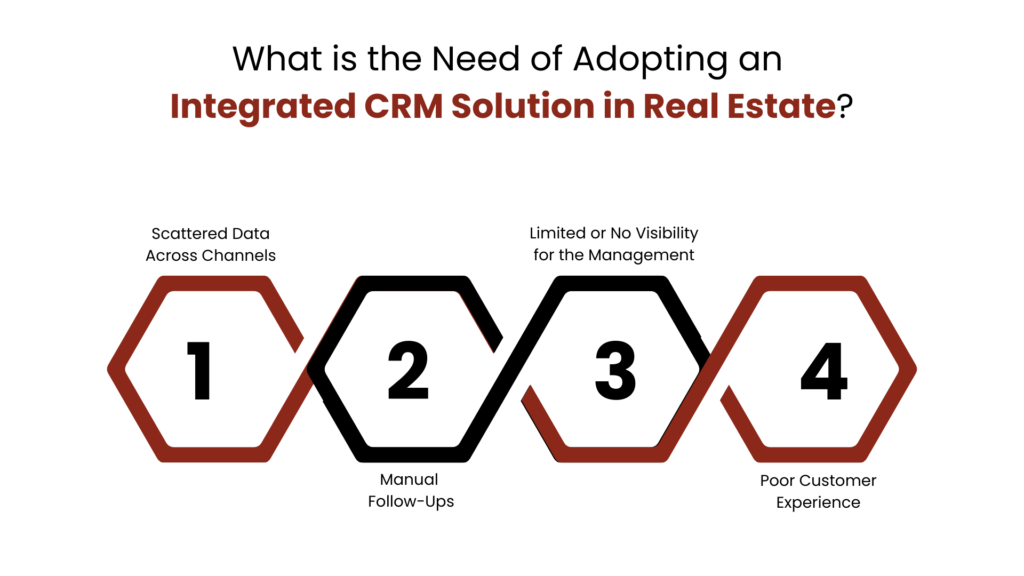
What is the Need of Adopting an Integrated CRM Solution in Real Estate?
The real estate market is highly competitive and there are multiple players in the market. Some succeed with a spot on business strategy while some businesses are still operating with obsolete technologies and manual leads. They manage their data via spreadsheets thinking that it is more convenient and reliable. But what these real estate agencies fail to understand is that the economy has become far more advanced and adapting to technology is not a choice anymore.
With manual data handling, these businesses struggle with some first world problems like scattered lead data across emails, chats, property portals, and calls, no or minimal context of customer information, query and history, no visibility for the management and this system eventually fails the business due to poor customer experience and outdated data.
Scattered Data Across Channels
Real estate businesses are receiving multiple property enquiries from various different sources like property portals, social media channels, official website, emails, and messaging channels. Managing this data separately and through manual spreadsheets leads to missed leads and delayed responses.
Manual Follow-Ups
When the data is not automated and managed without an integrated CRM solution for real estate, the agents are solely relying on their memory and spreadsheet data to follow-up. This either leads to the wrong follow-up with the wrong customer or a delayed or missed follow-up altogether. This slows down the business procedures and affects the connected workflows.
Limited or No Visibility for the Management
The manual data management lacks proper visibility and the data is not shared to the higher management and all team members. This non-transparency in communication delays the approval cycles and it becomes a struggle to track the deal progress, enquiry status, and agent performance.
Poor Customer Experience
When the data is not centralised within a CRM it leads to delayed responses, repeat questions and conversations, and irrelevant property suggestions. This disturbs the customer experiences and ultimately leads to a poor customer experience.
How Does a Cloud Based Integrated CRM Transform Real Estate Operations?
For the businesses in the real estate industry adopting a cloud based integrated CRM is no longer a choice but a mandate. It is transforming the real estate businesses in the sense that it centralizes the lead management systems, making the customer journey more meaningful and easier with the online site visits, instant cost sheets, and the most relevant and relatable pricing.
When the businesses achieve this level of automation they experience a 5x boost in the growth journey, simplified communication channels, and a smooth running internal workflow.
Centralised Lead Management
Adopting an integrated CRM solution built specially for real estate businesses centralises all your leads. It captures every incoming query within the system at first opportunity and converts it to a lead. It adds the complete customer data to the real estate CRM and then automatically assigns the lead to the most relevant agent.
This CRM practice ensures that all the client data is safely stored in the CRM for real estate and can be easily utilized for future predictions and offerings. Moreover, this eliminates the need for manual lead management systems, saving the agents time to focus on conversion rather than capture.
Smart Lead Scoring & Prioritization
Since the CRM is automated and possesses the advanced AI abilities it helps the agents with prioritization. Based on the customer budget preferences, location preferences, and property type, this smart AI assistant scores every lead and predicts the likeliness of conversion. Based on this lead scoring analysis the estate agents can easily identify which leads should be focused on and prioritized and which ones can be saved for later.
This means that the agents can grab the best opportunities faster and do not have to waste time on irrelevant leads or unnecessary conversations that will not convert.
Centralised Inventory & Property Portal Integration
A real estate lead management CRM brings all your property portals like magic bricks, 99 acres, house, and others on a single platform which allows you to manage everything on a single screen. The agents save time in jumping from tab to another and manage all their sold and unsold units from one CRM.
Further, the agents can keep the information updated at all times which eliminates the risk of duplicate units listed or sold units still showing as unsold. This also helps the agents in sending the relevant property recommendations to the clients and increase engagement.
One Click Cost Sheet Generations
In a business like real estate where quick decisions and fast responses are the key to deal closures, a real estate automation CRM has made this easy. Agents can create the cost sheets with a single click with accurate market prices and these can be shared with the customers in an instant.
This saves the agents time creating cost sheets manually that takes days, and with the transparency maintained in communication the management approval cycles are also shortened.
Conclusion
An integrated CRM solution for real estate business is no longer a luxury, but a strategic necessity. From capturing every enquiry to nurturing leads, managing properties, and closing deals, a CRM streamlines the entire sales journey.
Real estate businesses that invest in an integrated CRM gain better visibility, improved efficiency, stronger customer relationships, and scalable growth. In a market driven by speed and experience, adopting an integrated CRM is the key to staying competitive and future-ready.
FAQs
1. What is an integrated CRM?
CRM integration is the process of connecting your third-party applications which may exist in the cloud, in legacy systems, and in on-premise hardware and software to your CRM platform so that data and workflows can be automatically synced between them.
2. What is an example of CRM integration?
For example, when an order is placed on a company website, all of the customer, order, and product data is automatically transferred to the CRM and Enterprise Resource Planning (ERP) system without human intervention or manual data entry.
3. Why is an integrated CRM necessary for real estate businesses today?
With rising enquiry volumes and highly digital customer behaviour, manual lead handling is no longer effective. An integrated CRM helps real estate businesses manage multiple enquiries efficiently, respond faster, reduce lead leakage, and scale operations without operational chaos.
4. Why is an integrated CRM necessary for real estate businesses today?
With rising enquiry volumes and highly digital customer behaviour, manual lead handling is no longer effective. An integrated CRM helps real estate businesses manage multiple enquiries efficiently, respond faster, reduce lead leakage, and scale operations without operational chaos.
5. How does an integrated CRM improve customer experience?
By centralising customer data and conversation history, the CRM enables faster responses, personalised property suggestions, and consistent communication. This avoids repeat questions and irrelevant recommendations, resulting in a smoother and more professional customer journey.
For more insights, updates, and expert tips, follow us on LinkedIn.