

While most real estate businesses spend heavily on marketing campaigns, lead generation portals, or property exhibits to attract and lure customers, they forget that the real essence of deal closure lies in proper follow-ups. Businesses struggle with spreadsheets and manual entries, and without a proper real estate CRM for builders they end up losing important deals.
A property buyer these days is usually impatient and wants to act fast on a particular deal. Estate agencies that do not match up to this pace often lose a lot of revenue and buyers move to a competitor.
From the scenario stated above it is then safe to say that a major reason for such loss is the delayed process and laid back follow-up behaviour.
In this blog post, we discuss how such slowed down behaviour impacts sales, RoI, and revenue while understanding how a real estate automation software powered by AI can help such lost firms get back on track.
The Real Estate Sales Cycle Where Speed Wins Deals
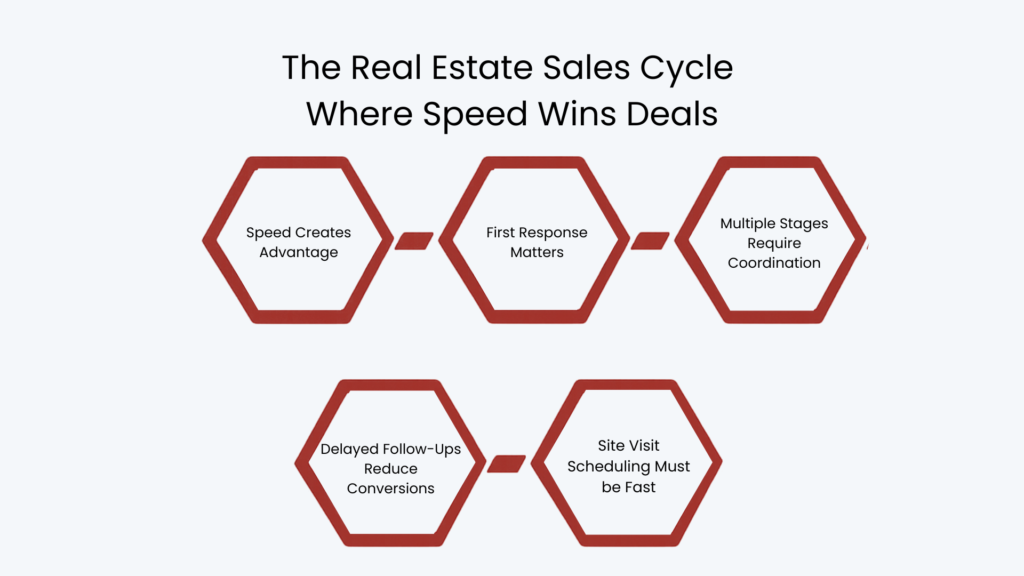
A real estate sales cycle is unique in comparison to other industries. Even if the buyers may take a few months or weeks to make the final decision, they want the initial process to be completed faster, quicker, and with full context and precision.
Speed Creates Advantage
Even though the buying cycle is longer, businesses who respond to the queries timely still gain a competitive advantage. It helps them gain the client’s trust and allows them to build cordial relationships.
First Response Matters
Most buyers contact the developers at the same time, and a delayed response here can result in lost deals. Hence, communicating immediately matters and instant communication increases the chance of conversion.
Multiple Stages Require Coordination
The real estate sales cycle involves multiple stages like lead generation, documentation, site visits, and negotiations. This means that even a small delay on any step can slow down the entire process leading to a lost opportunity.
Delayed Follow-Ups Reduce Conversions
Buyers often indulge in several interactions and before making a decision they expect proper follow-ups. A missed follow-up or inconsistency in follow-ups cause the potential customers to lose interest.
Site Visit Scheduling Must be Fast
Site visits play a critical role in the property buying process and improves customer engagement. Any delay at this critical juncture can lead to buyer drop-off and they move to competitors for a smooth experience.
How Revenue Leakage Happens Without a Real Estate CRM for Builders
A common myth related to revenue leakage is that it happens due to lack of demand. However, this is not the case. In fact the most common reason for a business loss is more often than not linked to operational inefficiencies.
A few examples that lead to such drastic losses are listed below.
- Missed Leads → If a potential buyer fills out the form at night and is being responded to the next day, it loses essence. By that time, the buyer has already engaged with other potential estate agents.
- Duplicate Communication → Without a centralised system when agents contact the same person, it leads to confusion and as a result the conversations are duplicated and run in a loop.
- Forgotten Follow-Ups → A buyer calls after carefully viewing each detail including finance. Since there is no automated reminder the follow-ups never happen.
- Delayed Payments → When finance and sales function individually without a unified communication system, it leads to delayed financing and payment schedules.
- Poor Customer Conversations → Scattered conversations, delayed follow-ups, and repeat questions lead to consumer distrust and poor experiences.
Role of AI-Backed Real Estate Automation in Preventing Revenue Loss
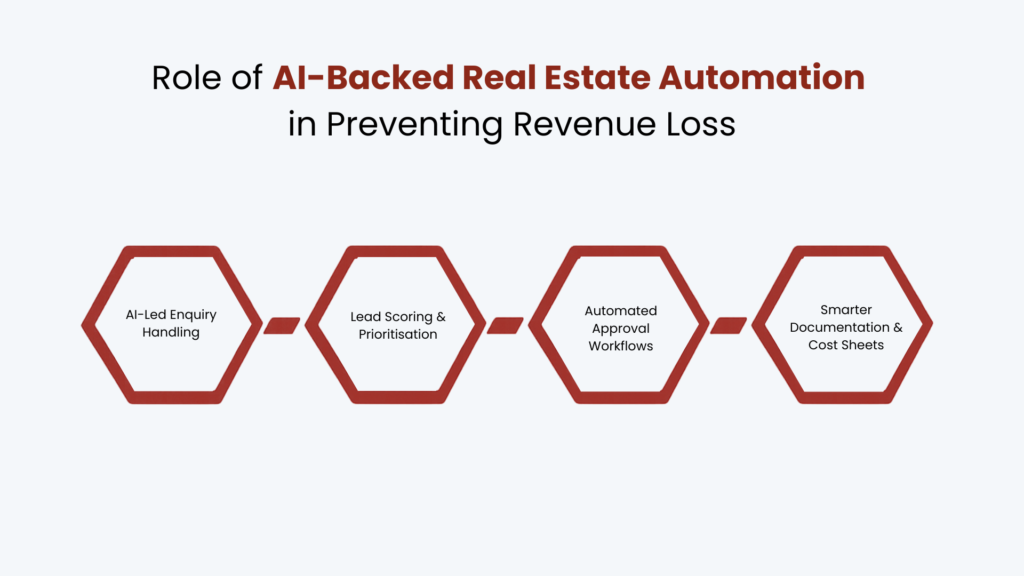
An AI-enabled real estate CRM for builders acts as a centralised platform that connects all the teams including marketing, sales, finance, customer support, and management and allows them to function in coordination without any delays.
AI-Led Enquiry Handling
The faster a query is responded to and acted upon, the higher are the chances of customer engagement and deal closures. With the automated enquiry system setup, each incoming query from all the portals is auto added to the CRM and then assigned by the AI bot to an agent.
This ensures that no lead is missed and no response is delayed. Further, the agent receives the complete information around a buyer that is required for the initial demo and introduction call.
Lead Scoring & Prioritisation
Prioritisation is important in the real estate industry and builders who do not react to hot leads on time, not only lose a client but it also affects the revenue. However, with the help of an AI agent and real-time analytics, each lead is automatically scored.
Based on the buying intent, purchase behaviour, budget, and location preferences – the real estate CRM for builders scores these leads. The dashboard can then be viewed by the stakeholders inside the organisation and agents can easily reach out to urgent buyers or hot leads.
Automated Approval Workflows
The most amount of time in an estate deal closure is taken during the approval process. This delay in approval makes the prospect disengaged and they gradually shift to other builders or agencies.
The automated real estate sales workflow simplifies this approval chain by sending notifications and triggers to the relevant party as soon as they are initiated inside the CRM for builders. This shortens the approval workflows by a significant timeline, and customers are engaged within a few hours of discussion.
Smarter Documentation & Cost Sheets
In order to close a real estate deal successfully, prospects must receive the documents and cost sheets timely. The advanced real estate CRM software allows the businesses to share the documents and cost sheets in an instant.
All the agents have to do is add the relevant data in the pre-defined cost sheet and documentation template. This can then be shared with the clients as it is without any delays. The data collected in this process is accurate and therefore it eliminates the risk of manual errors.
Real Estate Operations in the Future
The future of real estate will belong to those developers who know how to successfully integrate strong real estate projects with advanced digital operations.
Modern technology is transforming consumer expectations at a rapid pace. Today’s consumers are demanding:
- Immediate response time
- Electronic documentation
- Smooth communication
- Customized interaction
- Clear processes
- Quick transactions
Developers who lag behind in terms of digital operations may lose more than just sales; they may damage their reputation and risk losing revenue.
In today’s world, a Real Estate CRM is much more than a sales software. It is an integrated operation management system.
Conclusion
Without question, developers are definitely losing money when they have delayed operations without a Real Estate CRM for builders.
The loss might not necessarily be evident in their financial records; however, it manifests in the form of lost opportunities, slower reaction, inefficient follow-up, inefficiencies in the approval process, coordination problems, and lack of customer confidence.
When working in an intense real estate environment, any kind of delay may easily become a significant loss in booking and revenue generation.
A contemporary Real Estate CRM addresses all these problems through automation of operations, consolidation of customer data, improved collaboration between teams, and fast-tracking of the whole process of sales.
In a highly competitive environment, where developers want to grow sustainably and increase customer satisfaction, a Real Estate CRM system has become a necessity.
FAQs
1. Why do builders lack revenue without Real Estate CRM?
Builders miss out on revenues because of slow response time, missed follow-up activities, lack of effective communication, and ineffective operations process. Due to the absence of an effective CRM, potential leads are usually missed out.
2. What does a late follow-up in real estate sales indicate for business growth?
The result of late follow-up is loss of customer interest and trust. This is due to the fact that customers usually interact with many other developers within that period of time.
3. Why is fast action critical in real estate sales?
Even though real estate sales may require days or even weeks to complete the process, buyers need to be contacted within short notice periods for quick actions.
4. Which departments can be linked with the Real Estate CRM?
The Real Estate CRM links the sales department, marketing department, finance department, customer service department, and management department using a single platform.
5. Why is digital transformation critical for a real estate business?
Today’s customers demand immediate communication and digital records with fast transaction times. The businesses that do not transform digitally stand to lose their customers and income.
For more insights, updates, and expert tips, follow us on LinkedIn.