

Most builders in this digitally empowered world don’t lose deals because of bad inventory. They lose them because of slow follow-up.
Imagine a typical scenario of a business. A buyer fills out an inquiry form at 11 PM on a Sunday. By Monday morning, three other developers had already sent a WhatsApp message, a brochure, and a callback confirmation.
Your team is still sorting through the weekend leads. That deal? It’s already gone.
This is the conversion problem the Indian real estate market is sitting on right now and it has nothing to do with pricing or location.
It has everything to do with speed, consistency, and whether your sales process runs on people’s memory or on automated workflows in real estate CRM.
In 2026, the builders closing faster aren’t necessarily selling the best projects. They’re running smarter systems.
Here’s why that gap is widening and what it looks like when a real estate CRM with workflow automation is working the way it should.
Every Minute After an Enquiry Is Costing You Money
The 5-Minute Rule Buyers Expect in 2026
Research on lead response has shown the same pattern consistently: the probability of converting an inbound inquiry drops sharply after the first five minutes.
By the time 30 minutes have passed, you’re not competing on product anymore, you’re competing on whether the buyer still remembers why they were interested.
In a market where buyers are simultaneously browsing NoBroker, 99acres, Housing.com, and your project microsite, response time isn’t a courtesy. It’s your first sales move.
Why “We’ll Call Later” Doesn’t Work Anymore
“We’ll call later” made sense when buyers had limited options and more patience. Neither of those conditions applies right now.
Today’s buyer, especially in Tier 1 cities like Mumbai, Pune, and Bengaluru, is researching multiple projects at once, often during work hours, often on mobile.
If they don’t hear from you within minutes, they fill the gap with whoever does respond. Your follow-up call at 4 PM is competing against a site visit that’s already been scheduled with someone else.
Your Competitor’s CRM Never Sleeps
This is the part most sales managers underestimate. The builders who are pulling ahead right now aren’t hiring larger teams, they’re using AI-powered real estate CRM workflows that respond, assign, and follow up without anyone pressing a button.
Their CRM acknowledged that 11 PM inquiry before your team clocked in for the day. That’s not a technology advantage anymore. It’s a basic operational requirement.
What Happens Inside an Automated CRM While Your Team Is Busy?
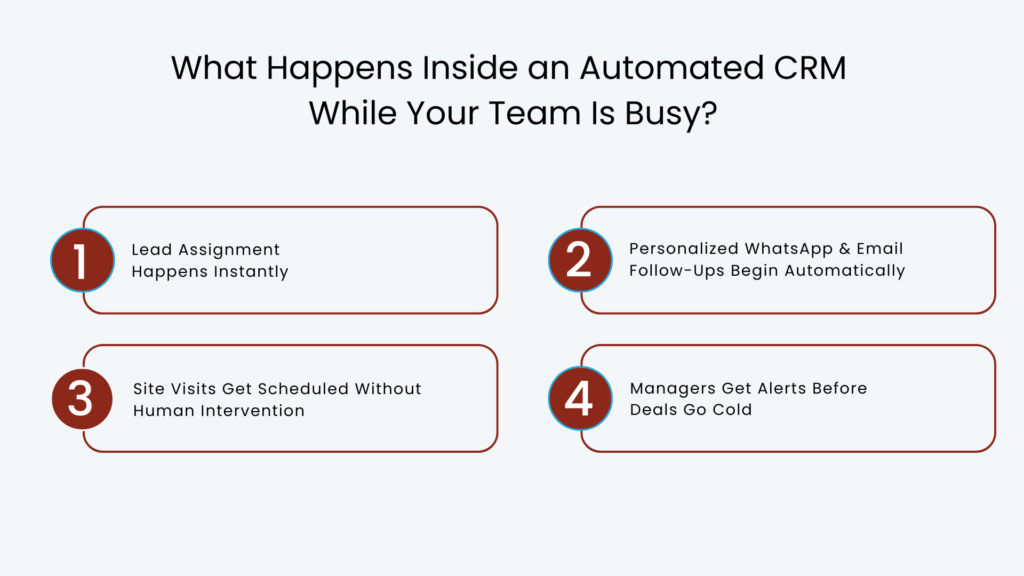
Lead Assignment Happens Instantly
The moment a lead comes in from a portal, a Facebook ad, a site visit QR code, or a direct form fill; automated workflows in real estate CRM routes it to the right sales executive based on project, location, budget range, or team availability. No manual sorting, no leads sitting in a shared inbox, no assignment happening three hours late.
Personalized WhatsApp & Email Follow-Ups Begin Automatically
Within minutes of assignment, the buyer receives a WhatsApp message, not a generic blast, but a message referencing the specific project they enquired about, the configuration they showed interest in, and a direct link to the brochure or virtual tour.
AI-powered lead management workflows make this level of personalization possible at scale without any manual input from the sales team.
Site Visits Get Scheduled Without Human Intervention
Buyers who respond to the initial message can confirm a site visit through an automated scheduling flow; selecting a date and time, receiving a calendar invite, and getting a reminder the morning of the visit. All of this happens before a sales executive has had a single conversation with them.
Managers Get Alerts Before Deals Go Cold
If a lead hasn’t been contacted within a defined window, or if a hot lead has gone quiet after multiple follow-ups, the system flags it.
Managers receive alerts on deals that need intervention before they’re lost, not after. This kind of proactive visibility is what separates a real estate CRM with automated workflows from a basic contact database.
7 Automated Workflows That Quietly Close More Deals
Instant Lead Qualification
Leads are automatically qualified based on their budget, schedule, preference of location, and origin. Leads with high intent take priority in routing while early-stage leads go through a nurture workflow. Your team works on conversations which are ready for conversion.
Auto Lead Distribution
Automatic round robin or rule-based allocation makes sure no lead is left alone. Leads are allocated keeping in mind team availability, project specialization, and geographical consideration.
Site Visit Automation
Confirmation messages, directions, pre-visit project information, and day-of reminders, all triggered automatically once a site visit is booked. Post-visit follow-up sequences kick in the same way.
Payment & Booking Notifications
When a buyer progresses to booking or payment stages, automated notifications go to the buyer, the sales executive, and relevant back-office teams simultaneously. No one is waiting on someone else to manually update the status.
Channel Partner Automation
Channel partner leads are tracked separately, assigned correctly, and followed up on, with commission tracking built into the workflow. Partners receive timely updates without the builder’s team managing those communications manually.
Re-engagement of Dormant Leads
Leads that went cold three months ago don’t disappear in a well-configured CRM, they enter re-engagement sequences triggered by new project launches, price revisions, or inventory updates. Many builders have closed deals from leads that sat dormant for over six months.
In 2026, Speed Will Matter More Than Inventory
Buyers Have More Choices Than Ever
The supply side of Indian real estate has expanded considerably. In most major micro-markets whether it’s Thane, Whitefield, or Sector 150 Noida, a buyer shortlisting 2BHKs in a given budget range has eight to twelve serious options. Differentiation on product alone is harder than it’s ever been.
Automation Is Becoming a Competitive Advantage
For now, builders who have invested in AI-powered real estate CRM workflows have a meaningful edge.
That window won’t stay open indefinitely. What’s a differentiator today becomes the baseline expectation within 18 months. The builders who implement now build operational muscle that compounds; better data, better conversion benchmarks, better-trained teams.
Builders That Respond First Will Sell First
This isn’t a bold prediction.It’s already observable in projects with comparable offerings in the same micro-market.
The developer with faster, more consistent follow-up, enabled by workflow automation consistently outsells the one relying on manual processes, even when the manual team is larger.
BuilderOpedia Turns Every Enquiry Into a Process — Not a Guess
BuilderOpedia is built specifically for the way Indian real estate sales actually works with the portal integrations, channel partner structures, RERA documentation requirements, and buyer communication preferences that generic CRMs don’t account for.
Automated Workflows In Real Estate CRMs like BuilderOpedia’s handle lead capture, qualification, distribution, follow-up, site visit scheduling, and re-engagement in a single connected system. Your sales executives spend their time on conversations, not coordination. Your managers have visibility into the pipeline in real time, not at the end of a reporting cycle.
Every inquiry that comes in enters a defined process, not a team member’s to-do list that may or may not get actioned today.
Conclusion
The conversion gap in Indian real estate in 2026 isn’t primarily a product problem or a pricing problem. It’s a process problem. Buyers move fast, choices are plentiful, and the developer who responds with the right information at the right time automatically, consistently, at scale, is the one that earns the site visit, the booking, and the referral.
Neglecting automated workflows in your real estate CRM isn’t a neutral decision. It’s a daily cost measured in leads that went cold, follow-ups that happened too late, and deals that closed with someone else.
BuilderOpedia exists to make sure that cost stops adding up.
FAQs
1. What are automated workflows in real estate CRM?
Automated workflows are pre-configured sequences within a CRM that trigger actions like lead assignment, follow-up messages, or site visit reminders automatically based on buyer behavior or defined time intervals, without requiring manual input from the sales team.
2. How do automated workflows improve lead conversion in real estate?
They eliminate the delays and inconsistencies that come with manual follow-up. By responding to inquiries instantly, routing leads correctly, and maintaining consistent communication throughout the buyer journey, automated workflows keep more leads engaged long enough to convert.
3. Is AI-powered real estate CRM suitable for small and mid-sized builders?
Yes. Platforms like BuilderOpedia are designed to scale, meaning smaller teams benefit just as much, often more, because automation compensates for limited headcount and ensures no lead is missed regardless of team size or working hours.
4. Can CRM automation handle channel partner leads separately from direct leads?
Absolutely. A well-configured real estate CRM with workflow automation tracks channel partner leads independently with separate assignment rules, communication flows, and commission tracking, so builders maintain full visibility across both lead sources without manual segregation.
For more insights, updates, and expert tips, follow us on LinkedIn.