

Real estate is a relationship-based business, but relationships alone do not close deals anymore. It is done with speed, right follow-up consistency, accuracy, and a right system that stores every bit of information with complete safety.
When such a system is absent from a property business, even the best sales team can lead to revenue leakage in ways that are difficult to spot until the damage is already eating up the profits.
Property CRM software has become the operational backbone of serious real estate businesses but not all CRM software is built the same.
The difference between a generic tool and one solution built specifically for real estate is the difference between software your team tolerates and software that actually drives results.
Customized Property CRM Software
Customized property CRM software is a platform built around the specific workflows, team structures, and sales processes of a real estate business. Rather than forcing your team to adapt to a generic system, it adapts to you.
That means custom fields for the data your business actually tracks, sales stages that reflect how your deals actually move, automation rules that match your follow-up process, and reporting that answers the questions your management team is actually asking.
It is real estate CRM software with the flexibility to function like it was built in-house, without the cost or complexity of building it from scratch.
Why Do Serious Real Estate Businesses Need Customization?
No two property businesses operate in entirely the same manner.
A developer managing large-scale residential projects has completely different requirements from a boutique agency handling luxury resales. A team of five operates nothing like a sales force of fifty spread across multiple cities.
Generic CRM platforms are built for the middle ground. They work reasonably well for businesses that fit a standard mold and fall short for everyone else.
Real estate, with its project-specific inventory, complex payment structures, RERA compliance requirements, and multi-channel lead sources, sits firmly outside that mold.
An integrated CRM solution for real estate business accounts for these realities from the start, rather than leaving your team to build manual workarounds that quietly consume hours every week.
Why Are Real Estate Sales Often Slower Than Expected?
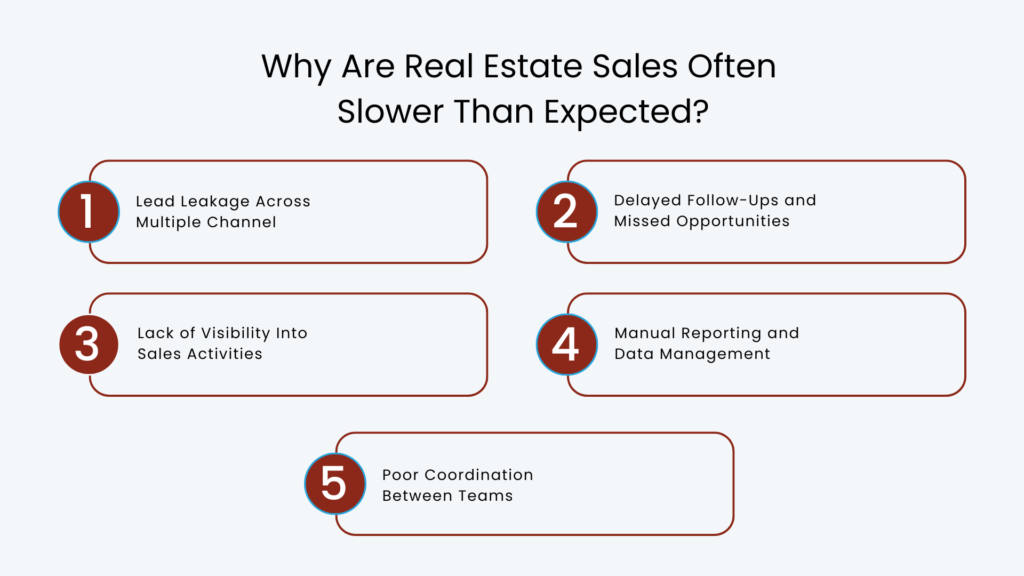
Before looking at solutions, it is worth understanding where the slowdowns actually come from.
Lead Leakage Across Multiple Channels
Inquiries arrive from property portals, social media, walk-ins, referrals, and broker networks simultaneously. Without a centralized lead management system capturing all of them, leads fall through the gaps constantly, often without anyone realizing it.
Delayed Follow-Ups and Missed Opportunities
Buyers in active markets are talking to multiple developers at once. A follow-up that comes twelve hours late is often a deal that has already moved on. Manual follow-up processes simply cannot maintain the response speed that today’s buyers expect.
Lack of Visibility Into Sales Activities
When managers cannot see pipeline status in real time, decisions get made on outdated information. Which projects are moving? Which leads have gone cold? Which agents need support? Without visibility, these questions get answered too late.
Manual Reporting and Data Management
Time spent pulling data into spreadsheets is time not spent selling. Manual reporting is also prone to errors, inconsistencies, and gaps that make it difficult to trust the numbers you are working with.
Poor Coordination Between Teams
Sales, channel partners, site teams, and finance rarely work from the same information. That misalignment creates delays, duplicate efforts, and a buyer experience that feels disjointed at exactly the moment it should feel seamless.
What Happens After Customized Property CRM Software Enters in Workflows?
This is where the right CRM software for real estate earns its place.
- Lead Tracking and Scoring: Every inquiry gets captured, categorized, and scored automatically. Your team focuses on the prospects most likely to convert rather than working through an undifferentiated pile of leads with no sense of priority.
- Inventory and Project Management: Live inventory across every project, updated in real time. When a buyer asks about availability, your agent answers with confidence rather than calling someone to check.
- Channel Partner Management: Broker networks are a significant source of business for most developers. A customized platform brings channel partners into the same system, tracks their leads, manages their commissions, and keeps everyone working from the same pipeline.
- Sales Automation: Follow-ups, reminders, document triggers, and status updates run automatically. The operational rhythm continues without anyone having to manually maintain it, which means fewer things falling through the cracks during high-volume periods.
- Reporting and Analytics: As a leading real estate CRM software, BuilderOpedia delivers dashboards that show what is actually happening across your sales operation; conversion rates, source performance, team activity, and project-level pipeline without anyone spending Friday afternoon compiling a report.
- Mobile Access for Teams: Site visits, client meetings, and on-ground sales do not happen at a desk. Mobile access means your team is working from live data wherever they are, and every update they make is visible to the back office instantly.
Customized CRM vs Standard CRM: Which Delivers Better Results?
| Standard CRM | Customized Property CRM | |
| Workflows | Generic workflows | Real estate-specific workflows |
| Flexibility | Limited flexibility | Fully adaptable |
| Process fit | Manual workarounds | Built around business processes |
The gap between the two columns is not theoretical. It shows up in adoption rates, in the quality of data your team actually enters, and in whether your CRM becomes a tool people rely on or one they work around.
Final Goal: Selecting The Right Customized Property CRM Software
With several options in the market, the decision comes down to a few factors that genuinely matter.
Industry Expertise
A CRM built by people who understand real estate will always outperform one that was adapted for it. Look for a platform with a track record specifically in property, not just in sales software broadly.
Scalability
Your business will grow. The platform you choose should handle that growth without requiring a full migration every time your team or project count increases.
Automation Capabilities
The depth of automation available determines how much manual work your team escapes. Assess this against your actual workflows, not a feature checklist.
Integration Support
Your CRM needs to connect with the tools already in your stack; ERP systems, payment platforms, communication tools, and property portals. Seamless integration keeps data flowing without manual transfer.
Mobile Accessibility
If your sales team cannot use it comfortably from their phone, adoption will suffer. Mobile functionality is not a bonus feature at this point; it is a basic requirement.
Reporting Features
Generic reports tell you what happened. Good reporting tells you why and what to do next. Evaluate whether the analytics on offer actually answer the questions your management team needs answered.
Post-Implementation Support
The questions always come after go-live. A vendor that disappears once the contract is signed creates problems that could have been avoided. Support quality is worth investigating before you commit.
Conclusion
Slow sales in real estate are rarely about the product. More often, they trace back to systems that were not built for the job; leads going untracked, follow-ups happening too late, teams working without visibility, and managers making decisions on incomplete data.
An all in one real estate CRM built for the specific realities of property sales removes those friction points one by one. BuilderOpedia’s customized property CRM software gives real estate businesses the infrastructure to move faster, operate more efficiently, and close more deals without adding headcount or complexity.
If your current setup is slowing your team down, the gap between where you are and where you could be is worth taking seriously.
FAQs
1. What is the difference between a standard CRM and customized property CRM software?
A standard CRM is built for general sales use and requires significant manual workarounds to fit real estate workflows. A customized property CRM is built around how property businesses actually operate; inventory management, payment structures, RERA compliance, and multi-channel lead handling are all accounted for from the start.
2. How does a property CRM software help reduce lead leakage?
It captures every inquiry automatically across all channels; portals, WhatsApp, referrals, walk-ins and routes each one to the right team member instantly. Nothing sits unassigned, and every lead’s status is visible in real time so follow-ups happen on time, every time.
3. Is BuilderOpedia suitable for small real estate teams or only large developers?
BuilderOpedia is built for both. The platform is fully configurable, which means a smaller agency and a large developer with multiple active projects can both set it up to match their specific scale and workflow without paying for what they do not need.
4. How long does implementation typically take?
Most teams are operational within a few weeks. Because BuilderOpedia is built specifically for real estate, the setup requires far less customization than adapting a generic CRM, which keeps the timeline short and the go-live process straightforward.
For more insights, updates, and expert tips, follow us on LinkedIn.