
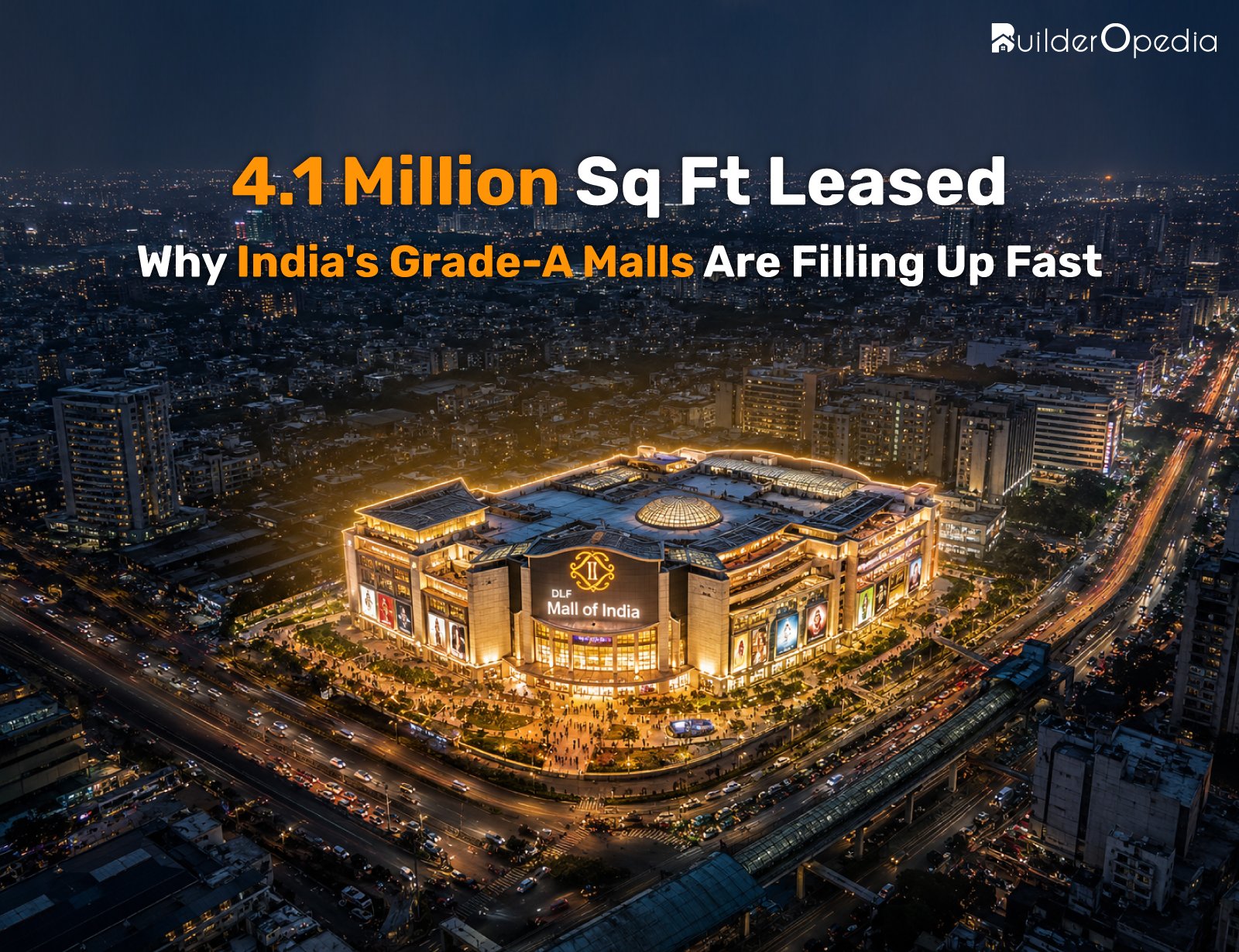
India’s organized retail market just delivered a number worth celebrating. Retail leasing rose to 4.1 million sq ft for Grade-A mall spaces across the country’s top seven cities in H1 2026, while occupancy in that same segment climbed to roughly 93.3% (vacancy fell to just 6.7%), the strongest occupancy level since 2010.
That is a strong signal of a maturing, increasingly confident retail sector, one where shoppers are showing up and retailers are committing to space faster than developers can build it.
The data comes from property consultant ANAROCK, and it tells the story of a retail market firing on demand even as new construction takes time to catch up. For retailers, developers, and investors alike, that gap looks less like a problem and more like an opening.
Retail Leasing Rises: The Numbers Behind the Growth
Approximately 4.1 million sq. ft. of Grade-A mall space was leased in the top seven cities of India in H1 2026. This is in comparison to 0.9 million sq. ft. of newly added space in the same time period, indicating that the pace of leasing was almost 4.5 times faster than the rate of new supply being added.
Even with both figures moderating year-on-year (leasing eased 24%, new completions eased 57%, largely due to geopolitical uncertainty delaying some project timelines), demand still comfortably led supply. That consistency across a softer period is itself the encouraging part of the story.
Zoom out to the last few years and a clear growth pattern emerges:
- 2023: 5.3 million sq ft of new supply against 6.5 million sq ft leased.
- 2024: New supply eased to 1.1 million sq ft, while leasing held firm at 6.5 million sq ft, nearly six times the space added.
- 2025: Supply recovered to 5.2 million sq ft, and leasing surged to a record 13 million sq ft.
- H1 2026: 0.9 million sq ft added against 4.1 million sq ft leased.
Why Rising Mall Occupancy Is a Strength Story
Occupancy is one of the best indicators of a thriving market, and this improvement in numbers makes the extent of its success evident. After the pandemic, the occupancy rate fell to the lowest level of 84.5% in 2021 (the vacancy rate hit 15.5%), while before the pandemic, the occupancy rate had reached its lowest point of 78.5% in 2011 (vacancy hit 21.5%). The current 93.3% occupancy means that the industry has come far since 2011.
ANAROCK’s Anuj Kejriwal framed it well: retailers’ biggest challenge today is not attracting shoppers, it is finding the right space to serve them. That is a good problem for a market to have. It reflects genuine, sustained consumer demand rather than a temporary spike.
The gap between Grade-A malls and lower-tier retail assets sharpens this picture further. Grade B and C malls run at lower occupancy, roughly 65% to 92%, while Grade-A assets have pulled well ahead.
That contrast shows India is not short on retail real estate broadly. It is specifically the well-located, professionally managed, institutionally owned malls that are in high demand, exactly the segment where quality development pays off.
Where the Opportunity Lies for Developers
ANAROCK’s report is candid about why Grade-A mall supply takes time to catch up, and each factor doubles as a competitive advantage for developers who can navigate it well:
- Land assembly: Grade-A malls need large, contiguous parcels in strong catchments, a genuine differentiator for developers who already hold or can secure the right sites.
- Capital commitment: Malls require more upfront capex than most housing projects, which rewards well-capitalized developers willing to play the longer game.
- Approval navigation: Government clearances and financing conditions add time, but developers who manage this efficiently gain a real head start on competitors.
- Execution speed: Once approvals clear, faster, well-managed construction becomes a meaningful edge in a market hungry for finished space.
The drop to only 1.1 million square feet in 2024, despite leasing continuing at 6.5 million square feet, perfectly illustrates what kind of payoff awaits those developers able to deliver reliably throughout cycles such as this one.
City-Level Momentum Worth Watching
Among the seven cities ANAROCK tracks, Delhi-NCR stood out as the clear leader in new Grade-A supply during H1 2026.
| City | New Grade-A Supply (H1 2026) | Leasing Activity (H1 2026) |
|---|---|---|
| Delhi-NCR | ~0.9 million sq ft | ~1.26 million sq ft |
| Mumbai | Limited new supply | Strong leasing on existing stock |
| Bengaluru | Limited new supply | Strong leasing on existing stock |
| Hyderabad | Limited new supply | Strong leasing on existing stock |
| Pune | Limited new supply | Strong leasing on existing stock |
| Chennai | Limited new supply | Strong leasing on existing stock |
| Kolkata | Limited new supply | Strong leasing on existing stock |
Delhi-NCR’s momentum shows what is possible when new Grade-A supply comes online: leasing activity followed almost immediately. The other six cities show just as much retailer appetite, absorbed entirely through existing malls, which points to sizable headroom for the next wave of Grade-A projects wherever they land first.
What This Means for Retailers
As far as brands looking at opportunities for growth are concerned, the positive correlation between the retail leasing numbers and competition in space implies continuing belief in physical retail. The retailers need to be prepared for:
- Proactive lease negotiations in order to get space in successful and crowded malls before others.
- Premium positioning, as landlords in competitive markets will favor those brands that provide the most value in terms of footfall.
- First mover advantage in other Indian cities, apart from Delhi-NCR, that will see an inflow of supply soon.
The trend of retail leasing rises across every recent cycle shows brands are not slowing their expansion plans. If anything, they are moving faster to lock in space before the next wave of new completions arrives.
What This Means for Developers and Investors
ANAROCK frames this data as a genuine opportunity, and the numbers back that up. Record-high Grade-A mall occupancy combined with sustained retailer demand is exactly the setup that rewards developers who can deliver retail real estate investment India projects on time and in the right locations.
Institutional investors have their own clear message from this: Assets that meet the criteria set forth by ANAROCK – site acquisition, financing, and approvals – will be well placed to earn substantial rents in a market where there are no good substitutes. The upside is huge for those who get it right.
Anyone tracking commercial real estate trends alongside residential development activity can use platforms like BuilderOpedia to stay updated on how demand is shifting across asset classes and shaping India’s broader, increasingly resilient property market.
The Bigger Picture
This is an upward trend of data first, and supply data second. The lease performance has maintained itself ahead of new supply despite the drop from last year. It is true that grade-A retail space takes longer to build because of the nature of construction and location which are key factors in making money out of it.
Expect the same momentum to continue: rising occupancy, confident retailer expansion, and a market where developers and investors who move decisively stand to benefit the most from India’s retail real estate growth story.
FAQs
1. What is the latest Grade-A mall occupancy in India?
Grade-A malls in the top seven cities in India witnessed an occupancy of about 93.3% in H1 2026 (vacancy at 6.7%), highest occupancy ever since 2010, reported ANAROCK.
2. Why is the growth in retail leasing outpacing that in new Grade-A malls?
The retailers leased 4.1 million sq ft in H1 2026 as compared to just 0.9 million sq ft of new Grade-A mall completions, indicating the high confidence of the retailers amid prolonged construction period of Grade-A malls due to availability of land and approvals.
3. Which city was at the forefront in terms of new Grade-A retail space addition in H1 2026?
The new Grade-A malls saw a total increase of 0.9 million sq ft of Delhi NCR, whereas other cities saw a good demand for the existing Grade-A mall space.
4. Are these numbers for Grade B and Grade C malls?
No. These are numbers for Grade-A malls only. Occupancy levels for Grade B and Grade C malls are lower, ranging from 65% to 92%.
For more insights, updates, and expert tips, follow us on LinkedIn.