
The real estate businesses have undergone several changes in the last few decades and with the rise of digital and online businesses customers now browse listings online, compare prices and submit enquiries online. However, this change becomes chaotic for businesses when they need to manage all these listings and enquiries on different property portals.
Therefore, to overcome this chaos and manage enquiries businesses leverage their CRM. The property portal integration within CRM allows the businesses to manage all their property listings in a single CRM without switching tabs or screens. This makes the estate agents efficient and they are able to view and manage a wide range of portals easily and effortlessly.
Further, with this integration the modern real estate businesses are able to avoid duplicate listings, delayed responses, and slowed down internal workflows. Moreover, the entire team gets a unified view of all the property portals making it simpler for the businesses to coordinate within the teams and maintain strong relationships with the brokers, agents, and other stakeholders.
What is Property Portals Integration Within CRM and Why is it Essential?
To explain simply, the property portals integration within CRM means that the real estate agents integrate all their property portals on which they have listed their properties into one CRM. This simplifies the complex workflows and makes the whole property management system more organised and structured.
Sync Data and Listings on a Single Platform
Integrating property portals within a CRM enables all property listings, customer inquiries, and lead data to be synchronized in one centralized system. Any update made to listings such as pricing, availability, or project details is reflected across platforms automatically. This eliminates data duplication, reduces errors, and ensures teams always work with accurate and up-to-date information
Respond Timely to Every Lead
When property portals are integrated with a CRM, every inquiry is instantly captured and routed to the appropriate sales representative. Automated alerts and lead assignment ensure no inquiry goes unnoticed or unattended. Faster responses significantly improve engagement rates and increase the likelihood of converting interested prospects into site visits and bookings.
Increased Sales Team Productivity
Automation removes the need for manual data entry, spreadsheet tracking, and switching between multiple portal dashboards. Sales teams can manage all leads, follow-ups, and customer interactions directly from the CRM. This streamlined workflow allows agents to focus more on nurturing relationships and closing deals rather than spending time on administrative tasks.
Reduced Lead Leakage
Without the property portal leads integration with CRM, leads from multiple portals are often missed, duplicated, or delayed due to manual handling. Integration ensures every lead is automatically recorded, tracked, and assigned with clear ownership and follow-up reminders. This structured approach minimizes lead loss, improves accountability, and maximizes revenue opportunities from every inquiry.
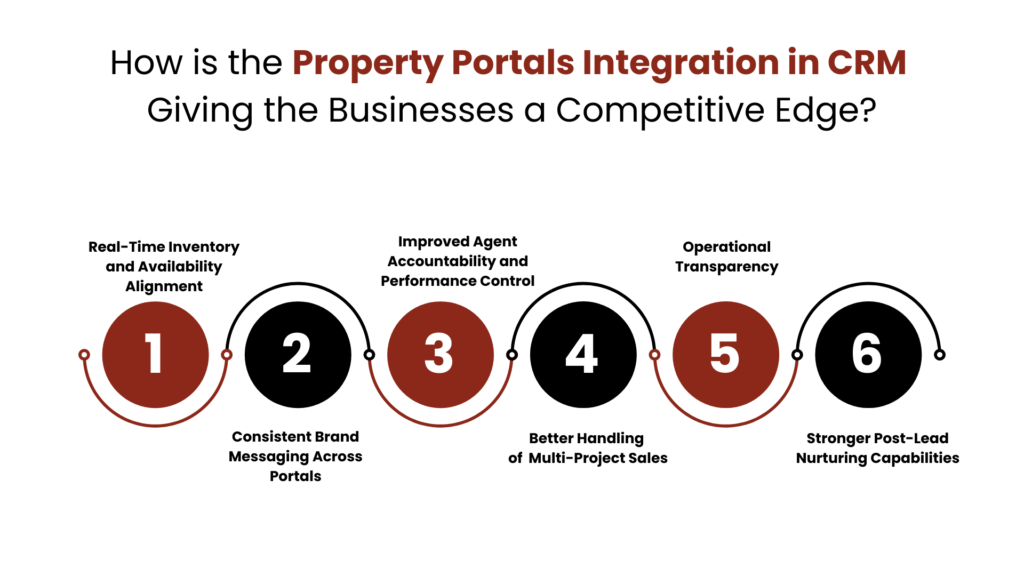
How is the Property Portals Integration in CRM Giving the Businesses a Competitive Edge?
When businesses integrate their property portals in their existing CRM it provides them a competitive edge. Many will question how, but as a truth, when businesses have access to all their property portals on a single platform it allows them to save time on administrative tasks and maintaining spreadsheets, and focus more on nurturing quality leads and driving them to conversion and closure.
Real-Time Inventory and Availability Alignment
CRM integration with property portals ensures that project inventory, pricing, and availability remain updated across all platforms. This prevents misinformation, avoids customer confusion, and builds trust by ensuring prospects always receive accurate details.
Consistent Brand Messaging Across Portals
When property portals are integrated with CRM, communication templates, project details, and follow-up messaging stay consistent. This reinforces brand positioning and ensures customers receive uniform information regardless of the inquiry source.
Improved Agent Accountability and Performance Control
CRM-based tracking makes agent activities fully transparent. Management can monitor response quality, follow-up frequency, and deal progression, driving accountability and improving individual and team performance.
Better Handling of Multi-Project Sales
For developers handling multiple projects across cities, CRM integration simplifies lead routing based on project relevance, geography, and agent expertise reducing confusion and improving operational efficiency.
Operational Transparency
End-to-end visibility into lead flow, agent actions, and deal outcomes enables leadership to make proactive decisions, fix gaps quickly, and stay ahead of competitors relying on fragmented systems.
Stronger Post-Lead Nurturing Capabilities
Integrated CRM workflows support long-term lead nurturing through automated reminders, follow-ups, and targeted campaigns. This ensures even slow-moving prospects remain engaged until they are ready to buy.
Does Property Portals Integration Within CRM Impact Business Revenue and Efficiency?
Yes. Integrating your property portals within your existing CRM can impact your business revenue and efficiency greatly. The real-time data and the data driven insights allows the real estate agencies to take informed business decisions and reach out to a wider audience with targeted messaging.
Data-Driven Insights and Performance Tracking
Property portal integration within a CRM gives real estate businesses clear visibility into lead performance, conversions, agent response times, and follow-up effectiveness. These insights help identify high-performing portals, optimize campaigns, and improve sales processes, enabling smarter, data-driven decisions that drive consistent growth.
Enhanced Customer Experience
Real Estate Portal CRM integration helps real estate businesses respond faster, personalize communication, and ensure smooth handovers between teams. This consistency creates a professional buying experience, boosts conversion rates, and strengthens brand trust in a highly competitive market.
Scalability for Growing Real Estate Businesses
As real estate businesses grow, lead volumes rise across portals, projects, and regions, making manual processes unsustainable. CRM-integrated portal workflows scale effortlessly, helping businesses manage high lead volumes, multiple teams, and changing requirements with ease making this a future-ready solution.
Conclusion
The real estate business landscape is transforming and the customer expectations have risen as well. The property portal integration within CRM allows the businesses to be more responsive. Further, when the property rates fluctuate or a unit is sold, instead of altering it manually, the agents use the CRM and AI capabilities to keep the data up-to-date and send the right communication to the customers.
FAQs
1. Why is portal-to-CRM integration important for real estate businesses?
Managing leads and listings across multiple portals manually leads to delays and errors. CRM integration simplifies operations, ensures faster responses, and helps teams stay organized as lead volumes grow.
2. How does CRM integration improve lead management?
All inquiries are automatically captured, assigned, and tracked within the CRM. This structured approach ensures timely follow-ups, better lead ownership, and fewer missed opportunities.
3. How does this integration improve sales team productivity?
Sales teams can manage leads, customer interactions, and follow-ups from a single system instead of switching between portals or maintaining spreadsheets, allowing them to focus on closing deals.
4. How does integrating portals with CRM create a competitive advantage?
Businesses gain real-time visibility into inventory, agent performance, and lead outcomes, enabling better decisions and faster execution than competitors using disconnected systems.
5. Can multiple portals be managed through one CRM?
Absolutely. A single CRM can centralize inquiries and listings from multiple portals, providing a unified view of all customer interactions.
For more insights, updates, and expert tips, follow us on LinkedIn.