

In an industry like real estate every UAE builder dreads the moment where a prospect visited your site three weeks ago, loved what they saw, and your sales executive never followed up. By the time someone noticed, the lead had booked with a competitor.
That moment doesn’t happen because of bad salespeople. It happens because the data wasn’t captured, wasn’t centralized, and nobody was accountable for the follow-up. That’s the operational gap that a real estate CRM with site visit tracking is built to fill.
The Problem Isn’t Leads: It’s What Happens After the First Visit
Most builders spend significantly on lead generation. Portals, digital ads, referral networks, the pipeline fills up. The breakdown happens downstream.
A site visit is the most qualified signal a prospect can send. They’ve moved past curiosity into evaluation mode. They’ve invested their time. And yet, in most real estate sales operations, the post-visit workflow is chaotic at best: a spreadsheet entry here, a WhatsApp message there, a follow-up call that may or may not happen depending on who’s working that day.
The result? Lead leakage, not at the top of the funnel, but at its most critical point.
What UAE builders with strong conversion rates do differently is treat the site visit as a structured event, not a casual check-in. Every visit gets logged, timestamped, contextualized, and connected to an automated follow-up chain.
Why Standard CRMs Fall Short for Site Visit Management in the UAE?
Generic CRM platforms are designed for inside sales like email sequences, pipeline stages, contact records. They aren’t built for the physical reality of real estate sales, where a conversion depends on what happens at the site, not at a desk.
Field teams need to log interactions on the go. Site managers need visibility into who’s visited which project. Sales heads need data across multiple locations simultaneously. And developers need aggregated reporting that connects visit frequency to actual booking probability.
Off-the-shelf tools don’t handle this. The result is usually a disconnected stack: one tool for lead capture, another for scheduling, a spreadsheet for visit logs, and a separate follow-up tracker. Each handoff is a chance for data to fall through.
This is precisely where an AI CRM with site visit tracking built specifically for real estate creates a measurable operational advantage.
QR Code-Based Site Visit Booking: Smarter Than It Sounds
One of the most underrated shifts in real estate site visit management is the move to QR code-based check-ins. Here’s how it actually works in practice:
A prospect receives a booking confirmation with a unique QR code. When they arrive at the project site, scanning that code auto-logs their arrival in the CRM, with time, date, and project details captured instantly. The assigned sales executive gets an immediate notification.
There’s no manual data entry. No “I’ll update the spreadsheet later.” No ambiguity about whether the visit actually happened.
Beyond the check-in, the same QR workflow can trigger: a welcome message to the prospect, an automatic task for the sales executive, and a follow-up sequence that kicks off within 24 hours if no update is logged.
For builders managing walk-in traffic across multiple projects, this kind of site visit booking via QR code CRM functionality converts a notoriously messy process into structured, trackable data.
Mobile Site Visit Tracking: Field Teams Need Real-Time Tools
Field sales teams in real estate operate differently from most industries, especially in the UAE realty market. They’re moving between projects, meeting prospects at sites, and often working in areas with limited connectivity. Expecting them to log visits at the end of the day, or at the end of the week, guarantees data loss.
Mobile site visit tracking for real estate solves this by enabling sales executives to update lead status, log visit outcomes, and schedule follow-ups directly from their phones, immediately after an interaction. The data hits the AI-led CRM in real time.
For sales managers, this means live visibility into field activity without chasing daily reports. For developers and operations heads, it means that the numbers in the dashboard actually reflect what’s happening on the ground.
There’s also an accountability dimension that shouldn’t be understated. When every visit is timestamped and geotagged, performance conversations become data-driven rather than theoretical.
What Multi-Project Builders Gain From Centralized Visit Analytics
Single-project builders have it relatively simple. The complexity multiplies fast once a developer is running three or four projects simultaneously, with different locations, different buyer profiles, different sales teams.
Without centralized and AI-backed real estate CRM site visit tracking, you end up with siloed data. Project A has its own Excel sheet, Project B uses a different tool, and there’s no reliable way to compare visit-to-conversion rates across the portfolio.
With the right CRM setup, a sales head can see:
- Which project is generating the most repeat visits (a strong buying intent signal)
- Which visit sources (campaigns, referrals, walk-ins) that convert at the highest rates
- Where follow-up failures are concentrated, by project and by executive
- How visit volume trends map to booking cycles
This isn’t reporting for reporting’s sake. It’s the operational intelligence that lets a builder decide where to deploy more sales resources, which projects need visit experience improvements, and which lead sources deserve more budget.
The ROI Case: Where Visit Tracking Actually Moves the Number
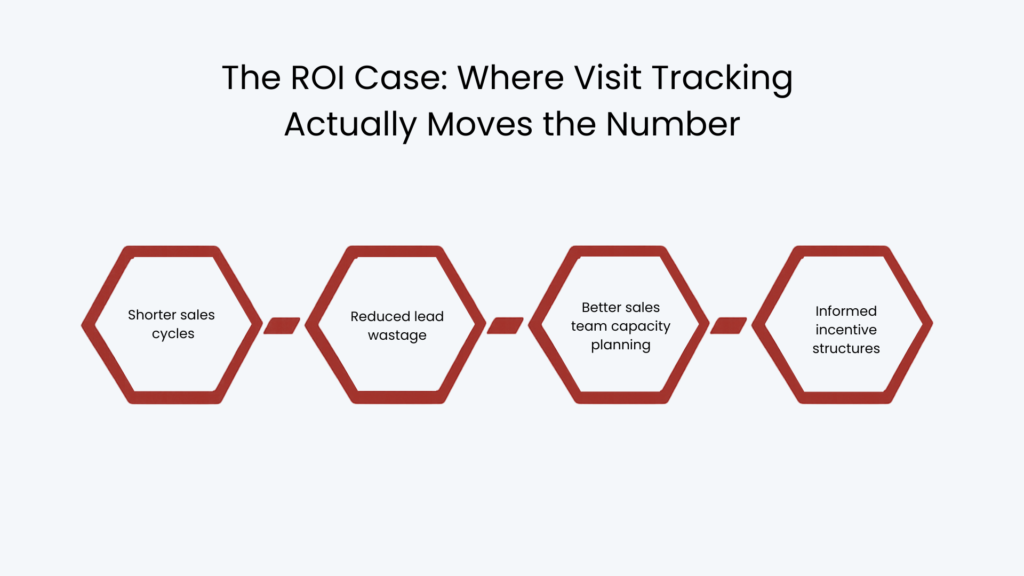
Let’s be specific about where site visit tracking real estate CRM creates financial impact in the UAE real estate industry.
Shorter sales cycles: Prospects who receive timely, relevant follow-up after a site visit convert faster. When the context (what they asked, what they liked, what their hesitations were) is captured in the CRM, the next conversation picks up where the last one left off.
Reduced lead wastage: Industry research consistently shows that lead response time is one of the strongest conversion predictors. When a visit triggers an automated task with a defined follow-up window, response time drops dramatically.
Better sales team capacity planning: When visit data is tracked over time, patterns emerge. Peak visit periods become predictable. Builders can staff appropriately and ensure that high-intent prospects aren’t waiting too long for attention.
Informed incentive structures: Repeat visits before booking are a documented buyer behavior in real estate. When CRMs track visit frequency per lead, sales teams know when to move from nurturing to closing, and when to escalate.
According to NAR research, buyers visit an average of multiple properties before making a decision. Builders who systematically track and act on each touchpoint are operating with a structural advantage over those who don’t.
From Data Collection to Decision-Making: Closing the Loop
Collecting site visit data is necessary. Using it is what actually drives ROI.
The best implementations of real estate CRM with site visit tracking don’t just log visits. They create closed-loop workflows. A visit is logged → a follow-up task is assigned → the outcome of that follow-up updates the lead stage → aggregate data informs the next week’s sales briefing.
That loop turns individual interactions into institutional knowledge. Over time, a builder can identify exactly what visit sequence (how many visits, over what timeline, with what follow-up cadence) leads to a booking. That’s a repeatable playbook, not a guess.
See how Builderopedia brings this full workflow together →
Implementation: What Getting This Right Actually Requires
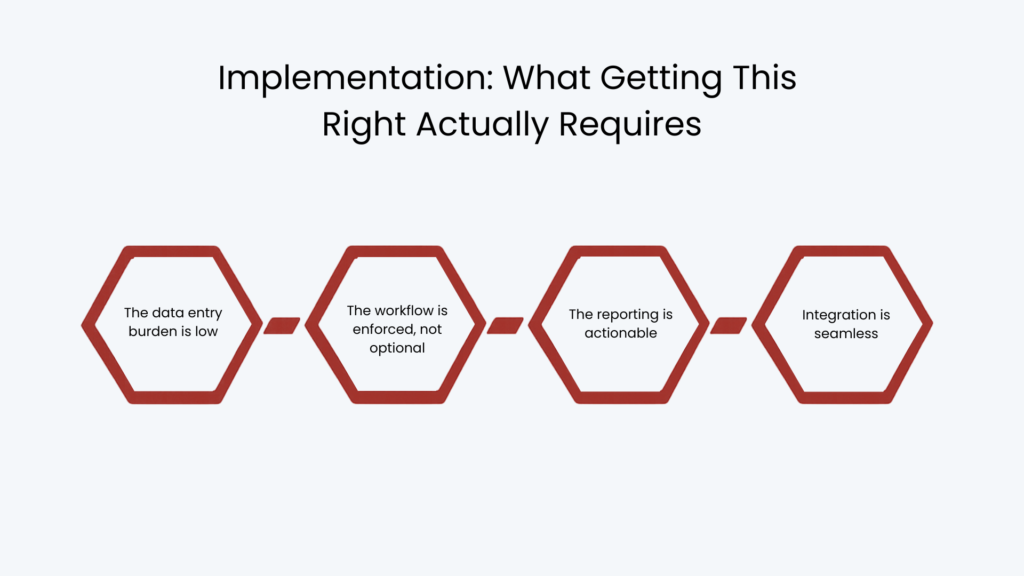
Deploying a site visit CRM isn’t purely a technology decision. It’s a process decision. The technology works when:
The data entry burden is low: QR codes, mobile-first interfaces, and automated triggers mean your field team spends thirty seconds logging a visit, not five minutes.
The workflow is enforced, not optional: Visit logging should be tied to lead progression. A lead can’t move to the next stage without a visit being recorded. This creates accountability without requiring micromanagement.
The reporting is actionable: Dashboards that show visit counts are table stakes. What drives decisions is visit-to-meeting rates, follow-up completion rates, and time-from-visit-to-booking trends broken out by project and source.
Integration is seamless: The CRM should connect to your lead sources, communication tools, and if applicable, booking platforms, so visit data sits in the same place as everything else.
Explore Builderopedia’s full real estate CRM capabilities →
The Operational Shift Worth Making
Builders in the UAE, who invest in structured visit management aren’t doing something exotic. They’re simply filling a gap that’s costing them conversions every week.
The prospect who visited and didn’t hear back, the follow-up that was logged as “pending” for ten days, the sales executive who couldn’t remember which project a lead had visited: these are fixable problems. They’re also expensive ones.
An AI-enabled real estate CRM with site visit tracking purpose-built for developers isn’t about technology adoption for its own sake. It’s about capturing the value that’s already in your funnel, from leads who’ve already shown up, and converting it at a higher rate.
That’s not a feature conversation. It’s a revenue conversation.
FAQs
1. What is site visit tracking in a real estate CRM?
The feature of site visit tracking in a real estate CRM involves capturing details such as visit time, date, sales executive, follow-ups performed, and more about when a client visits the project location using a CRM that manages leads and pipelines.
2. How is site visit booking using QR code possible for builders?
When you book a visit with a builder, he receives a unique QR code. Upon scanning it once reaching the project location, it registers as a site visit in your CRM, notifies the assigned sales executive and sets up a follow-up task.
3. Why do UAE real estate developers need CRM with site visit tracking as compared to regular CRMs?
Regular CRMs cater to inside sales activities, whereas real estate requires a CRM with functionalities for managing external sales activities.
4. How does mobile site visit tracking help real estate sales teams in the UAE?
Mobile site visit tracking allows the UAE field sales executives to log visit outcomes, update lead status, and trigger follow-ups from their phones immediately after a site interaction, keeping CRM data accurate and enabling real-time visibility for sales managers.
5. What is the ROI for builders in using site visit tracking within their CRM system?
Using a Real Estate CRM With Site Visit Tracking makes your sales reps more efficient and the need for constant manual follow-ups reduces. The builders can run the real time analysis of these visits to analyse which leads will convert and that becomes the major ROI.
For more insights, updates, and expert tips, follow us on LinkedIn.