

Most Delhi realtors aim for a high property demand and lots of queries. However, one thing that they do not take into account is that managing this lead flow without a real estate CRM in Delhi seems almost impossible. With that heavy demand and lack of a scalable system, the usual CRM struggles with slow downloads, delayed projects, and missed follow-ups.
In a business like real estate where speed matters the most, leads often only tend to engage with those realtors and teams who respond within the first few minutes. No response in the first 5 minutes of an enquiry is already a lost opportunity to the competitors.
This is exactly why a scalable real estate CRM that can effectively manage these continuous flow of queries without compromising on the quality and performance becomes a necessity. It not only aims to deliver an above satisfactory customer experience, but also ensures personalised and to the point engagement.
In this blog post we aim to discuss the common pitfalls or challenges the businesses in the real estate industry face, and how AI-driven PropTech CRMs like BuilderOpedia in Delhi work to solve this problem and help the businesses grow without slowing down the entire CRM ecosystem.
5 Common Pitfalls of Managing Multiple Leads & How a Real Estate CRM in Delhi Solves Them
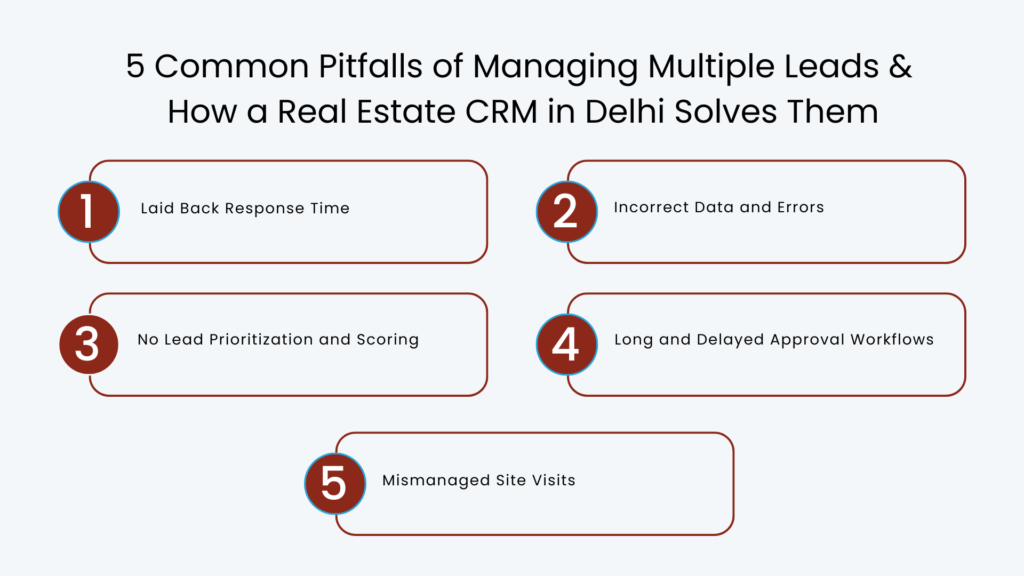
Challenge 1 – Laid Back Response Time
A lead is often hot in the first five minutes of being generated and manual lead handling often delays this process by a significant amount of time. By the time you decide to reach out on one portal and turn the opportunity in your favour, the lead has already started contacting multiple other sellers for an instant response. Caught in this chaos, you also miss out on leads from other portals.
Solution – Automated Enquiry Handling
While a manual system is no longer efficient, a scalable real estate CRM in Delhi comes equipped with an automated enquiry handling system. It captures all the leads and enquiry forms from all the portals in a unified inbox channel and sends a notification to the agents’ system. The AI works in the back to identify the most suitable rep and accordingly assigns the lead. This allows the agents to respond to the lead with a quick follow-up message, which is enough to grab their attention for a continued discussion.
Challenge 2 – Incorrect Data and Errors
Even if you have a CRM but it lacks relevant automation, it becomes null and void. In such a scenario, the real estate agents spend most of their time in transferring the lead data to the CRM from different sources like emails, property portals, and messaging platforms. This increases the risk of missed or incorrect information being added to the system. This leads to a missed chance.
Solution – Automated Data Management
With an automated real estate CRM for Delhi enterprises, the prospect’s complete information is automatically stored in the CRM. As soon as the enquiry form is filled, the CRM auto captures the data and inputs it in the CRM meticulously. So when the agent receives an enquiry alert, they can connect with full context and since the information is added directly in the CRM from the form, the chances of errors are either minimal or zero, unlike maintaining spreadsheets.
Challenge 3 – No Lead Prioritization and Scoring
With multiple leads flowing in the system within a few hours of a launch or existing project, it is essential to understand which leads matter and can convert. In the race to respond to every lead, the agents end up giving the same level of attention to every lead and often just pass by the high potential prospects, and they often remain unattended or left on hold.
Solution – AI-Based Lead Scoring
A real estate CRM in Delhi/NCR with advanced AI lead scoring capabilities comes into picture here. This lead prioritization system analyses every incoming and existing lead carefully based on the buying intent, budget and location preferences, buying timeline, and other requirements. It then scores them with the help of trained AI models and presents the agents with a report letting them know which leads are most relevant and require immediate attention. This helps the reps save time on cold leads and they are able to focus on high conversion prospects.
Challenge 4 – Long and Delayed Approval Workflows
Most Delhi realtors often end up losing their leads during the approvals and long procedures. If a lead has come up with an enquiry, lets say for negotiating a contract, it is evident that it requires to be discussed with the management. However, a lack of proper approval flow and with management having no clue about this client, it takes days for an agent to get back with a follow-up, and the client starts moving out of the discussion, eventually disengaging completely.
Solution – Automated Approvals and Workflows
An AI-driven realtor CRM in North India resolves this issue. It offers complete visibility of the prospect with the contacting agents and the management alike. This means that the management has a complete overview of the ongoing discussions. Furthermore, the system triggers automated approval requests as soon a stage is cleared. The management with the full context approves it and the deal moves forward without any obstructions.
Challenge 5 – Mismanaged Site Visits
Site visits are a crucial part of the real estate deals, and when these are managed manually in spreadsheets or through personal calls and messages outside of a CRM, it is not only chaotic, but also leads to duplicate customer records and sometimes no show candidates. This becomes a significant reason for a missed opportunity.
Solution – QR Based Smart Site Visits
A powerful real estate CRM is equipped with a smart QR based site visit booking and management system. This allows the agents to coordinate with the prospects well in advance, schedule visits as per their timeline, and send due notifications and reminders to complete the visit smoothly. Additionally, each site visit information is duly recorded in the system with full visibility to management. With this it becomes easier for the relator and the agent to identify if the opportunity will close or not and they can prepare accordingly.
Key Aspects of a Scalable Real Estate CRM
Apart from the 5 common pitfalls discussed above, below are a few features and core qualities that make a CRM truly scalable.
- A fully configurable and customisable CRM that grows with you and not vice versa. With growing business needs and goals being updated in relation to the competition, this CRM adapts to your demands without disrupting the current workflows.
- A well defined AI assistant and generative AI that helps you respond with respect to the ongoing customer conversation and not with what has already been discussed earlier.
- An automated approval workflow that does not require manual intervention and the management has full knowledge about the prospect beforehand. This helps in avoiding days of delays and the loss of an opportunity.
Conclusion
Managing large volumes of leads is beyond just storing contacts, and a real estate CRM in Delhi is a solution to this problem. Agents not only need a CRM, but also need a software that is scalable in true sense and can adapt to the business without disrupting workflows.
A scalable real estate software does not come at the cost of lost response time, but comes from automated lead captures, timely follow-ups, and real time tracking of every touchpoint in customer journey. This allows for smooth business operations and transparency in the system leads to faster closures, while enhancing team productivity and improving ROI.
FAQs
1. Why is it important to have fast response times for Delhi realtors handling large numbers of leads?
In the first five minutes following enquiry submission, the lead is hot and any delay may make the buyer go to other agents that respond quickly. Using a scalable CRM allows for capturing of enquiries and automatic allocation to agents before the lead gets cold.
2. How does a CRM for real estate minimize chances of data inaccuracies when leads are sourced from various channels?
Instead of manual entry of prospect information by agents from different sources such as emails, portals, and messages, the CRM automatically captures and saves prospect data upon enquiry completion.
3. What is the benefit of having AI-based lead scoring in a large volume of leads?
The AI-based lead scoring evaluates individual lead’s purchase intention, budget, preferred locations and timeline, then scores and ranks them according to priority.
4. How does a process of automated approvals help in ensuring that the lead does not become cold?
The management will have complete visibility into the conversation taking place with the prospect the moment there is a decision stage for any enquiry, and the system generates an approval request automatically without any delay like in the case of manual escalations.
5. What makes an estate CRM system truly scalable as opposed to one which is feature-rich?
It should be fully configurable so that it scales with your growing requirements, unlike you having to work around it. There should be scalability of automated approvals, lead scoring, and even site visits.
For more insights, updates, and expert tips, follow us on LinkedIn.