

The real estate industry is growing fast and the digital advancements are changing the way businesses function. In businesses where time is of essence, keeping track of every client data and interaction becomes a necessity and a real estate CRM software is helping businesses achieve the same. Also, it is automating the business workflows, allowing the realtors to focus on faster deal closures.
The automation in the real estate software solution is a revolutionary move for all the estate agencies. It simplifies complex business problems like lead management, site visit management, documentation, and even follow-ups. This helps the sales agents increase productivity and boost the customer conversations while scaling the business.
With advanced AI systems developed, the business gets access to real time insights into the client journey including buyer preferences, budget, property preferences, and income patterns. These real-time dashboards save the businesses the manual hassle to scout for best leads, and the lead scoring system automatically scores every lead based on these parameters. The businesses can then make informed decisions and keep track of every little detail.
What is a Real Estate CRM Software?
In simple terms, a real estate CRM software is a technology that is helping the real estate businesses simplify the complex business processes. The customer relationship management software is designed to manage property leads, bookings, customer onboarding and documentation processes.
By maintaining every customer information and maintaining transparency in communication the businesses are able to improve the team coordination and ensure that each stakeholder has accurate information and up-to-date information at all times.
The Productivity Challenges in Real Estate
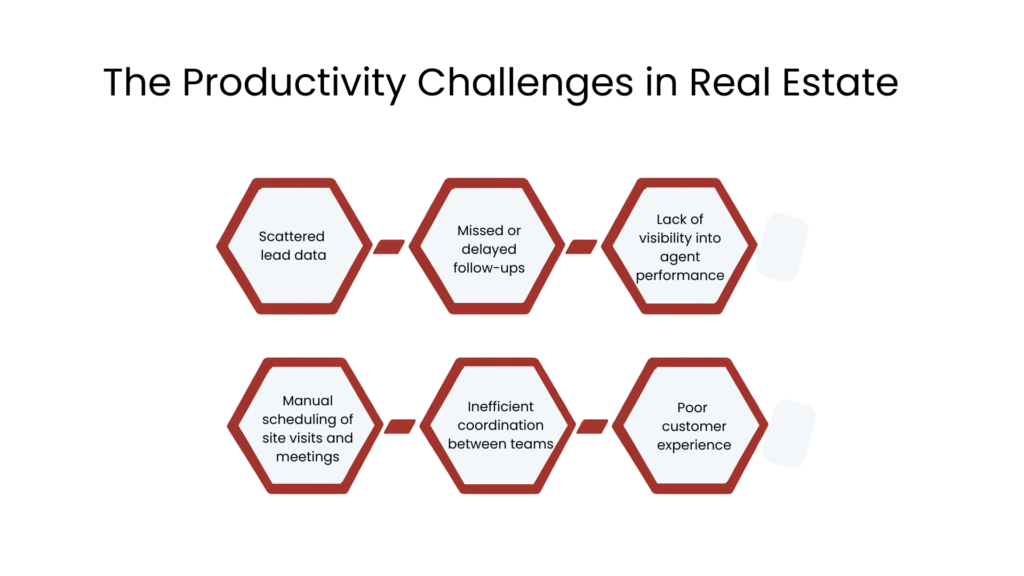
When the real estate leads and data is not stored in a CRM, the agents struggle with scattered data, mismanaged workflows and lost leads. This not only costs the businesses their revenue, but also costs them the loss of high-quality convertible leads.
Scattered lead data
When lead information is spread across multiple channels, agents struggle to access complete and accurate data. Important details often get duplicated or lost, leading to confusion and inefficiencies. This scattered approach slows down response times and weakens lead management. Ultimately, it impacts conversion rates and revenue.
Missed or delayed follow-ups
Manual follow-up processes rely heavily on human memory and effort. As lead volumes increase, timely responses become difficult to manage. Missed or delayed follow-ups reduce customer interest and trust. Over time, this directly results in lost sales opportunities.
Lack of visibility into agent performance
Without centralized reporting, managers cannot accurately track agent activities or deal progress. It becomes difficult to measure productivity, response times, and conversion ratios. This lack of insight prevents data-driven decision-making. Performance gaps often go unnoticed until revenue is affected.
Manual scheduling of site visits and meetings
Scheduling site visits manually requires multiple calls, messages, and confirmations. This increases administrative workload and creates room for errors or overlaps. Delays and miscommunication often frustrate both agents and customers. It also leads to higher chances of missed or rescheduled appointments.
Inefficient coordination between teams
When teams work in silos, information flow breaks down across departments. Marketing insights may not reach sales on time, and operations may lack deal visibility. This misalignment causes delays and duplicated efforts. As a result, the overall sales cycle becomes longer and less efficient.
Poor customer experience
Inconsistent communication occurs when customer history and context are missing. Clients may receive repeated questions or conflicting information from different agents. This creates frustration and lowers confidence in the brand. A poor experience often pushes customers toward competitors.
How is the Real Estate CRM Software Changing the Game?
Real estate CRM software is an evolving entity in terms of its influence on property companies’ management of their lead and customer relationships. By centralizing and often automating data management while at the same time providing timely data as a way to assist companies in improving productivity in their management of customer relationships, CRM software has become a game-changer in the ever-changing property market.
360° View of Customer Interactions
Real estate CRM software unifies every customer inquiry, communication, and transaction in a central system. Instead of scattered notes in spreadsheets or different apps, teams can view complete interaction history at a glance, enabling faster responses and more informed decisions. This unified view enhances customer engagement and ensures no opportunities are missed throughout the sales journey.
AI-Driven Lead Prioritization
Modern CRM platforms use AI to score and prioritize leads based on engagement and conversion likelihood. This allows teams to focus efforts on high-value prospects and reduce time spent chasing low-priority inquiries. By prioritizing intelligently, agents can increase conversion rates while making better use of their time and resources.
Centralized Inventory & Project Insights
Real estate CRM solution integrates property listings, inventory status, payment schedules, and project progress in one dashboard. Agents and administrators gain real-time visibility into available units, outstanding dues, and performance metrics streamlining planning and decision-making. This transparency helps teams stay organized and responsive throughout the sales cycle.
Automated Workflows That Reduce Manual Tasks
One of the biggest game-changing advantages of real estate CRM is workflow automation. Routine tasks like follow-ups, notifications, and status updates are automated, freeing agents from repetitive administrative work. This improved efficiency allows professionals to focus on high-impact activities like client engagement, showings, and closing deals.
Enhanced Collaboration Across Teams
By centralizing leads, communications, and project data, CRM software enables seamless collaboration among sales, marketing, and operations teams. Everyone works from the same information in real time, reducing miscommunication or duplicated efforts. This alignment leads to smoother workflows and a more coordinated customer experience.
Real-Time Analytics for Smarter Decisions
Real estate CRM systems translate raw data into actionable insights with visual dashboards and reports. Stakeholders can monitor lead sources, agent performance, campaign results, and sales trends helping them optimize strategies and adapt quickly to market conditions. Access to accurate analytics replaces guesswork with informed decision-making.
Accessible Anywhere, Increasing Flexibility
Cloud-enabled CRM platforms allow agents to access property details, customer information, and communication history from any device. Whether in the office, at a property site, or on the move, teams stay connected and productive without needing to return to a central location. This flexibility supports faster responses and greater operational agility.
Conclusion
In today’s competitive real estate market, productivity is the key differentiator between average performers and market leaders. Real estate CRM software empowers businesses to eliminate inefficiencies, automate routine tasks, and enable data-driven decision making. By centralizing customer information, improving collaboration, and streamlining workflows, a real estate CRM allows agents and managers to focus on high-value activities that drive growth.
FAQs
1. What is a CRM in real estate?
If you are considering becoming a real estate agent or broker, you’ll likely benefit from using a good real estate CRM, or customer relationship management software, to help you manage, attract, and retain clients, streamline transactions and close deals on time.
2. How does real estate CRM software improve productivity?
Real estate CRM software automates repetitive tasks like follow-ups, lead assignment, and scheduling. It reduces manual effort, minimizes errors, and allows agents to focus more on client engagement and deal closures, ultimately boosting overall productivity.
3. How does a real estate CRM help manage leads more efficiently?
CRM software captures leads from multiple sources and stores them in a centralized database. With AI-driven lead scoring and prioritization, agents can focus on high-quality prospects, respond faster, and improve conversion rates.
4. Can real estate CRM software reduce missed follow-ups?
Yes, CRM systems automate follow-up reminders and notifications. This ensures timely communication with prospects and customers, preventing missed opportunities and improving response consistency.
5. How does real estate CRM enhance customer experience?
By maintaining complete customer history and interaction context, CRM software enables personalized and consistent communication. Customers receive timely, relevant responses, which builds trust and improves overall satisfaction.
For more insights, updates, and expert tips, follow us on LinkedIn.