
In a real estate business where the estate agents receive multiple leads from multiple sources including different property portals, social media, and official websites, it becomes a challenge to manage all of them. As the business portfolio grows, relying on spreadsheets becomes non-feasible and this is where a property management CRM becomes a critical part of a smooth real estate journey.
A CRM for property management is designed specially to automate and centralise the property portal workflow and be able to manage all the property portals from a single CRM. This automated workflow simplifies the tenant and lease management while improving the operational business efficiency, transparency, and tenant satisfaction.
By integrating all the property portals into one CRM, the businesses avoid duplicate listings, outdated listings, and non relevant listings. This helps them decrease the response time of the agents and allows the estate agents to deliver a smooth customer experience while contributing to the overall business growth.
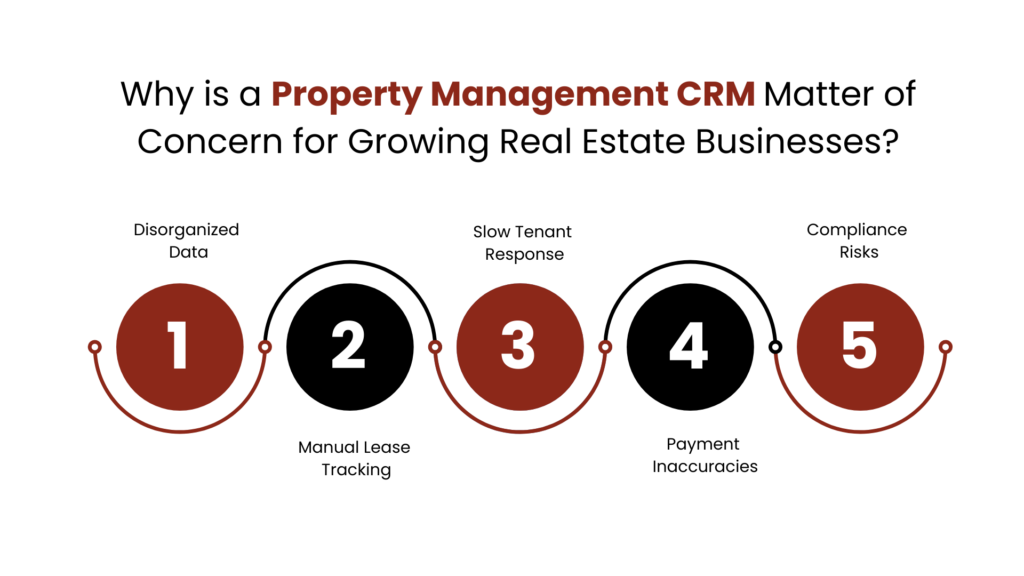
Why is a Property Management CRM Matter of Concern for Growing Real Estate Businesses?
Most of the realtors in the market use a CRM for real estate to simplify lead management and drive automated conversations and chatbot follow-ups so that they can focus on other high-priority tasks. However, what most estate brokers do not understand is that the problem is not just lead management but the multiple sources.
Estate agents and brokers still use the traditional spreadsheet system which has not only become obsolete in the tech savvy era of today, but is also no longer feasible. This manual system often leads to missed or lost leads and costs the businesses a loss and a missed opportunity.
Other than spreadsheet errors, brokers face several other issues like delayed responses, inaccurate rent tracking due to outdated information, compliance risks and scattered leads.
Disorganized Data
Tenant and lease information spread across spreadsheets and emails makes it difficult to access accurate records quickly. This often leads to errors, duplicated work, and poor visibility across teams.
Manual Lease Tracking
Tracking lease start dates, renewals, and expirations manually increases the risk of missed deadlines. Without automation, renewals can be delayed, leading to vacancies and revenue loss.
Slow Tenant Response
Delayed replies to tenant inquiries and maintenance requests reduce tenant satisfaction. Lack of a centralized system makes it harder to track, prioritize, and resolve issues on time.
Payment Inaccuracies
Manual rent tracking and follow-ups can result in missed or late payments. This impacts cash flow and increases the administrative effort required for reconciliation.
Compliance Risks
Missing deadlines or incomplete documentation can expose property managers to legal and regulatory risks. Without proper tracking, maintaining compliance becomes challenging.
How Does a Real Estate CRM Software Help in Overcoming the Business Inefficiencies?
While businesses run the risk of data loss and revenue loss with a manually handled property and lead management system, a well defined and well executed property management CRM helps the businesses overcome this loss and increase the team and operational efficiency.
By integrating a CRM for property management in the existing system, the estate agents and brokers not only get access to a centralized and transparent system with unified inbox communication, but also get their hands on the latest AI technologies that can craft the ideal responses to a query with the help of advanced machine learning.
Centralised Lead Management
Centralised lead management ensures that all customer inquiries are captured, tracked, and managed from a single platform. It automatically assigns inquiries to the right teams and enables faster responses. This improves lead conversion rates while enhancing customer experience through timely follow-ups.
Property Portals In One CRM
Property Portals Integration allows seamless syncing with leading real estate listing platforms. Enquiries from multiple portals are centralized into one system, eliminating manual data entry. This ensures no leads are missed and helps teams manage listings and responses more efficiently.
AI-Enabled Guidance
AI-Powered Guidance assists teams by providing intelligent recommendations and next-step actions. It helps prioritize leads, suggest responses, and improve decision-making. This feature enhances productivity while reducing dependency on manual analysis.
Fully Configurable
The platform is fully configurable to match unique business workflows and processes. Users can customize fields, pipelines, dashboards, and automation rules. This flexibility ensures the system adapts as business needs evolve.
Channel Partner Integration
Channel Partner Integration enables smooth collaboration with brokers, agents, and external partners. It centralizes partner activities, lead sharing, and performance tracking. This improves transparency and strengthens partner relationships.
Smart Site Visit Management
Smart Site Visit Management simplifies the scheduling, tracking, and follow-up of property visits. It provides real-time visibility into visit status and customer feedback. This ensures better coordination between sales teams and prospects.
One-Click Cost Sheets
One-Click Cost Sheets allow instant generation of detailed pricing and cost breakdowns. This feature reduces manual effort and ensures accuracy and consistency. It helps sales teams respond faster with clear and professional cost estimates.
Automated Workflows
Automated Workflows streamline repetitive tasks such as follow-ups, notifications, and status updates. By reducing manual intervention, teams can focus on high-value activities. This leads to faster execution, fewer errors, and improved operational efficiency.
How Does a Property Management Software Enable Smooth Internal Workflows?
A real estate CRM software goes beyond automated workflows, lead management and one click cost sheets. It adds to the smooth internal workflows of the business, ensuring that the agents and brokers do not miss a single lead and crack every deal before the competition.
The major issue any realtor and their agents face is to capture and respond to a lead without any delays. A mobile application allows the estate agents and brokers to communicate with their customers on the go without any interruptions. This enables a uniform communication flow and helps in building a stronger customer relationship.
The second major issue these estate agents face is delayed responses or forgotten follow-ups. With the AI powered systems installed in a property management software, the agents can easily time and schedule their follow-ups and conversations.The AI will handle the conversation just like a human until the agents are available themselves. Further, this advanced AI technology can redirect the customers to the exact query within seconds.
The last and the most commonly faced issue by brokers and realtors is to keep track of customer activity and understand their actual preferences. This is resolved with the help of real-time analytics and dashboards that are available within the CRM. These dashboards help the business and marketing teams understand the customers in detail, and they accordingly use the information to send personalised property recommendations and tailored marketing offers.
Conclusion
The real estate business is flourishing by the minute and each agency wants to be on top when it comes to competing. While the traditional systems are no longer feasible, a property management CRM has changed the entire game. By centralising the leads, property portals, and every broker, the companies have not only simplified the tenant and lease management systems, but have also made them more reliable and trustworthy.
A Property management Software is no longer a luxury but a necessity for efficient tenant and lease management. By centralizing data, automating workflows, improving communication, and providing actionable insights, a CRM transforms how property managers operate.
FAQs
1. What is a Property Management CRM?
A CRM for property management is a centralized software solution designed to manage property listings, tenant data, leases, leads, and communications from multiple channels. It helps real estate businesses automate workflows, reduce manual effort, and improve operational efficiency while delivering a better customer experience.
2. How does a Property Management CRM simplify tenant and lease management?
A real estate CRM software centralizes tenant details, lease agreements, renewal dates, and payment records in one system. Automated reminders, document storage, and workflow management reduce errors, prevent missed deadlines, and ensure smooth lease lifecycle management.
3. Can a Property Management CRM improve internal team workflows?
Yes, a CRM streamlines internal workflows by automating task assignments, follow-ups, and communication. Mobile access and real-time dashboards ensure agents stay connected, organized, and responsive, even while working remotely.
4. Is Property Management CRM suitable for growing real estate businesses?
Absolutely. A property management software is scalable and adapts as business portfolios expand. It supports increased lead volumes, multiple properties, channel partners, and advanced reporting without increasing administrative complexity.
5. How does a Property Management CRM improve customer experience?
By enabling faster responses, personalized communication, accurate property information, and timely follow-ups, a CRM ensures a smooth and transparent customer journey. This builds trust, improves satisfaction, and increases the likelihood of successful deals.
For more insights, updates, and expert tips, follow us on LinkedIn.