
More leads are lost to slow response times and forgotten follow-ups than to bad pitches or weak products. That’s the uncomfortable truth most real estate businesses don’t examine closely enough.
The reason it keeps happening isn’t a people problem, it’s a systems problem. When your CRM lives on a desktop and your team lives in the field, the gap between where work happens and where it gets recorded creates a leak that compounds quietly across every lead, every site visit, and every deal that should have closed but didn’t.
A mobile first CRM for real estate closes that gap. The global real estate CRM market is on track to reach USD 11.89 billion by 2033 and the businesses driving that growth aren’t buying software for their offices. They’re putting it in their team’s pockets.
Why Traditional CRMs Break Down in Real Estate?
Ask any sales manager at a developer firm why their CRM adoption is low, and the answer is almost always the same: the team doesn’t use it because it doesn’t work the way they work.
A field executive on their fourth site visit of the day isn’t going to open a laptop, log into a browser-based system, navigate through five menus, and fill in twelve required fields just to update a lead status. They’re going to send a WhatsApp message and make a mental note. By the time they get back to a desk, half the detail is gone.
This is the adoption problem that kills CRM ROI in real estate before it starts. 76% of CRM users cite complexity as their primary frustration. The fix isn’t more training, it’s a system designed for how real estate professionals actually operate.
A real estate mobile CRM removes that friction entirely. Updates happen in seconds from the field. Leads get logged in real time. Follow-up reminders fire automatically. When the tool works the way the team works, adoption follows naturally.
The Features That Actually Matter for Field Teams
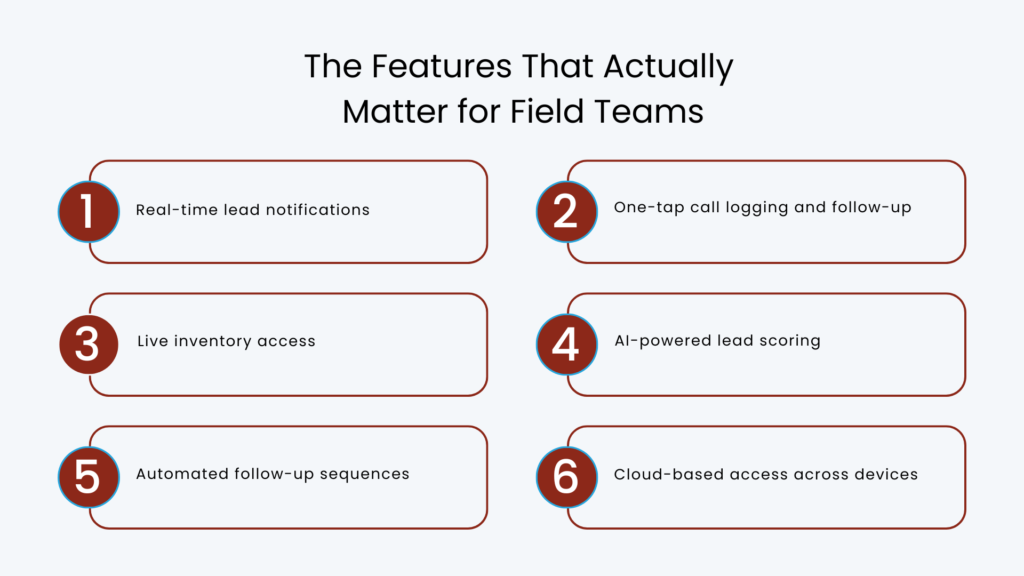
Not all CRM features are created equal for real estate. The ones that move the needle for agents, brokers, and on-ground developers are specific and a mobile first CRM for real estate that gets these right changes how a sales team functions day to day.
Real-time lead notifications
Every new lead, regardless of source, reaches the assigned executive instantly on their phone. First response time drops, and in real estate, the agent who responds first has a measurable advantage.
One-tap call logging and follow-up
After a site visit or a call, the update should take ten seconds, not ten minutes. Voice notes, quick status changes, and smart follow-up scheduling mean nothing falls through the cracks during a busy day.
Live inventory access
When a buyer is standing at a project and asking about availability, the answer shouldn’t require a call back to the office. Live unit-level inventory, pricing, and status accessible instantly from a phone closes that gap in the conversation.
AI-powered lead scoring
An AI powered real estate CRM doesn’t just store leads, it ranks them by conversion probability, so teams focus energy on the prospects most likely to close. This is where intelligent automation separates high-performing teams from those working on gut instinct alone.
Automated follow-up sequences
Real estate sales cycles are long and multi-touch. An intelligent mobile CRM for real estate agents automates reminders, follow-up messages, and re-engagement sequences so no lead goes cold simply because someone forgot to check.
Cloud-based access across devices
A cloud based real estate CRM means data is always current, accessible from any device, and never dependent on being in a specific office or logged into a specific machine.
Real Estate Automation That Compounds Over Time
Manual processes have a ceiling. Real estate automation software removes it.
When lead assignment, follow-up scheduling, payment reminders, and status updates happen automatically triggered by conditions rather than human memory, the compounding effect on productivity is significant.
Teams aren’t just faster; they’re more consistent. Every lead gets the same follow-up cadence. No prospect falls through a gap because someone was busy, sick, or simply forgot.
Who Needs a Mobile First CRM Most Right Now?
The honest answer is: any real estate operation with a team in the field.
Developers and builders
With large on-ground sales teams need real-time pipeline visibility without pulling executives off site to file reports. A mobile first CRM for real estate gives managers a live dashboard from their own phone ,no desk required.
Brokers and channel partners
Managing high volumes of incoming leads from multiple portals need instant routing and fast response capability. The broker firm that responds in two minutes consistently outperforms the one that responds in two hours, regardless of the quality of the team.
Property managers
Handling tenant communication, renewal follow-ups, and maintenance coordination benefit from a unified system where all interactions are logged and accessible, especially when managing multiple properties simultaneously.
Where BuilderOpedia Comes In?
BuilderOpedia is built for the real estate industry not adapted from a generic CRM and retrofitted for it.
The platform is designed around how developers, brokers, agents, and property managers actually operate: in the field, on mobile, managing complex pipelines across multiple projects and locations.
The mobile CRM for real estate agents within BuilderOpedia works as the operational core; real-time lead capture, instant notifications, one-tap updates, AI-powered lead scoring, automated follow-up sequences, live inventory access, and full pipeline visibility from any device.
Every feature is built for the specific workflows that drive real estate sales, not adapted from a software category that was designed for a different industry entirely.
Conclusion
The real estate professional who closes more deals in 2026 isn’t necessarily the most experienced or the most persuasive. They’re the one with the fastest follow-up, the clearest pipeline visibility, and the least amount of time lost to manual admin.
A mobile first CRM for real estate is the infrastructure that makes all three possible and BuilderOpedia is the platform purpose-built to deliver it.
If your team is still managing leads in spreadsheets, following up from memory, or losing deals to slower response times, the tool isn’t the limiting factor anymore. The choice of tool is. Get Started with BuilderOpedia
FAQs
1. What is a mobile first CRM for real estate?
It’s a CRM system designed primarily for smartphone use, built around how real estate professionals actually work in the field, at site visits, on calls, and between locations.
2. How does a real estate mobile CRM improve sales performance?
By ensuring nothing falls through the cracks. Leads are logged instantly, follow-ups are automated, and the sales team always has full lead history and inventory access at their fingertips. The result is faster response times, more consistent follow-up cadences, and managers who have real-time visibility without having to chase reports.
3. What makes an AI powered real estate CRM different from a standard one?
Standard CRMs store and organise data. An AI powered real estate CRM analyses that data to surface insights, ranking leads by conversion probability, predicting which deals are at risk of going cold, suggesting the optimal time to follow up, and automating outreach based on buyer behaviour. It turns your pipeline data into a competitive advantage, not just a record-keeping exercise.
4. Is a cloud based real estate CRM secure for sensitive client data?
Yes, reputable cloud based real estate CRM platforms use enterprise-grade encryption, role-based access controls, and regular security audits. Data is backed up automatically and accessible from any authorized device, which is significantly more secure than local spreadsheets or device-specific storage that can be lost, stolen, or corrupted.
For more insights, updates, and expert tips, follow us on LinkedIn.