
Most realtors struggle to get faster deals and are unable to scale their businesses. This is not due to inefficient teams but due to the lengthy manual processes leading to leaked leads and missed oppoThe real estate industry has undergone several changes in the past few years. Buyers not only expect faster replies but also expect more personalized conversations and consistent engagement throughout the journey. This calls for integrated real estate CRM solutions that combine sales, marketing and support through a single platform for a hassle free experience.
On one hand where the disconnected systems lead to data silos, missed leads and delayed follow-ups, the integrated CRM for real estate leads to transparency in communication, automatic lead tracking, and real-time data that can be converted to actionable insights.
What is an integrated Real Estate CRM Solution?
A unified workflow and integrated solutions are critical for businesses when they are growing and scaling. It allows for smooth business operations and maintains transparency in communication. The integrated real estate CRM solutions are not just a business solution to keep track of leads, but are required for unified access.
An integrated solution allows the realtors to manage all their property portals from a single CRM without having to switch between screens. Further, the AI automations give agents the time to focus on nurturing high quality leads while the CRM takes care of their follow-ups and initial lead handling.
Why do the Integrated Real Estate CRM Solutions Matter?
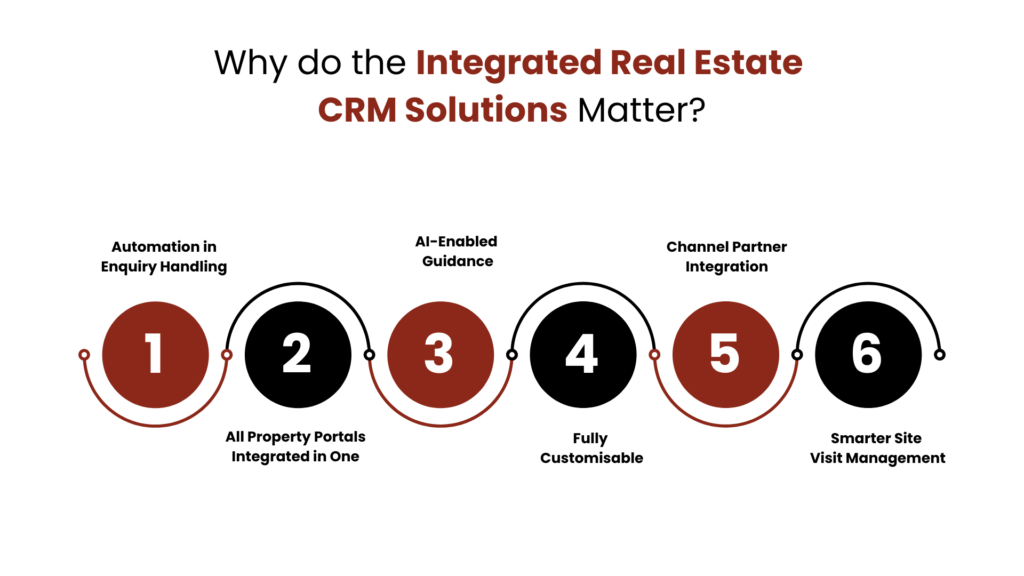
The real estate CRM integration matters in the business of real estate to move fast and stay ahead of the competition. By working together as a team and making the workflows smoother, the businesses not only earn their clients’ respect and trust but also earn the goodwill required to scale and grow.
Moreover, when the integrated CRM solutions for real estate are capable of handling your entire customer journey from start to finish. It makes your entire customer journey and experience memorable, and the likelihood of conversion is higher.
Automation in Enquiry Handling
The phase where most estate agents struggle is the initial phase of capturing and following-up with leads. They struggle to find quality clients in the pool of so many leads, and when they do, it gets difficult for them to keep up because of disconnected systems and workflows.
An integrated CRM brings the perfect solution to this problem. The real estate CRM integration captures every incoming query and converts them to a lead. It then auto-assigns the lead to the right agent at the right time. The agent then receives an instant notification about the assigned lead, and they can easily start working on the lead without any confusion or delays. The customer interaction is carefully recorded in the system to make informed decisions w.r.t the lead.
All Property Portals Integrated in One
It becomes chaotic when the real estate businesses and agents have to continuously shift screens to keep track of every property listing and keep a check on the numbers. But when they integrate a real estate CRM solution the dynamics change.
The estate agents get a unified view of all the property listings across all the portals. With this unified inbox view, the estate agents can see every property listing and sync their data via a single CRM. This not only saves the business costs but also saves time. Everyone from lower to higher management has the same view and it is easier to coordinate internally.
AI-Enabled Guidance
The real estate CRM integration equips the real estate companies and agents with the most advanced AI systems. These systems carefully capture every lead and record every client interaction with most detail. Based on this available data, it is able to run a predictive analysis and suggest the next best course of action.
With this deep analysis and research available, agents can take immediate action on the lead and nurture it to conversion. This saves a significant amount of time for the agents and they are able to take quick actions on the lead. With the AI guidance available your staff works better, is more responsive, and is able to develop stronger customer relations.
Fully Customisable
Real estate businesses often scale at a rapid rate and with this growth, their CRM starts to become obsolete. But the modern real estate CRM solutions are fully customisable and have enough room to adapt to the new and incoming business changes every minute. These integrated CRM solutions allow your business to scale rapidly without disrupting the current business workflow.
Channel Partner Integration
The real estate agents often have multiple channel partners that they collaborate with, which includes brokers and channel partners. With the help of an integrated CRM solution in real estate the estate agencies can easily have full control over their brokers and partners on a single platform and can keep full track of enquiries, approvals, and commissions without switching screens.
Smarter Site Visit Management
Site visit is a critical juncture in the real estate buying journey of a client and can make or break the deal. Most agents often miss out on capitalising this opportunity because of sloppy and mismanaged follow-ups. However, with the real estate CRM integration, agents can easily schedule and manage the site visits with just a click.
When the agents schedule the visit, the prospect will receive an instant confirmation and once they give their confirmation, the further steps are uninitiated. The agent and the customer receive the follow-up notifications well in advance, which ensures that both the parties show up for the visit on time. This helps in eliminating no shows and the buyer interest can be vetted at an early stage.
Business Impact of Integrated Real Estate CRM Solutions
The integrated real estate CRM solutions have a great impact on the business and if utilized correctly, it can help the business scale and grow at a rapid rate. It not only allows for seamless interactions across teams and clients, but also enables accurate data driven decisions and real-time reporting data.
Seamless handover between marketing, sales, and support
An integrated CRM ensures that customer information flows smoothly from marketing to sales and then to support without manual intervention. When a lead converts, all interaction history, campaign responses, site visits, preferences, and commitments are automatically available to the next team. This eliminates data loss, reduces repetition for customers, and ensures every team has full context at every stage of the journey.
Consistent communication across all touchpoints
With a centralized CRM, all customer communications like emails, calls, WhatsApp messages, SMS, and support interactions are managed from a single platform. This ensures messaging remains consistent, timely, and aligned with the customer’s current stage in the journey. Customers receive clear, relevant communication instead of conflicting or duplicate messages from different teams.
Accurate data-driven decisions
An integrated CRM consolidates real-time data from marketing campaigns, sales pipelines, and support interactions into unified dashboards and reports. This allows leadership to make informed decisions based on actual performance metrics such as lead quality, conversion rates, campaign ROI, and customer satisfaction rather than assumptions or fragmented reports.
Improved accountability and visibility
Every lead, task, interaction, and outcome is tracked within the CRM, creating complete transparency across teams. Managers can clearly see who owns each lead or customer, what actions have been taken, and where delays or bottlenecks exist. This improves accountability, enhances team productivity, and enables proactive performance management.
Conclusion
In an industry built on trust, relationships, and timing, integration is the key to staying competitive. With the right integrated CRM in place, real estate businesses can transform fragmented processes into a unified, intelligent, and scalable growth engine.
As a final word, an integrated real estate CRM solution is the need of the hour and businesses can make great use of the CRM. It allows for seamless customer interactions and smooth business operations with transparent communication.
FAQs
1. What does seamless handover between marketing, sales, and support mean in a CRM?
Seamless handover means all customer data, interactions, and history automatically move from marketing to sales and then to support within a single CRM system. This ensures no information is lost and every team has full context when engaging with the customer.
2. How does an integrated CRM improve communication across customer touchpoints?
An integrated CRM centralizes emails, calls, WhatsApp messages, SMS, and support interactions in one platform. This ensures customers receive consistent, relevant, and timely communication regardless of which team they interact with.
3. Why is consistent communication important in real estate sales?
Consistent communication builds trust, reduces confusion, and improves customer experience. In real estate, where decision cycles are long, consistent messaging ensures prospects stay engaged and informed throughout their journey.
4. How does a CRM enable accurate data-driven decision-making?
A CRM collects real-time data from marketing campaigns, sales pipelines, and support activities. This data is presented through dashboards and reports, helping businesses make informed decisions based on performance metrics rather than assumptions.
5. What type of data can be tracked for better decision-making?
CRMs track lead sources, campaign ROI, conversion rates, site visit outcomes, sales velocity, agent performance, customer queries, and resolution timelines, providing a complete operational view.
For more insights, updates, and expert tips, follow us on LinkedIn.