
In the real estate business where time is the key factor to close a deal, following up with the client is even more critical. One missed follow-up can lead to a lost deal. Whether it’s a buyer asking for property details, a tenant asking for rental options, or an investor requiring pricing quality, follow-ups are critical and a CRM for real estate agents is helping these businesses enable timely follow-ups and quick actions.
This CRM solution for realtors is aimed at streamlining the business workflows, maintaining transparent communication, and making the sales teams more efficient and responsive towards their customers. Put in simple words, the CRM software for real estate agents is automating the entire business workflow by centralising customer data and unifying the conversation data.
This data centralisation helps in achieving more quality leads and fastens the sales processes. In a business era where customers expect quick replies and personalized experiences, this CRM transformation has become a must for the real estate agents.
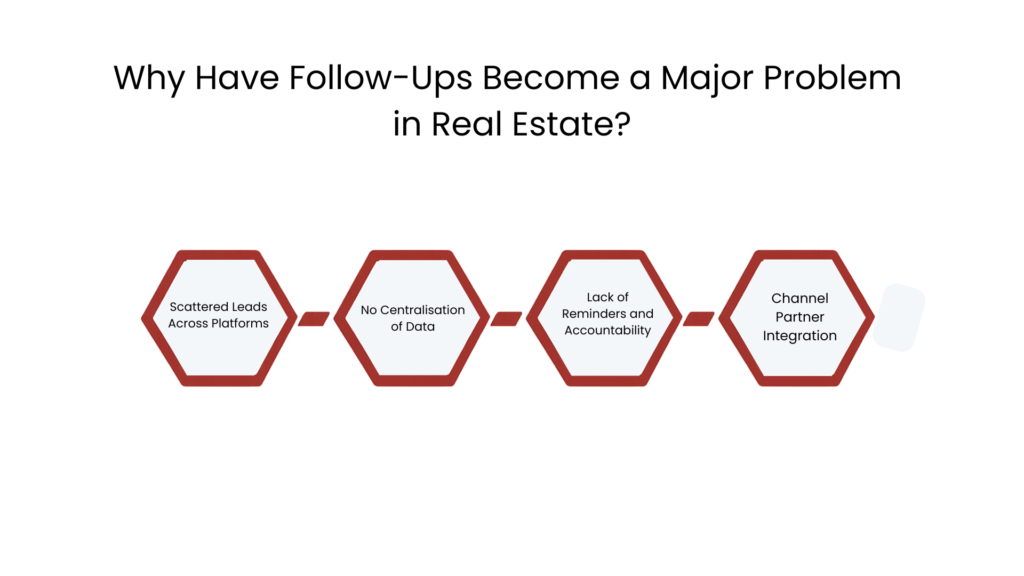
Why Have Follow-Ups Become a Major Problem in Real Estate?
In the real estate business time is a critical factor when it comes to deal closures. When real estate agents are dealing with a large number of queries on a daily basis and with the lack of a proper CRM system these conversations are not recorded anywhere, and the sales agents either forget about these leads or they get lost in the pool somewhere.
There can be multiple reasons as to why the estate agents are missing follow-ups including scattered data, no centralised data tracking, manual spreadsheet maintenance, and agents juggling between multiple properties.
Scattered Leads Across Platforms
The real estate businesses have their properties listed on multiple property portals and the data is often scattered on multiple platforms. All these customer profiles are manually entered into the spreadsheet which may lead to missed data and eventually increase the follow-up gaps.
No Centralisation of Data
Without a proper CRM the data is not centralised and not recorded properly into the system. This means that the customer data is not entered in a single CRM and when the case is shifted from one stage to another, the agents have no context of the previous conversations which leads to repetitive conversations and frustrated customers.
Lack of Reminders And Accountability
When the data is not recorded into the CRM and no agents are accountable for any of the customer conversations leading to chaos in the system and this often leads to laid back follow-ups and missed conversations and leads. With this lack of reminders and accountability, the need for a CRM for real estate agents becomes a necessity.
Agents Juggling Between Properties & Clients
When the leads and property portals are not added into the CRM system for real estate, agents find themselves juggling between multiple property portals and different client data on each platform. With the lack of a CRM to add this data to, manual spreadsheets become the go to way, but are not the most efficient when it comes to data management.
How is a CRM for Real Estate Agents Minimising the Follow-Up Gaps?
When companies integrate a CRM platform for real estate agents they experience automation like never before. They are able to automate the lead management system, keep detailed track of the entire customer journey, schedule site visits online, manage payment and documentation online, and streamline the internal workflows and follow-ups.
Automated Enquiry Handling
Most real estate teams face challenges with scattered leads and delayed responses. A real estate CRM solution has enabled the real estate agencies to automate this entire process. The leads are captured automatically into the CRM from every portal and every messaging channel and then auto assigned to the right agent with an instant notification being triggered to the agent automatically.
This reduces the risk of delayed responses and follow-ups. The agents are able to respond to the client queries much faster and with transparent access each team and management has clear access to all the conversations making it easier to follow.
Property Portal Integration
With the integration of multiple property portals into a single CRM, the agents get a unified view of all the property portals and they can clearly see all their sold and unsold units and can get clarity on what works and what does not. This allows the agents to have accurate data of property listings when talking to the customers.
AI Enabled Guidance
With AI technologies and guidance available within the CRM, the guess work reduces and the agents can work based on real time insights. The AI agent will search all your leads and all the client interactions and then suggest the next best action. This way the agents are confident in their actions and react quicker to get results. Further, no time goes to waste, and no opportunity is missed.
Site Visits Made Easier
With a CRM for real estate agents the site visit scheduling and cost sheet generations have become easier. Agents can schedule the site visits completely online and an instant notification will be sent to the customers for confirmation. Once the customer confirms the appointment, the agent receives a notification This leads to a lesser number of no shows and each agent activity song with his whereabouts are being tracked in the CRM.
Smart Lead Scoring
A technologically advanced and a well integrated CRM enables smart lead scoring for each prospect. The leads are scored based upon their past buying behaviors, their interest level in the property, and the data available in the system. With this 360 degree analysis available, agents become responsive to the high-potential and high-end luxury clients.
One Click Cost Sheets Availability
When customers are scouting for properties it is only natural that they ask for the cost of the property. There are various kinds of costs that are added and deducted in property valuation before the final cost is shared with the customer.
With the help of a CRM, the costs that take hours to be calculated are completed instantly, can be updated on the go and is then shared to the customers on the go. This helps the companies easily compete with the competitors by capturing leads faster with one click cost sheets. Also, these calculations are error free, leaving no scope of delay when shared to the customer.
Conclusion
Follow-up gaps are one of the most expensive problems in a real estate business and reducing these gaps timely is a necessity. A CRM for real estate agents is solving this problem smartly by automating follow-ups and reducing the agent response time. It centralises all the customer data, and all the client interactions are stored in a unified communication inbox.
By removing manual dependency and enabling timely, personalized engagement, CRM systems empower agents to respond faster, work smarter, and close more deals. In a market where speed and experience matter more than ever, a CRM is no longer a luxury; it is a necessity for sustainable success.
FAQs
1. What is a CRM for real estate agents?
If you are considering becoming a real estate agent or broker, you’ll likely benefit from using a good real estate CRM, or customer relationship management software, to help you manage, attract, and retain clients, streamline transactions – and close deals on time.
2. What are follow-up gaps in real estate?
Follow-up gaps occur when real estate agents miss or delay responding to client enquiries. This can happen due to scattered data, lack of reminders, manual tracking, or managing multiple clients and properties simultaneously, often resulting in lost deals.
3. How does centralized customer data reduce follow-up gaps?
Centralized data ensures all customer profiles, conversations, and property interactions are stored in one system. Agents gain full context before contacting clients, avoiding repetitive conversations and improving response quality.
4. What problems do real estate agents face without a CRM?
Without a CRM, agents face scattered leads across portals, manual spreadsheet maintenance, lack of accountability, forgotten reminders, and difficulty managing multiple clients and properties efficiently.
5. How do one-click cost sheets improve the sales process?
One-click cost sheets enable instant property price calculations and sharing with customers. This speeds up decision-making, ensures accuracy, and helps agents respond faster than competitors.
For more insights, updates, and expert tips, follow us on LinkedIn.