

The real estate business in India has been on a growth curve, and with the growing demand for properties, the businesses experience heavy flow of inquiries. These enquiries come from multiple property portals and agents spend most of their time coordinating with these leads on multiple tabs and screens. That is why a CRM for real estate in India has become a necessity and is no longer optional.
But the question is – ‘Why does India need a real estate CRM?’ To answer simply, a real estate CRM helps companies manage every lead with ease in a single CRM and automates the entire customer journey. This not only reduces the manual efforts and work, but also leaves ample time with the agents to focus on high quality leads and conversions.
Moreover, by using the CRM for real estate businesses in India, the companies can easily integrate all their property portals and channel partners and coordinate with each broker, agent, and portal on a single platform. They can schedule easy site visits and file the entire documentation online. This automation helps the businesses scale faster and also gives them a competitive edge.
How Has the Real Estate Landscape in India Changed?
The Indian real estate business landscape has evolved over time and the way buyers look at this business now has also changed. People now discover properties through online portals, social media, or through promotional company messages. With the digital landscape evolving, customers now expect instant replies, tailored recommendations, and quick action.
Since the buyers have become more tech savvy today, the businesses are also expected to leverage the Real Estate CRM in India to manage the flow of incoming leads, understand buyer preferences better, and send across the right messaging to the customers.
The Complexity of Lead Management System in Real Estate?
Real estate businesses receive queries from multiple sources including property portals, social media, and promotional messaging across platforms and official websites. In the traditional sense, the agencies manage these leads through spreadsheets or via a different CRM. This leaves the real estate agents with a lot of mismanaged data, multiple sheets, and no or minimal internal communication.
With this chaotic and mismanaged system, the real estate agents lose leads, struggle to find exact customer data, and are unable to follow-up with the clients due to limited or no context. This adds to the complexity of lead management systems and often results in repeat customer conversations without context.
How Have Businesses Leveraged the CRM for Real Estate in India for Growth & Scalability?
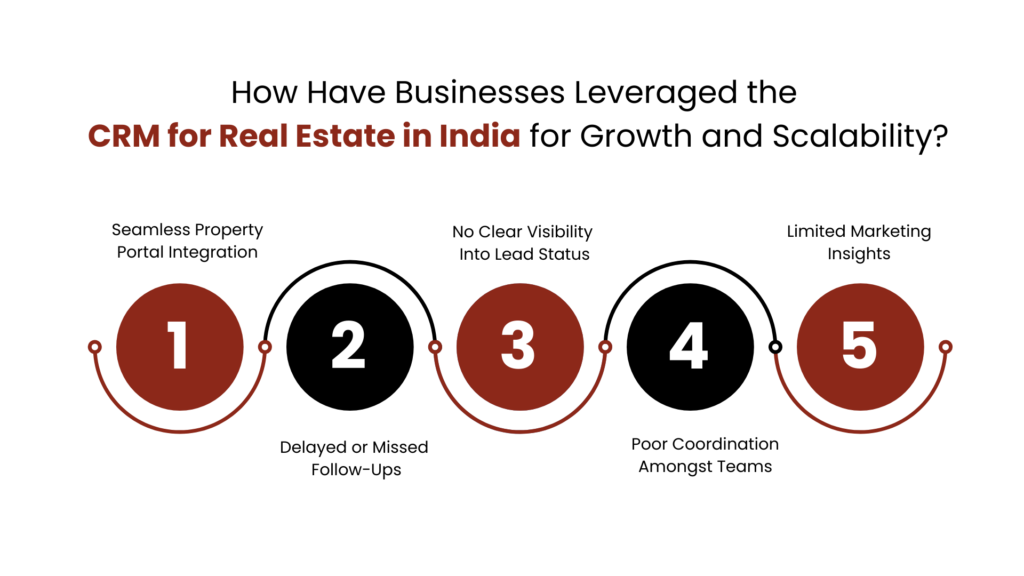
Adopting a real estate CRM software has changed the business game for India. Realtors leverage this AI enabled CRM to automate routine tasks, manage leads efficiently to avoid any missed ones. Further, the online documentation processes, site visit bookings, portal and channel partner integrations have allowed the small, medium, and large scale businesses to scale faster, increase revenue, and stay ahead of their immediate competition.
Seamless Property Portal Integration
Realtors can now manage every property portal from a single CRM without switching screens. Maintaining every portal individually becomes a challenge for most real estate agents and businesses when it is done outside of a CRM. However, with a good CRM the business agents can effortlessly manage all their property listings and sync data for every customer automatically.
AI Powered Guidance
Since the business environments have gone digitally advanced, the use of AI becomes inevitable. Estate agencies use the AI powered guidance to personalise property recommendations for every customer, send messages that relate to the buyer preferences, run discounts and promotional offers, and the AI analysis suggests the next best action for business.
QR Code Site Visit Booking
Booking a site visit in the traditional sense includes a lot of back and forth, and agents and clients often struggle to coordinate on a preferred time. However, the Real Estate and Property CRM Software in India, the prospects simply need to scan a QR code for instant site visit booking. As soon the QR code is scanned, the buyer will fill in the time and preferred day of visit and the connected agent will instantly receive the notification. This eliminates all manual intervention and the coordination becomes effortless and simple.
Automated KYC Management
The businesses are required to maintain clear and verified customer records in the system while maintaining data security. With an automated KYC management within the system businesses can easily capture, verify, and approve KYC documentation, and also get the documents signed digitally. This reduces the manual efforts and the businesses enable faster processes and shorter approval workflows.
One Click Cost Sheets
Generating cost sheets often remains a hassle for businesses because they need to add each cost variant manually in a spreadsheet, get approval, and then share. This utilises several man hours and customers do not wait. To avoid this and maintain customer interest, the agents use the one click cost sheets feature within the CRM. The costs are updated on the go based on real time data, and the agents simply need to add a few variants, and the cost sheet becomes ready to share. This saves the agents’ time and they are able to focus on deal closures.
How Does Using a CRM for Real Estate in India Enhances CX?
A CRM for real estate agents in India goes a long way when managed and implemented properly. Where most businesses think that a real estate CRM must be complex, they fail to understand that even the simplest of real estate CRM can do wonders with the right support and proper functionalities.
Faster Lead Response Time
When leads are stored in a single, well-organized system, it becomes much easier to respond quickly and accurately. Notifications and alerts ensure that new inquiries are seen immediately, reducing delays in communication. Faster responses help capture prospects’ interest while their intent is high, increasing the likelihood of meaningful conversations and successful conversions.
Organization and Clarity
A simple CRM replaces scattered notes, spreadsheets, and inbox messages with a clear and structured system. All client details, conversations, and deal stages are accessible from one place, making information easy to track and update. This level of organization reduces confusion, lowers stress, and allows professionals to concentrate on the most important tasks.
Smooth Client Communication
Maintaining regular communication is essential for building long-term trust with clients. CRM reminders and task tracking help ensure that follow-ups happen on time and without gaps. Consistent outreach makes interactions feel more professional and reliable, strengthening relationships and improving overall client satisfaction.
Higher Productivity
By automating routine tasks and simplifying daily workflows, a CRM software in real estate helps professionals make better use of their time. Less effort is spent on manual data entry or searching for information, allowing more focus on client meetings and deal negotiations. As a result, more leads can be managed effectively without increasing workload pressure.
Easily Scalable
A CRM for real estate businesses in India is designed to adapt as a business grows, without adding unnecessary complexity. Whether lead volume increases or team members are added, the system continues to function smoothly. This flexibility allows real estate professionals to scale their operations confidently while keeping processes easy to manage and understand.
Conclusion
The real estate businesses are moving fast and with digital advancements taking over, the CRM for real estate in India becomes a thriving business factor. Real estate agencies automate every routine task, manage every lead from every property portal within the CRM, and automate the entire customer journey from site visit booking to final payment reminders.
This not only helps these businesses scale faster and gain a competitive edge but also reduces the manual efforts by almost 40%. Agents are able to focus on high priority leads, maintain consistent communication and follow-ups, and build stronger, long lasting client relationships.
FAQs
1. How is CRM used in real estate?
A real estate CRM can significantly benefit your agency by centralizing client data, automating follow-ups, tracking property interests, and streamlining communication. This leads to improved client relationships, higher conversion rates, and better overall productivity.
2. Why is a CRM important for real estate businesses in India?
With leads coming from multiple property portals, social media, and channel partners, managing inquiries manually becomes inefficient. A CRM helps organize leads, automate follow-ups, reduce manual work, and improve conversion rates while ensuring better customer experience.
3. How does a CRM improve customer experience in real estate?
A CRM enables faster responses, personalized property recommendations, timely follow-ups, and clear communication. Buyers receive consistent updates and tailored interactions, which builds trust and enhances overall customer satisfaction.
4. Can a CRM help real estate businesses scale faster?
Yes, by automating routine tasks, managing high lead volumes, and providing data-driven insights, a CRM allows businesses to grow without adding operational complexity. It supports expansion while maintaining efficiency and control.
5. How has CRM changed the property selling landscape in India?
CRM adoption has transformed property sales by enabling faster lead handling, digital engagement, automated workflows, and better customer relationships. It has helped real estate businesses become more organized, competitive, and customer-centric in a rapidly digital market.
For more insights, updates, and expert tips, follow us on LinkedIn.