
Most property managers don’t think they have a systems problem. They think they have a time problem. Too many calls, too many follow-ups, too many things to track. But here’s what’s actually happening ;the time problem is, in reality, the system’s problem. And until that gets fixed, the revenue loss just keeps quietly compounding.
A property management CRM isn’t something you add to your workflow. It replaces the parts of your workflow that were never built to scale in the first place.
Spreadsheets, sticky notes, email threads, calendar reminders for lease renewals, none of that was designed for a growing real estate business. It was designed for a simpler time, and most businesses outgrow it faster than they realize.
When a real estate lead management CRM is built specifically around how property managers actually work; inquiry handling, unit pipelines, tenant communication, maintenance tracking; the difference shows up almost immediately. In response times. In renewal rates. In how much your team can handle without burning out.
This blog breaks down exactly what that difference looks like, and why it matters more than most operators think.
What a Customized Property Management CRM Can Do That Spreadsheets Can’t?
Let’s be honest, spreadsheets work, until they don’t. They don’t send you reminders. They don’t tell you a lead went cold three days ago. They don’t connect to your listing portals or flag that a lease is expiring in 60 days.
A customized property management CRM does all of that, and then some. Here’s what you actually get:
- Leads captured automatically, from every source. No more checking four different inboxes. Every inquiry from your website, portals, or referrals lands in one pipeline — assigned, time-stamped, and ready for follow-up.
- Full conversation history, per tenant and per unit
Every call, email, and message is stored against the right record. A new team member can pick up any relationship without asking what happened last time. - Lease renewal alerts that work ahead of the problem
The CRM flags upcoming lease expirations 90 to 120 days out and triggers outreach automatically. You’re not scrambling to fill a unit, you’re negotiating a renewal before the tenant even considers leaving. - Maintenance request tracking from start to finish
Logged, assigned, updated, resolved. Tenants stop chasing you for updates, and nothing gets forgotten in someone’s inbox. - A live pipeline view of every vacant unit
A proper CRM for property management shows you exactly where each prospect stands; first inquiry, viewing scheduled, application submitted. No guesswork. - Reports that generate themselves. Occupancy trends, lead conversion rates, average time-to-lease, response time by team member; pulled automatically, without manually stitching together five different spreadsheets.
- Integrations with the tools you already use. Accounting software, listing platforms, communication tools; a custom CRM connects them so data flows instead of getting re-entered over and over.
- Team accountability built into the system. Tasks are assigned, deadlines are visible, and managers can see what’s moving and what’s stuck — without having to ask.
How a Customized Property Management CRM Solves Everyday Operational Challenges?
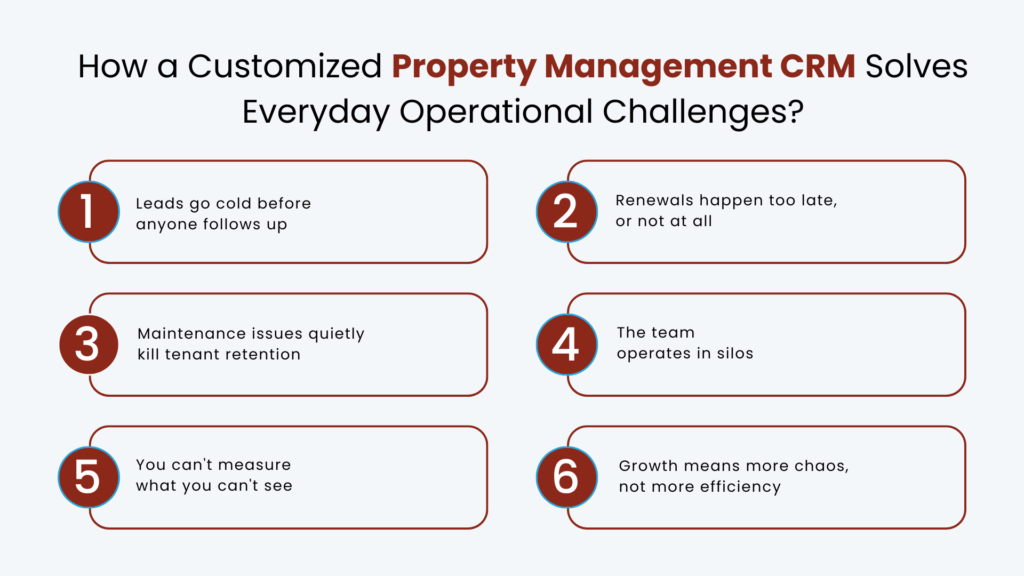
The real cost of running a property portfolio on manual processes isn’t obvious in any single moment. It shows up across dozens of small failures every week. A property management CRM solves these one by one and the cumulative effect is significant.
1. Leads go cold before anyone follows up
Most prospective tenants make a decision within 24 to 48 hours of reaching out. If your follow-up depends on someone remembering to check a shared inbox, you’re already too slow. Automation changes that. The inquiry gets a response immediately, and the follow-up sequence runs whether or not anyone on your team is available.
2. Renewals happen too late, or not at all
Reactive renewal conversations; the ones that start because a tenant already gave notice, almost never go well. You’re filling a vacancy instead of retaining a tenant. A CRM for real estate keeps you ahead of that by making proactive outreach a built-in part of the process, not an afterthought.
3. Maintenance issues quietly kill tenant retention
A request that gets lost doesn’t just create an unhappy tenant. It creates a tenant who tells three people not to rent from you. CRM-based maintenance tracking closes that loop, every request acknowledged, every resolution documented.
4. The team operates in silos
Leasing, maintenance, and management often work from completely separate information. A CRM brings all of it together, so when a tenant calls with a question, whoever picks up actually knows what’s going on.
5. You can’t measure what you can’t see
If your reporting relies on manually pulling data from spreadsheets, it’s already out of date by the time you look at it. A CRM gives you a real-time picture of portfolio performance not a snapshot from two days ago.
6. Growth means more chaos, not more efficiency
Adding units to a spreadsheet-based operation just adds more rows, more risk, and more room for things to fall through the cracks. A CRM scales with you. Whether you’re at 30 units or 300, the underlying processes stay consistent.
Why Profitability Depends on More Than Just Occupancy Rates?
Here’s a number most property managers don’t think about: the full cost of tenant turnover. Advertising a vacant unit, screening applicants, cleaning and preparing the property, and absorbing the gap between leases depending on your market, that can easily run into thousands of dollars per unit.
Multiply that across a portfolio with a high turnover rate, and you’ve got a profitability problem that occupancy figures alone will never reveal.
A 95% occupied portfolio can still be underperforming. If your renewal process is slow, your lead conversion is weak, or your tenant experience is inconsistent, you’re paying the turnover tax more often than you need to. That’s not a market problem. It’s an operational problem.
A property management CRM surfaces exactly this. It tracks lead sources so you know which channels are actually delivering quality tenants. It monitors renewal timelines so you know where you’re losing people. It captures tenant interactions so you can spot dissatisfaction before it becomes a notice to vacate.
For CRM for real estate investors managing multiple properties across different locations, this kind of visibility isn’t just useful; it’s what separates a portfolio that performs from one that perpetually feels like it should be doing better.
Profitability comes from retention, conversion, and tight operations. All three depend on having the right data, in the right place, at the right time.
Conclusion
The property businesses that grow consistently aren’t necessarily the ones moving the fastest. They’re the ones that stop plugging holes manually and build systems that don’t leak in the first place. A customized property management CRM is that system; one that handles lead capture, tenant communication, lease management, and team coordination without depending on someone remembering to do the right thing at the right time.
Add a well-configured real estate sales CRM on top of that, and you’ve got full visibility from the moment a prospect expresses interest to the moment they renew their third lease. That’s what a high-performing real estate operation looks like behind the scenes.
BuilderOpedia builds these systems for real estate businesses; custom, practical, and built around how you actually work. If manual processes are costing you more than you realize, it’s worth a conversation. Book a Consultation with BuilderOpedia.
FAQs
1. Is a property management CRM only useful for large portfolios?
Not at all. If anything, smaller portfolios benefit from getting organized early. Building clean processes when you’re managing 20 units is far easier than trying to fix a broken system when you’re at 80. A CRM grows with you; the structure you put in place now is what makes scaling manageable later.
2. How is a property management CRM different from regular real estate software?
Most real estate software focuses on transactions; listings, contracts, closings. A property management CRM is built around ongoing relationships: tenant communication, lease renewals, maintenance, and pipeline management for vacant units. It’s designed for the operational side of real estate, not just the transactional side.
3. Can a CRM actually improve tenant retention?
Yes and this is one of the most underappreciated benefits. Faster maintenance responses, proactive renewal outreach, and consistent communication all directly impact whether tenants stay or leave. A real estate lead management CRM tracks all of these touchpoints and gives your team the visibility to act before a tenant has already decided to move on.
4. What does the setup process look like with BuilderOpedia?
We start with a discovery session to understand your current workflows, pain points, and goals. From there, we design and build a CRM that fits your operation, not a generic template. Implementation typically takes four to eight weeks, including data migration, integrations, and team training. You’re involved throughout, and we don’t hand it off until your team is comfortable using it.
For more insights, updates, and expert tips, follow us on LinkedIn.