

Digital transformation is reshaping the real estate industry and with AI rapidly taking over, lead and deal management are no longer driven by manual spreadsheets. The manual legacies are not feasible anymore as they simply store data which goes unnoticed most of the time. This is where the AI-powered real estate CRMs shine and grow.
While traditional CRMs were largely active in storing data and reminding agents to follow-up, they could not predict the intent or suggest the next best actions. This is exactly where the AI real estate software gained more advantage and the real estate agencies made the switch.
This real estate CRM software allowed them to manage their leads more effectively with a unified system approach and use the machine learning approach to turn information to insights and use it to build a personalized rapport with the users.
What About the AI Real Estate CRM Makes it Smarter than Other CRMs in the Market?
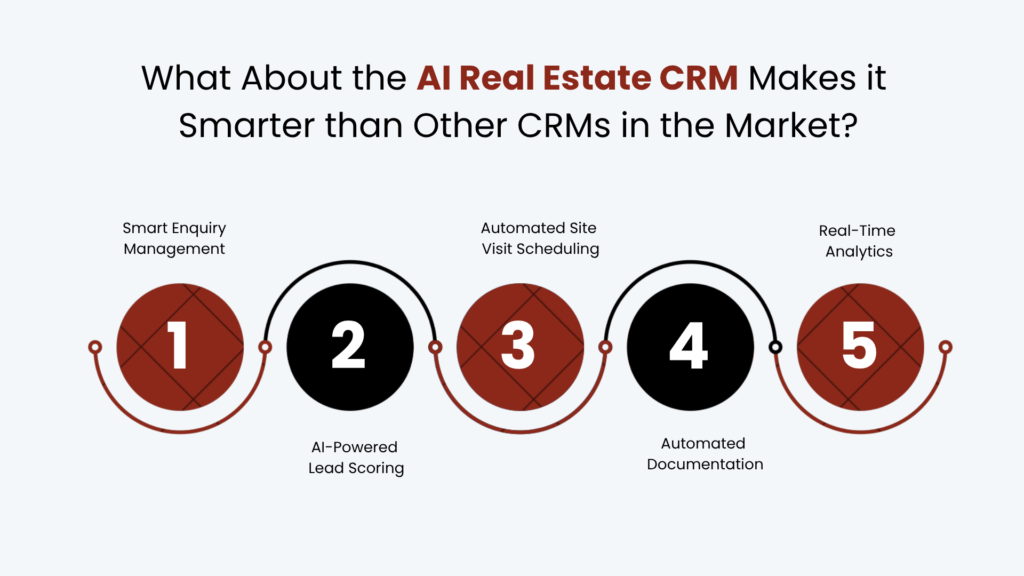
An AI-powered real estate CRM combines the power of a traditional CRM with advanced AI functionalities. Here is what makes it different:
Smart Enquiry Management
A traditional CRM requires the agents to scout for leads from various portals, connect with them, and then manually add the data to the real estate software. Now when AI steps in, the manual effort is eliminated. The system captures the leads from every portal and website and automatically adds it to the unified CRM.
AI-Powered Lead Scoring
With multiple leads flowing in, agents find it difficult to prioritise and understand which lead is genuine and hot. The AI empowered lead scoring system analyses each lead based on intent and past buying behaviour and categorises them as hot, cold, or warm leads. This helps the agents which lead to the target first and they can reach out without losing the opportunity.
Automated Site Visit Scheduling
The site visits are critical for buyer decisions and the agents now prefer scheduling it online. The site visit can be easily scheduled through QR code scan or via the agents themselves through online messaging. This reduces the amount of no shows significantly and also reduces the back and forth of the discussion.
Automated Documentation
The documentation process is extremely critical in the real estate business and customers demand quick documentation. With the pre-set documentation templates in the AI CRM, the estate agents just need to fill in the user details and they can instantly share the cost sheets and all the documentation process. The prospect can read it, sign digitally, and book the property.
Real-Time Analytics
The real-time analytics provides the agents with deeper understanding about the users as to what is their buying intent, their purchase patterns, location preferences, and budget. With the detailed dashboards, the agents can pitch the most relevant property recommendations. This enhances the personal connection and the users are not spammed with irrelevant campaigns or recommendations.
How Does a Realtor CRM Platform Improves the Real Estate Sales Cycles?
If executed accurately, an AI-powered real estate CRM has various benefits and can significantly reduce the sales cycles. Here is how it can do this.
- Faster lead qualification: The agents no longer spend time on manually vetting every lead and deciding. The AI does this and categorises each lead based on parameters like intent, deadline, preferences, and budgets. The agents can easily focus on high-priority leads.
- Personalised engagement: The AI systems analyse each lead to customise the engagement. This increases the response rate and builds trust.
- Reduced operational burden: Automation minimises all repetitive tasks and the agents can easily spend more time on selling rather than completing administrative tasks.
- Smarter forecasting: The AI predictive analysis helps forecast the sales pipelines with better accuracy. Estate agents can plan resources, prioritise deals, and predict revenue with confidence.
- Better client experiences: prospects these days expect faster responses, personalized engagement, and personalised recommendations. The AI-powered agents deliver all three seamlessly within a single CRM.
What Should You Look for in an AI-Powered Real Estate CRM
Choosing the right AI based real estate CRM is critical and can make or break an investment. Here are the top 5 things to look for in a real estate lead management software.
- The first thing to look for is the AI depth. Whether the AI is being used for automating basic internal workflows or is used for predictive insights.
- The purpose of an AI property management software is to simplify the user journey and workflows. Agents should be able to adopt the system quickly without technical training.
- The AI system should smoothly sync with third party tools like marketing, finance, and other communication and transaction tools.
- Your AI CRM should adapt to the business and not vice-versa. Look for a CRM that is scalable and flexible.
- The real estate industry deals with sensitive data and confidential information. The CRM should ensure complete data security and compliance to avoid any legal or data privacy issues later.
The Future of AI-Powered Real Estate CRM
The future of real estate CRM lies in advanced virtual and augmented reality integrations that create immersive experiences. This includes virtual site visits based on buyer preferences and accelerates the decision making processes.
With AI evolving every year, hyper personalised customer journeys can be the real deal. This will suggest buyers the most suitable neighbourhoods based on their lifestyle, budget, location and environment preferences.
Agents will use commands to add or edit data in the CRM, update pipelines, access insights, and create tasks. Lastly, going beyond chatbots, the AI powered property management software will proactively give suggestions as to when to make a counter offer, when to drop prices, or when to launch custom made campaigns.
Conclusion
The real estate industry is thriving, and AI powered real estate CRM is surely taking over. Artificial intelligence has totally changed the way business leaders operate. Earlier, the leads that were hunted down manually from portals and websites are now being automatically curated by the AI powered lead managing softwares.
These CRMs score and categorise every lead making it easier for the agents to understand which ones to reach out on priority. AI-backed software in real estate is not a tool of redundancy but the tools of empowerment that automate everything from a site visit to documentation and the entire buying experience.
It is now safe to say that the future of real estate lies in smarter deal management systems that are data-driven, intelligent, and customer centric. The core of this transformation lies in an AI CRM for real estate that is smarter, safer, faster, scalable, and flexible. It not only promises long-term business growth, but ensures a safe future for the industry.
FAQs
1. Can I use AI for real estate?
Both types of AI can be mapped to real estate workflows. Generative AI powers content creation like listing descriptions or virtual staging, while agentic AI drives automation, decision support, and proactive lead engagement.
2. What is AI-powered lead scoring in real estate CRM software?
The AI empowered lead scoring system analyses each lead based on intent and past buying behaviour and categorises them as hot, cold, or warm leads. This helps the agents which lead to the target first and they can reach out without losing the opportunity.
3. Can an AI CRM assist in scheduling site visits automatically?
Yes, an AI CRM can assist prospects in scheduling site visits digitally. The site visit can be easily scheduled through QR code scan or via the agents themselves through online messaging. This reduces the amount of no shows significantly and also reduces the back and forth of the discussion.
4. What is the future of AI-powered real estate CRM?
The future of AI-powered real estate CRM is virtual site visits using augmented reality, personalized customer experiences, voice command to update the CRM, and AI-driven recommendations to make counter offers, price reductions, and campaign strategies.
5. What should businesses look for in an AI real estate CRM?
Businesses must look for the depth of AI, ease of adoption, third-party app connectivity, scalability, flexibility, and data security compliance in an AI real estate CRM because it handles sensitive information.
For more insights, updates, and expert tips, follow us on LinkedIn.