

The real estate industry has always been relationship driven and for years spreadsheets have been the go to tool for data maintenance. While the traditional systems worked in the past, the modern era demands powerful responses and customers too expect immediacy. This need for immediacy has been addressed using an AI CRM for real estate agents.
The transition from the conventional to the advanced AI-powered real estate CRM is not merely a move forward in terms of technology, it is a change in the way the real estate agent conducts his or her activities and interacts with clients.
The introduction of automation, intelligence, and real-time communication has truly revolutionized the concept of real estate CRM.
Let us find out what changes have occurred and why this shift is taking place.
The Limitations of Spreadsheets in Modern Real Estate
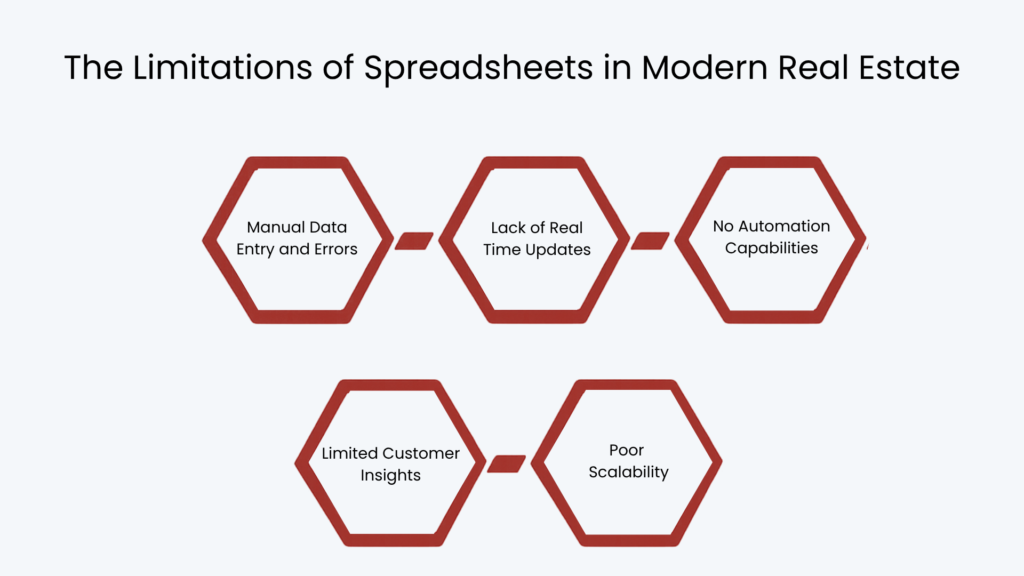
For the longest time the estate agencies and businesses have been using spreadsheets like excel or google sheets to store and manage data. However, as the operations scale, these systems start to become obsolete.
Manual Data Entry and Errors
Spreadsheets rely heavily on manual updates and the client details, update lead status, and track communication themselves. It not only takes away time, but human error also becomes more likely.
Lack of Real Time Updates
The property market is volatile and even minor delays could result in loss of potential customers. Real time collaboration is not possible through spreadsheets because they do not allow real time updates.
No Automation Capabilities
Follow-ups in real estate are crucial and missed ones result in the loss of a potential buyer. Spreadsheets cannot automate reminders, follow-ups, or lead nurturing processes.
Limited Customer Insights
While spreadsheets are fully capable of storing data, they do not analyse it. Agents then often lack insights into customer behavior, preferences, and buying patterns.
Poor Scalability
As the number of leads grows, managing this data manually becomes chaotic and inefficient. Also, sorting, filtering, and maintaining the large data sets soon becomes difficult.
How is an AI CRM for Real Estate Agents Resolving The Manual Incapabilities?
Where traditional systems fail, the AI CRM for real estate agents steps in and ensures that no lead is missed or lost, through automation. It fuels and powers the CRM in such a way that every procedure in the real estate sales journey is automated and interconnected.
Smart Enquiry Systems
With the help of an AI-based CRM system for estate brokers, lead management has been made easier by automatically fetching leads from all property websites and social media as well as other platforms through which customers connect. The generated leads are subsequently classified according to their level of intention and probability of conversion. It ensures that agents spend their time engaging with promising leads.
Real-Time Analytics Dashboard
Speed is the key to real estate business success and the AI-led lead automation for real estate unifies every communication channel including messaging apps, emails, and calls into one platform. This helps in ensuring that agents respond to the user queries in a timely manner, keep full track of customer interaction history, and switch between channels seamlessly. These real-time dashboards help the agents in sending tailored messages to the prospects.
Real Estate Sales Automation
The CRM with AI for realtors allows the agents to automate every step of the sales process. This means that when a prospect sends an enquiry, the AI CRM for real estate agents automatically records it as a lead and triggers a notification to the agents to coordinate. Further, the follow-ups are automated, AI takes care of common queries even when your agents are not around, and the transparency allows for smooth and effortless communication.
Site Visit Management
Site visit remains a critical part of the real estate management CRM and must be completed successfully for a deal to close. However, manual site visits remain a challenge and are not really feasible. This is where an AI CRM steps in and allows the agents to enable a smooth site visit experience. The agents can send a time slot to the clients via messaging or can share a QR code to the clients so that they can book the time slot and save the time in back and forth communications.
One Click Cost Sheets & Documentation
Customers in today’s time demand a quick and accurate response, especially when it comes to costing. While the manual cost sheets can take hours, the one click cost sheets are simple. The generative AI assistant makes sure that your prices stay updated at all times and all the agents have to do is fill the cost sheet and can instantly share the file to the clients. This helps the real estate firms beat the competition and close the deals faster.
Possible Challenges in Adopting an AI Real Estate Lead Generation System & How to Overcome Them
Although the shift from traditional CRM systems to an AI CRM for real estate agents is necessary, it is important to understand that adapting in the first go may not be possible. Here are a few challenges that businesses might face and the solution to overcome them.
| Challenges | Solutions with Modern AI CRM |
|---|---|
| Perceived complexity in implementation | User-friendly interfaces make AI CRM easy to set up and use without technical expertise |
| High initial cost concerns | Cost-effective in the long run by improving efficiency and reducing manual work |
| Resistance to change from traditional tools | Intuitive design and minimal training help teams transition smoothly from spreadsheets |
| Difficulty in scaling operations | Scalable systems that grow with businesses of all sizes |
| Lack of technical knowledge | Guided onboarding, support, and automation reduce dependency on technical skills |
| Fear of disrupting existing workflows | Seamless integration with existing tools ensures minimal disruption |
| Time required for training teams | Simple dashboards and automation reduce the learning curve significantly |
| Uncertainty about ROI | Data-driven insights and improved conversions clearly demonstrate business value |
Conclusion
Moving from spreadsheets to real estate smart systems is an important milestone in the career of any real estate agent.
Although spreadsheets were the first tool used in managing the flow of information, they do not meet the needs of today’s real estate market. Artificial intelligence-based customer relationship management platforms provide efficiency, intelligence, and automation needed to achieve success.
With the help of an AI CRM for real estate agents, sales reps can manage leads efficiently, provide personalized interactions, respond quickly, make decisions based on data, and close transactions faster.
In the competitive field of real estate, every little thing matters. The future is for real estate agents that are not only putting in the work but doing it intelligently.
FAQs
1. What is an AI CRM for real estate agents?
An AI CRM for real estate agents is an advanced system that uses automation, intelligence, and real-time communication to manage leads, streamline workflows, and improve customer interactions.
2. Why are spreadsheets not useful for real estate companies anymore?
This is because spreadsheets need manual entry of data, do not give real-time information, cannot automate processes, offer poor insight, and are not efficient when dealing with more leads.
3. How does AI CRM solve manual inefficiencies in real estate?
AI CRM for real estate agents ensures that no lead is missed or lost, through automation. It fuels and powers the CRM in such a way that every procedure in the real estate sales journey is automated and interconnected.
4. What are the main advantages of AI CRM in real estate?
Time-saving, personalized customer interaction, quick response, informed decision-making, and fast closing of deals.
5. What challenges do businesses face when adopting AI CRM?
Few challenges faced while adoption include complexity, high implementation costs, reluctance to change, lack of technical understanding, and fear of disruptions to the workflow.
For more insights, updates, and expert tips, follow us on LinkedIn.