
Imagine your sales team receives 200 new enquiries from a weekend property expo. Some of those leads are ready to book a site visit this week. Others are casually browsing and will not buy for another six months. A few are not genuinely interested at all.
Without a system to tell them apart, your team treats all 200 the same way. They call down the list in order, spend equal time on every prospect, and inevitably miss the buyers who were actually ready to move. By the time they circle back, those hot leads have booked with a competitor.
This is the core problem that an AI-based property CRM solves. Not just by storing lead data, but by reading it, scoring it, and telling your team exactly who deserves attention right now.
Why Manual Lead Management Fails in Real Estate
There are numerous factors and difficulties inherent only in the real estate lead generation process. Even one single project can generate hundreds of leads, which may come from real estate websites, social media promotions, referrals, walk-in customers, and a variety of other sources at once.
In general, there are two ways of handling leads – allocating leads to an agent on duty and using the FIFO method. None of the mentioned approaches takes into account the quality of leads, thus failing to connect to the client willing to buy in the next three days.
It is quite obvious what consequences this behavior may have. The high-intent leads become poor leads due to the delayed reaction. Lower-quality leads simply waste good chances for selling while forcing agents to exert more effort than necessary. Lead leakage, the hidden danger of the sales funnel in real estate, only gets stronger every day.
Manual lead qualifying also lacks objective data to work with. A sales agent won’t know if the person calling them has visited the project page four times already, compared three floor plans, and downloaded the payment schedule. AI-driven CRM for real estate knows it all.
How an AI-Based Property CRM Categorises Leads Automatically
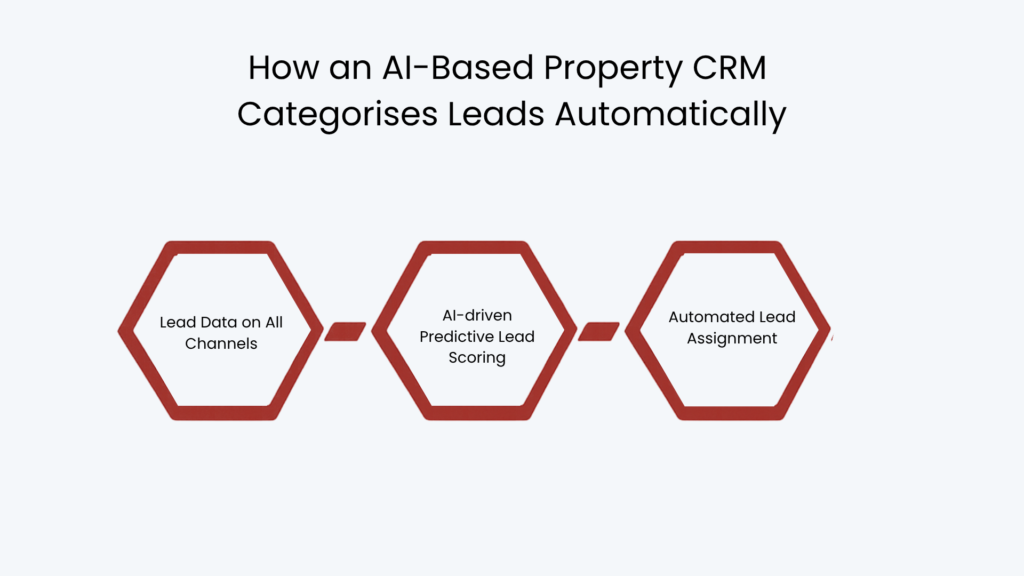
AI lead categorisation works by collecting behavioural and demographic signals from every touchpoint and converting them into a score or category that tells your team how close a prospect is to buying.
Lead Data on All Channels
An AI-powered CRM for real estate collates lead data from property listings, WhatsApp queries, website traffic, email campaigns, and marketing efforts. It forms a complete profile of each lead without forcing you to compile data from various sources manually.
It matters because the intent to purchase often doesn’t reveal itself in one contact alone. For example, a lead who initially contacted you regarding pricing three weeks ago but returned to the project website five more times has become increasingly interested in the property. AI knows how to read that trend. Your sales executive browsing through an excel sheet would miss out on such insights.
AI-driven Predictive Lead Scoring
- After collecting the data, AI drives predictive lead scoring to rank each lead. The factors taken into account during scoring include:
- How often and when the prospect engages with your listings
- Quality of the source (referral or direct enquiry carry greater weightage compared to leads sourced from bulk websites)
- Stage in the property sales funnel (e.g., site visit vs. initial enquiry)
- Compatibility between the budget/configuration preference of the client and the existing inventory
The output is a ranked list. Hot leads sit at the top. Cold and unqualified leads are filtered to the bottom. Your team no longer decides who to call first based on gut feeling. The AI handles that decision for them.
Automated Lead Assignment
After scoring, smart lead assignment routes each prospect to the right salesperson based on availability, expertise, language preference, or project specialisation. A builder running multiple projects across different cities can ensure that enquiries for each development go directly to the team trained to handle them.
This eliminates the delay between a lead arriving in the system and a sales rep picking it up. Speed matters enormously in real estate. Research from industry studies shows that leads contacted within the first five minutes are significantly more likely to convert than those reached an hour later. Automated assignment removes the gap between enquiry and first contact.
Where Builders Lose Time Without AI Lead Categorisation
The time cost of unstructured lead management is rarely calculated directly. It shows up in subtler ways.
Multiple follow-ups of cold leads: Since there is no sorting by categories, sales reps make multiple calls to low-potential prospects since they do not understand that these leads have little chance of becoming their customers. The average duration of such calls is five to ten minutes. When there are ten sales reps, who work with fifty leads every day, a lot of their time is wasted.
No follow-up triggers: If the person has been to your website, requested a new pricing sheet, and then became silent again, he is very likely to be considering different options. Without any AI-technology, the follow-up will either happen too late or won’t happen at all.
Ineffective nurturing: Even though the lead is currently not willing to make a purchase, it is the source of potential profits in the future. Due to the absence of automated real estate lead nurturing workflows, these leads receive either nothing or some kind of general messages.
Reporting difficulties: Since the data about leads is located in spreadsheets, WhatsApp groups, and even notes, sales managers cannot track the effectiveness of these channels and figure out how to get more conversions.
The Business Impact of AI Lead Scoring in Real Estate
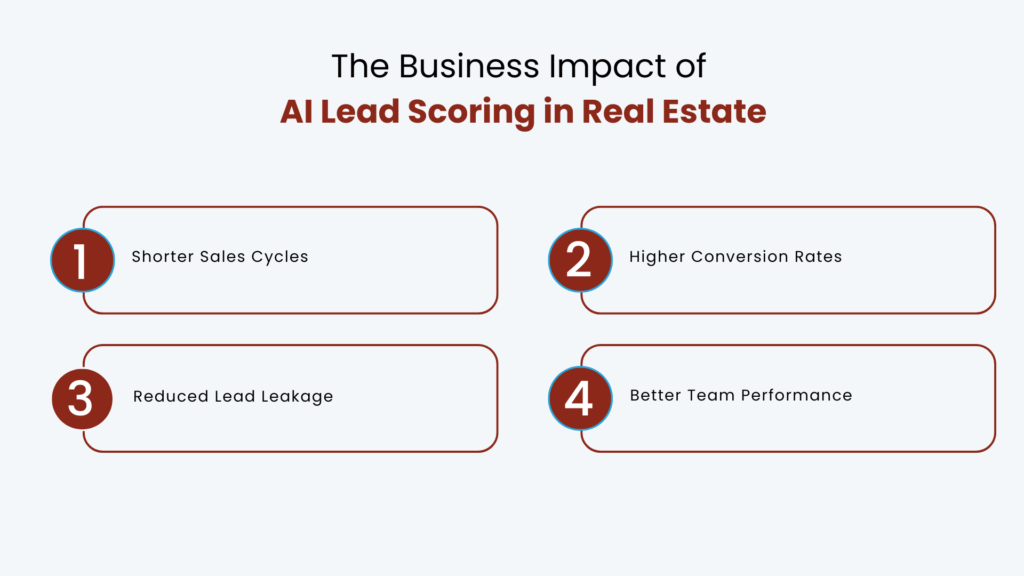
The operational benefits of smart lead categorisation translate into direct business outcomes.
Shorter Sales Cycles
When salespeople focus on high-scoring leads, they spend more time in productive conversations and less time chasing prospects who are not ready. That concentration of effort shortens the average time from first enquiry to booking.
Higher Conversion Rates
AI customer insights reveal which lead attributes correlate with actual purchases. Over time, the scoring model becomes more accurate for your specific projects and buyer profiles, improving the quality of recommendations and lifting conversion rates.
Reduced Lead Leakage
Every uncontacted lead is a potential booking lost. Automated lead assignment and follow-up alerts ensure that leads do not go cold simply because no one was paying attention. AI-powered real estate CRM systems create accountability that manual processes cannot.
Better Team Performance
When your sales team has a clear, prioritised call list each morning, they start the day with focus rather than confusion. Morale improves. Performance improves. The CRM becomes a tool they want to use rather than a system they have to maintain.
According to Salesforce research on CRM adoption and AI-driven automation, companies that use AI for lead management report significant improvements in sales productivity and pipeline accuracy.
What to Look for in an AI-Based Property CRM
Just because a CRM refers to its AI functionality does not mean it offers true automation services. This is where the value of automation becomes evident in a builder CRM platform.
- The ability to collect multiple sources of leads by importing enquiries from websites, campaigns, WhatsApp, and organic traffic through an automatic system.
- The ability to configure scoring criteria that consider the most important aspects of your business and buyer base, and do not use general algorithms.
- Automatic triggering of workflow processes depending on pre-defined conditions, and how a lead interacts with a website or marketing campaign.
- Live viewing of your entire pipeline so sales management can see where each of their leads is, and address any potential problems early on.
- Integration with inventory and cost information so salespeople always know what products are available and at what prices.
Conclusion
The real estate market does not reward the slowest responder. It rewards the team that knows who to call, when to call them, and what to say when the conversation happens.
An AI-based property CRM makes that level of precision possible at scale. By automating lead categorisation, applying predictive lead scoring, and removing the manual overhead of organising and prioritising your pipeline, it gives your sales team back the hours they were spending on the wrong prospects and redirects that energy toward buyers who are genuinely ready to move.
For builders and developers managing hundreds of enquiries across multiple projects, this is not a luxury. It is how modern real estate sales operate.
FAQs
1. What is an AI-based property CRM?
AI-based Property Customer Relationship Management is used to describe a CRM system that uses AI tools in managing activities like sorting, prioritization, allocation, and action taken on leads in the property industry. This does away with manual sorting and prioritizing of leads by the salespeople, as it relies on artificial intelligence to prioritize and rank leads prior to executing actions on them.
2. What is AI lead categorization in real estate?
AI lead categorization refers to the collection of all the information regarding every interaction a customer has had with the company. Data collected include online enquiry forms, visits, email activity, and even historical data. The scoring system scores each lead and ranks them based on such variables as budget fit, engagement level, interest level, and lead source quality.
3. How does AI lead scoring assist in saving time for builders?
By doing away with the manual evaluation process of the sales team in determining the quality of leads, AI lead scoring enables the sales team to make use of their time efficiently. Rather than having to evaluate leads from an unsorted list of leads, they will be able to use the daily list of sorted leads that contains the most promising leads in it.
4. What is meant by the term ‘lead leakage’ and what does an AI real estate CRM prevent?
The term ‘lead leakage’ relates to those customers who enter the sales pipeline, but due to lack of follow-ups, they either become disinterested in proceeding further with you, or book somewhere else. It can be avoided by ensuring that there is lead assignment by means of automation, which triggers follow-ups for them according to their behavior and reminds the agent to follow up on them even when silent.
5. Can small or mid-sized builders benefit from an AI-based property CRM?
Yes. AI-enabled property CRM platforms designed for builders are built to scale. A smaller team managing one or two projects benefits from the same lead prioritisation and automation as a large developer running ten. The efficiency gains are often more noticeable for smaller teams because they have fewer resources to absorb the cost of missed leads or disorganised follow-up.
For more insights, updates, and expert tips, follow us on LinkedIn.