
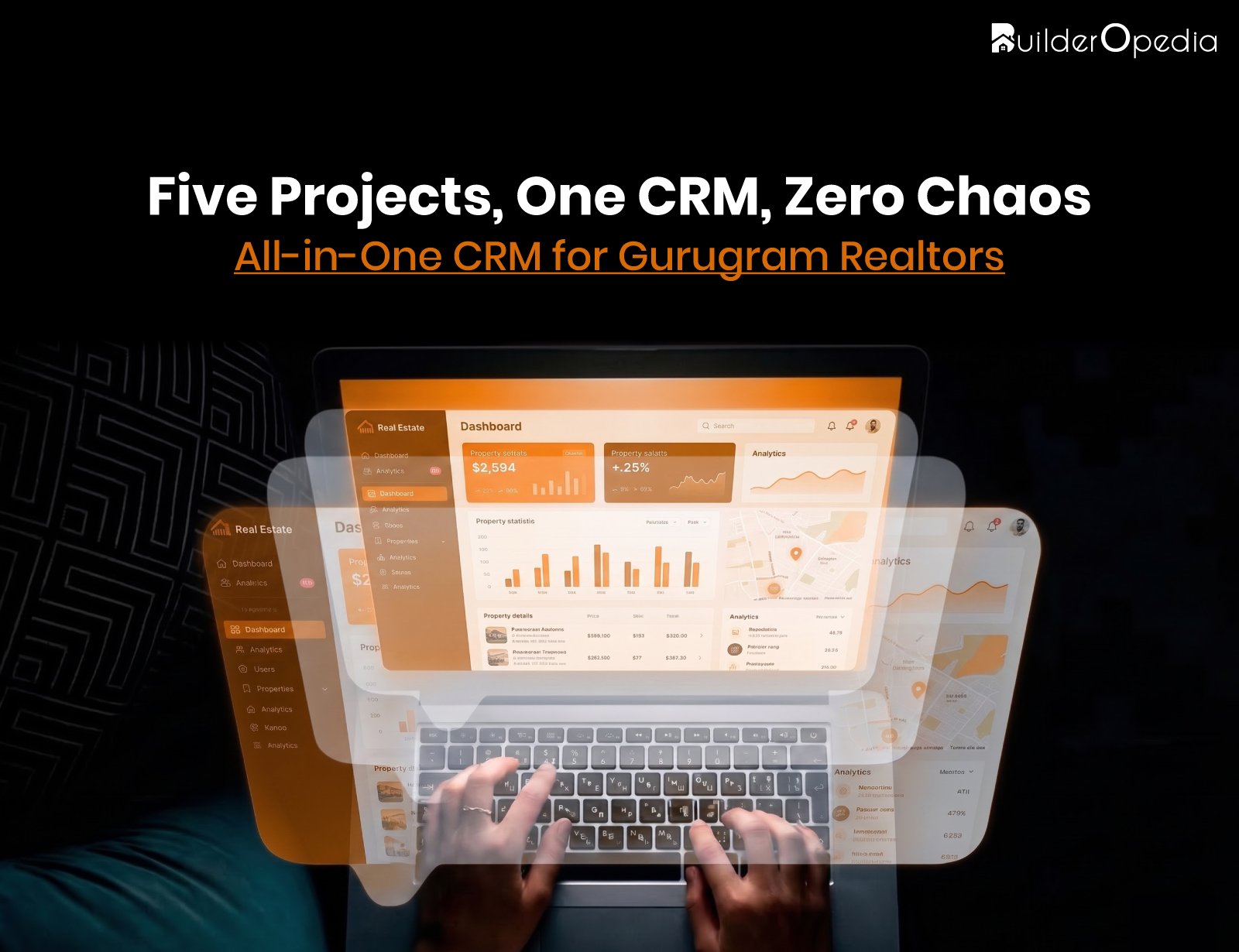
Developers running more than one project at a time often end up running more than one system too: a separate lead sheet per launch, a different inventory file per site, a sales team reporting progress in its own format. None of this is intentional; it builds up as projects are added.
A centralized CRM for real estate in Gurugram changes this by giving every project its own space inside one system, while leads, inventory, site visits, and customer records stay connected across the portfolio.
One CRM, Multiple Projects, Clearer Control
Centralization will not make every project similar to others. Each of the projects will be able to work on its own dashboard and have its own inventory, sales pipeline, and staff allocation; at the same time, the management will be able to see everything through one login. This is especially important for developers who are going to use the CRM for Real Estate in Gurugram.
A simple example: A developer with a residential tower in Sector 84 and a plotted development in Sohna can keep both projects separate for daily sales work, while a sales head pulls up project-wise lead counts and bookings without asking each team for an update.
How Multi-Project Lead Management Can Work
Every lead moves through roughly the same stages: capture, assignment, follow-up, site visit, negotiation, booking. The challenge with multiple projects is keeping this journey visible without agents duplicating work across spreadsheets.
A connected system can support this by:
- Enquiries captured from property portal, website and marketing campaigns into a single lead pipeline
- Automated allocation of lead to correct project and sales person
- Reminder notifications sent to ensure leads are followed up and not forgotten
- Status tracking and lead-project association in a single place
Enquiry handling tends to slow down exactly when leads arrive from many sources and agents track them across scattered files. When Real Estate Lead Generation in Gurugram spans multiple campaigns and projects, that visibility becomes more important, not less.
Route the Right Lead to the Right Project
A potential customer may inquire about a certain project within one micro-market, even though their criteria suit another project more. The centrally placed real estate CRM solution will highlight such a situation in the context of the first interaction, if it is set up for this purpose, so that the salesperson would know the whole truth and not just receive one inquiry while another project is ignored.
Keep Inventory and Sales Teams Working From the Same Information
Multi-project developers frequently lose time reconciling inventory across spreadsheets: which units are sold, which are on hold, and which are still available. When two projects are selling at once, this becomes harder to track manually.
A centralized inventory dashboard can give teams a live, project-wise view of unit and parking status, so someone checking availability for one project isn’t working from a report meant for another. Status changes reflect immediately, reducing the risk of two reps quoting the same unit, an error that tends to multiply as the portfolio grows.
Give Every Project Its Own Workflow Without Creating Separate Systems
Not all projects go through the same sales process. There can be a requirement for additional approval processes for the sale of a luxury product, while planning and development can be streamlined for easier follow-ups. Applying the same sales process to all projects is typically circumvented by someone.
A configurable real estate CRM allows each project its own fields, stages, and approval steps without a separate platform, and teams can adjust fields as requirements change without disrupting live projects. One CRM does not mean one fixed way of working; it means one place where different workflows coexist.
Bring Site Visits, Follow-Ups and Sales Activity Into One View
Site visits are where most deals move forward or stall. Across multiple projects, keeping visit schedules, agent assignments, and outcomes organized becomes harder without a shared system.
A connected CRM can help teams:
- Schedule and confirm visits with automatic notifications
- Track check-ins and capture visit outcomes in real time
- Trigger follow-up actions based on what happened during the visit
- Keep marketing and sales aligned on which leads are progressing
This system makes it possible for the sales manager overseeing multiple product launches to monitor all visits on one screen without having to follow up with each individual project team.
Where Channel Partners Fit Into a Multi-Project CRM
Channel partners are a significant lead source for most Gurugram developers, especially across simultaneous launches. Managing broker enquiries, onboarding, and commissions through calls and spreadsheets tends to break down as active projects grow.
A centralized approach to channel partner management can bring broker enquiries, deal tracking, and commission visibility into one system mapped to the right project, removing the manual coordination that eats into a partner manager’s time when several projects sell at once.
What Management Can See From One Dashboard
Consolidated reporting is one of the clearest benefits of a single system for a multi-project business. Instead of waiting for each project team to compile updates, management can view the following in near real time, where the CRM supports it:
| Multi-project task | Disconnected tools | Centralized CRM approach |
|---|---|---|
| Lead assignment | Manual or scattered | Centralized workflow |
| Project visibility | Separate reports | Project-level dashboards |
| Inventory | Multiple spreadsheets | Unified availability view |
| Follow-ups | Individual tracking | Centralized activity history |
| Site visits | Separate schedules | Connected sales workflow |
| Channel partners | Messages and spreadsheets | Centralized partner records |
| Reporting | Manual consolidation | Unified reporting |
Not every CRM surfaces every field by default; the value comes from how well the system can be configured to match what a developer needs to track.
One CRM for Real Estate CRM in Gurugram Does Not Mean One Size Fits All
A long feature list is not, by itself, a reason to choose a platform. The more useful question is whether the system adapts to how a developer actually runs projects, since sales processes, inventory structures, and reporting needs differ from one developer to another. This is why configurability matters more for multi-project developers than for a single-site business: a workflow that works for one launch may need adjustment for the next.
A Simple Framework for Choosing a Multi-Project Real Estate CRM
The right starting point depends on how complex the current portfolio already is:
- One to two simple projects: Focus on lead management and follow-ups
- Multiple projects and several sales teams: focus on project-specific workflows and routing.
- Extensive channel partners’ network: Focus on partners’ management and deals visibility.
- Complicated or rapidly changing inventory: Focus on centralized real-time inventory overview.
- Rapid scaling with launches: Focus on adaptive workflows that do not affect existing projects.
Developers evaluating CRM for Real estate in Haryana more broadly, not just Gurugram, should apply the same framework since complexity, not location, is usually the bigger factor.
This could differ from one developer to another since while one wants to make sure that there is lead assignment for projects and reporting, another could be dealing with many brokers’ networks and thus wants to concentrate the commission management. The third developer, who has launched a new project along with others, would integrate it into the current process.
Disconnected Tools vs. a Centralized CRM Approach
| Multi-project task | Disconnected tools | Centralized CRM approach |
|---|---|---|
| Lead assignment | Manual or scattered | Centralized workflow |
| Project visibility | Separate reports | Project-level dashboards |
| Inventory | Multiple spreadsheets | Unified availability view |
| Follow-ups | Individual tracking | Centralized activity history |
| Site visits | Separate schedules | Connected sales workflow |
| Channel partners | Messages and spreadsheets | Centralized partner records |
| Reporting | Manual consolidation | Unified reporting |
Gurugram’s pipeline keeps expanding: the Haryana Real Estate Regulatory Authority approved 51 projects worth nearly four billion dollars in the first half of 2026, strengthening the case for one connected system as more projects move into active sales at once.
Conclusion
Managing multiple projects doesn’t always mean managing multiple systems that operate independently of each other. With CRM for Real Estate in Gurugram set up properly, developers can have all performance metrics on their projects in one place, have faster lead distribution, precise inventory management through different launches, site visit follow-ups and channel partner monitoring without any manual effort.
None of this guarantees higher sales on its own, but it can reduce manual work, improve visibility, and help teams respond faster as active projects grow. If your current system still relies on separate spreadsheets per project, it may be worth evaluating a configurable, multi-project CRM, especially if you’re exploring Real Estate CRM Development in Gurgaon or comparing Real Estate CRM Software in Gurgaon for an upcoming launch.
FAQs
1. Is it possible to use a single CRM for multiple real estate projects?
Yes. One central CRM solution could have multiple projects being managed at the same time; each project could have its own leads, inventory, and workflows while the management has an overview of all these details on one dashboard.
2. How would the usage of multi-project CRM benefit developers in Gurugram?
By using one multi-project CRM for real estate in Gurugram, one can do away with having multiple reports per project, which usually require spreadsheets. This way, there is one single view of leads, inventory, and visits to the projects in real-time.
3. Can one configure the real estate CRM to have project-wise leads and inventory?
Yes, one can configure the real estate CRM to maintain leads and inventory for individual projects such that only those relevant details are seen by the team working for the project.
4. How could CRM be helpful in managing the channel partners across projects?
With a centralized system, all broker inquiries, deal progress, and commissions are tracked against the right project, thereby eliminating the manual effort involved in coordination via calls and spreadsheets.
5. What are the key features for developers to consider when choosing a multi-project CRM for real estate in Gurugram?
They should include workflow customizability, reporting on a per-project basis, ability to track inventory from a central point and lead routing. This is true regardless of whether you are choosing the Best Real Estate Lead Generation Company in Gurugram to go hand-in-hand with your CRM or comparing them directly.
For more insights, updates, and expert tips, follow us on LinkedIn.