
Most real estate sales teams are sitting on a goldmine of lead data. The problem is that the data stays scattered. Leads come in from property portals, website forms, referrals, walk-ins, and WhatsApp messages. Without a system to make sense of all that, follow-ups slip, hot leads go cold, and your sales numbers stay flat.
This is where AI CRM for real estate agents transforms the business. Instead of logging data manually and guessing which leads are worth calling first, your team gets a system that reads the signals, scores the leads, and tells you exactly where to focus.
This article breaks down how AI-powered CRM connects lead intelligence with actual sales performance. And why that connection matters for builders, developers, brokers, and the sales teams working the floor every day.
The Importance of Lead Intelligence in Modern Real Estate Sales
A lead who has already browsed your project page three times, downloaded the brochure, and asked about how payments can be made is not the same lead as the one who registered on the website six weeks ago but stopped replying.
The traditional CRM software system registers them both in the same manner: simply by adding their name to a list.
But lead intelligence takes things further than that. It involves evaluating buyer behavior and determining where he/she is in their purchase journey through interactions and engagement histories. Having done so, you can then tailor your approach to that particular buyer.
As per National Association of Realtors, the first thing that most buyers take into consideration when picking a real estate agent is the time it takes for the agent to get back to him/her. And this isn’t a people issue; it’s a technical one. AI CRM fixes it once and for all.
How AI-Powered CRM Systems Turn Data into Actionable Insights?
A well-built AI Real Estate CRM does not just store data. It works on that data in the background and surfaces what your team needs to act on.
Here is what that looks like in practice:
- Lead Scoring: This method involves assigning a priority score for each lead depending on activities, sources, levels of involvement and buying intent. Your staff will be making calls to the high-score leads.
- Behavior Tracking: All actions made by the leads on your listing, email marketing, and other communications will be tracked and used in updating their profiles.
- Automated Alerts: Whenever a lead scores above a defined threshold or performs a specified action, an alert is sent out to your sales person.
- Pipeline Visibility: Your managers will have a clear view of all deals in your pipelines from any given project.
A McKinsey report on sales and AI found that companies using AI in their sales processes reported significant improvements in lead conversion and customer satisfaction. Real estate teams that move to cloud-based AI Real Estate CRM are seeing exactly that.
Key Ways AI Connects Lead Intelligence with Sales Performance
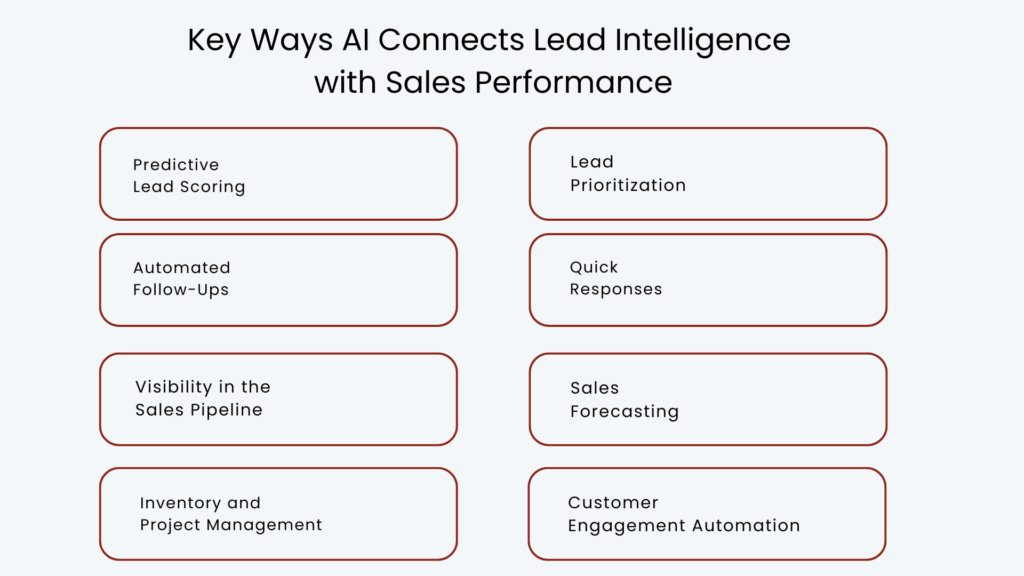
Predictive Lead Scoring
All leads that come into your CRM are scored. It is done by taking into consideration factors such as lead source, lead response time, lead engagement with your content, and even lead persona.
You don’t need to figure out who you should contact next because your CRM does that for you by using data and analysis.
Lead Prioritization
If the lead score is high enough, your team will know that he or she needs to be contacted right away. Leads with a lower score will be nurtured until they score higher. It is amazing how such a small step can improve productivity and results for your sales team.
Automated Follow-Ups
One of the largest causes of lead leaks in real estate lies in the lag time from contact number one to contact number two. The buyer has forgotten. The agent has become preoccupied. The deal has become a distant memory.
CRM systems that include artificial intelligence functions solve this problem by automating the process of follow-ups. In case the potential client does not answer the first contact, then the system will send a follow-up email on your behalf automatically.
Quick Responses
Quick response times matter more in real estate than other industries because once a buyer makes an inquiry, he or she is probably looking at several options. The team with the quickest response usually wins the meeting.
A Cloud AI CRM for real estate brokers will help create an automatic response, assign the lead to the appropriate broker and assign a call action to follow up with the client within minutes, something that would have needed an additional employee before.
Visibility in the Sales Pipeline
It is essential for sales directors and managers to be able to see what happens in all projects, with different agents and in different stages of each sale.
The cloud-based AI CRM in the real estate sector offers real-time access to the complete pipeline, giving you visibility on what is going on at every point in your deals and your sales force.
Sales Forecasting
With enough historical data, AI can forecast how many deals are likely to close in a given period based on current pipeline health. That kind of visibility helps management plan staffing, marketing spend, and inventory availability far more accurately.
Inventory and Project Management
In terms of inventory, management is just as crucial as lead management for your organization. You need to know what units are available, reserved, or sold in order to provide accurate information for the customers to your sales team without any double bookings.
Customer Engagement Automation
The AI-powered CRM for builders and developers automates the whole process of communication with the customer from initial contact, site visits, appointments, booking, and beyond.
Real-World Use Cases for Builders, Developers, and Brokers
Large-scale residential developers – With multiple projects running simultaneously use AI CRM to manage hundreds of active leads across their full project portfolio. Instead of separate spreadsheets per project, the entire pipeline sits in one system.
Brokerage firms – With multiple agents use AI CRM for real estate brokers to ensure that no lead falls through the cracks when agents are on leave or handling multiple clients. The system keeps nurturing until someone is available to take over.
Channel partner networks – Use CRM automation to track referrals, manage commissions, and ensure every partner is kept in the loop about project updates and available inventory.
Real estate teams like those at Max Estates, EMAAR, and Adani Realty have trusted AI-powered platforms, like BuilderOpedia CRM to streamline these exact workflows at scale.
| Challenge | How AI CRM Addresses It |
|---|---|
| Slow lead response times | Automated instant acknowledgments and agent assignment |
| Manual follow-up gaps | Drip sequences triggered by lead behavior |
| No visibility into pipeline health | Real-time dashboard for managers and sales heads |
| Inventory confusion across projects | Centralized inventory view with live availability |
| Sales forecasting inaccuracy | AI-driven predictions based on pipeline data |
| Inconsistent lead quality assessment | Standardized scoring based on behavior and profile |
Common Challenges and How AI CRM Solves Them
What to Look for in an AI-Powered Real Estate CRM
If you are evaluating platforms, here are the capabilities that matter most:
- Inbuilt AI lead scoring capabilities that don’t come as a standalone addon
- Workflows that can be configured without the need to involve developers
- Live inventory dashboard that is directly linked to your sales funnel
- Mobile support to enable field workers to update lead status on the go
- Integrations with property portals that enable automatic fetching of leads from sites such as 99acres, Magicbricks, or Housing.com
- Role-specific access controls that ensure managers, agents, and partners get access only to what’s relevant for them
- Analytics and reports showing you the percentage of conversions and performance at every level
Your real estate CRM tool with AI functionalities needs to be one that makes your team efficient.
Why BuilderOpedia Is Built for Modern Real Estate Teams?
BuilderOpedia is an AI-based CRM platform designed for real estate sales management processes based on how sales occur. This includes every process in the sale cycle, from initial inquiry to after booking engagement, with AI-based tools to enable your team to be efficient at every level.
Some key features include:
- Smart lead scoring that helps your team focus on the leads most likely to convert, so time is not wasted chasing cold inquiries
- Automated workflows that trigger follow-ups, assign leads, and send reminders without manual input from your team
- 360-degree customer view so every agent can see the full history of any lead before picking up the phone
- Centralized inventory management across all your active projects, with real-time availability and booking status
- One-click cost sheets and smart document generation to speed up the proposal and booking process
- Channel partner integration to keep your broker and referral network connected to the right project updates
Conclusion
The gap between lead intelligence and sales performance is not a people problem. It is a systems problem. When your team has the right tools, they follow up faster, prioritize better, and close more deals. That is what AI CRM for real estate agents is designed to deliver.
Key points to remember:
- The application of artificial intelligence in lead scoring enables companies to concentrate on potential clients who have a higher probability of converting rather than manually managing a lengthy list of contacts.
- Follow-up automation decreases any loss of prospects from stage one to stage two.
- Visibility within the pipeline and forecast provide the necessary information for managers to run their business in an efficient manner.
- Tools for inventory management and customer engagement encompass all stages of the sales process.
For those of you who are still using spreadsheets and other outdated tools, then BuilderOpedia could very well be your ideal solution. It has been designed specifically for real estate sales teams and utilizes advanced artificial intelligence features to enable lead intelligence to directly correlate to the actions that earn revenue.
FAQs
1. What is AI CRM for real estate agents and why is it helpful when trying to sell more houses?
AI CRM for real estate agents is customer relationship management software that uses artificial intelligence to automatically score, follow up with, and show the most relevant leads. This makes real estate agents able to close more deals because all the guesswork involved in selecting which leads are important to pursue gets eliminated.
2. What distinguishes an AI CRM for real estate brokers from regular CRM software?
An AI CRM for real estate brokers is far more advanced than regular CRM software. Instead of simply recording contacts and actions taken, it uses data about customer behavior and predictive scoring to inform brokers when they are ready to make a purchase and manages routine communication. At the same time, it allows management to monitor their progress.
3. What are some key points to consider when choosing a CRM for realtors with AI capabilities?
Some key factors include built-in lead scoring functionality, automated workflow triggers, integration with property portals, real-time inventory management, accessibility through mobile devices, and conversion rates analytics. The main objective is a solution that will minimize the amount of effort required from your side while improving responsiveness and accuracy of transactions.
4. Is AI Real Estate CRM a good choice for builders/developers who operate multiple projects?
Certainly. AI Real Estate CRM is especially relevant for builders/developers since it provides functionality for managing the inventory for various projects, monitoring leads for all projects at once, as well as automating the entire process of customer communication from lead generation to bookings. Channel partners are also important for any large developer.
5. Can a cloud-based AI Real Estate CRM improve sales team performance for a mid-size brokerage?
Certainly. The cloud-based AI Real Estate CRM will provide consistency in lead processing for all agents, guaranteeing follow-ups and giving management the necessary metrics to motivate under-performers and encourage best performers. In many cases, the cloud-based AI Real Estate CRM will substitute traditional solutions such as spreadsheets and separate communication applications.
For more insights, updates, and expert tips, follow us on LinkedIn.