

Pune’s real estate market doesn’t slow down. Between the expanding IT corridors, the steady demand from young professionals, and the surge in residential projects across Baner, Hinjewadi, Wakad, and Kharadi builders and agencies here are operating in one of the most competitive property markets in India.
And competition at this level exposes something quickly: businesses that run on spreadsheets, WhatsApp follow-ups, and scattered call logs cannot keep pace. Not anymore.
That is why the conversation around CRM for real estate business in Pune has shifted. It is no longer a question of whether you need one. It is a question of whether you can afford to operate without it.
The Problem With How Most Real Estate Businesses Operate
Walk into most mid-sized real estate offices in Pune and you will find almost the same setup where one can see a sales team managing leads across multiple sources, a marketing team running ads on several platforms, and a backend team trying to stitch it all together with Excel files and group chats.
It functions, to a point. But as the inquiry volume grows, the cracks show fast. Leads from 99acres, Housing.com, and social media campaigns arrive in different places. Follow-up reminders live in individual reps’ phones. There is no reliable way to know which channel is generating quality leads, how long a deal is taking to close, or why a promising prospect went cold three weeks ago.
The result is predictable; missed opportunities, inconsistent customer experiences, and a sales process that depends entirely on individual effort rather than a reliable system.
A well-implemented property management CRM changes the entire structure of how a real estate business operates. Not just the sales team, but the whole pipeline from inquiry to possession.
What a Real Estate CRM Actually Does for Pune Businesses?
A generic CRM captures contacts. A leading real estate CRM software in Pune is built around how property sales actually work and that distinction matters enormously.
Consider the sales cycle. A residential property inquiry does not convert in a day. It moves through multiple touchpoints; an initial inquiry, a follow-up call, a site visit, a second visit with the family, a pricing discussion, a legal review, and finally a booking.
Every stage is different with its own actions, decision-makers, and timeline. An AI-powered CRM made for real estate keeps track of all that stuff automatically, no need for your team to manually update spreadsheets after each interaction.
It does more than just track leads. It handles lead source attribution, so you can figure out which campaigns, portals, or referral channels actually work and deserve your investment. Plus, it has automated follow-up sequences, ensuring no prospect falls through the cracks because a rep forgot to call back.
Also, it manages inventory, showing what units are available, on hold, or sold across many projects at once. And managers get visibility into team performance; conversion rates, response times, and pipeline health –without needing weekly reports.
That’s what sets a real estate CRM apart from generic sales tools slapped with some property labels.
Why Does Pune Specifically Demands a Smarter Approach?
Pune is not a single market. It is several micro-markets operating simultaneously, each with different buyer profiles, price points, and demand drivers.
For example, a buyer looking at a 2BHK in Wagholi has entirely different concerns than someone evaluating a luxury apartment in Koregaon Park or a plotted development in Talegaon. Their budget, their timeline, their objections, and the information they need before making a decision, all of it differs.
Real estate agencies CRM in Pune that are worth their name account for this. They allow segmentation by project, location, buyer profile, and stage of interest which means your sales team is not having the same generic conversation with every prospect. They are speaking to what that specific buyer cares about, at the right moment.
This level of personalisation, at scale, is not achievable manually. It requires a system.
The Role of Data in Modern Real Estate Sales
There is a significant difference between a business that makes decisions based on gut feel and one that uses a real estate data analysis platform to understand what is actually happening across its sales operation.
The data available inside a properly used CRM is remarkably useful. Which lead sources have the highest site-visit conversion rate? Which projects are generating inquiries but not bookings and why? Which sales representatives are converting at above-average rates, and what can be learned from how they operate?
These are not just interesting questions. They are the questions that determine where marketing budgets go, which projects get prioritised, and how sales training should be structured. Without reliable data, these decisions get made on assumption. With it, they get made on evidence.
Builders in Pune who have made this shift report cleaner pipelines, shorter sales cycles, and significantly less revenue lost to leads that simply were not followed up properly.
What About Agencies Operating From Outside of Pune?
Many real estate agencies today operate across both markets managing projects in Pune while handling inventory and clients in Mumbai or some other city. This creates its own set of coordination challenges.
A CRM designed especially for real estate agencies in Mumbai and Pune must handle operations from both cities using just one system. Teams need to see everything happening across locations, and managers need reports that combine data from everywhere. Customers should have the same experience no matter where they start their inquiry.
The correct platform does this effortlessly. It lets leaders see all offices without controlling every small detail themselves, making it smooth for everyone involved.
Choosing the Right CRM: What Exactly Builders Should Look For
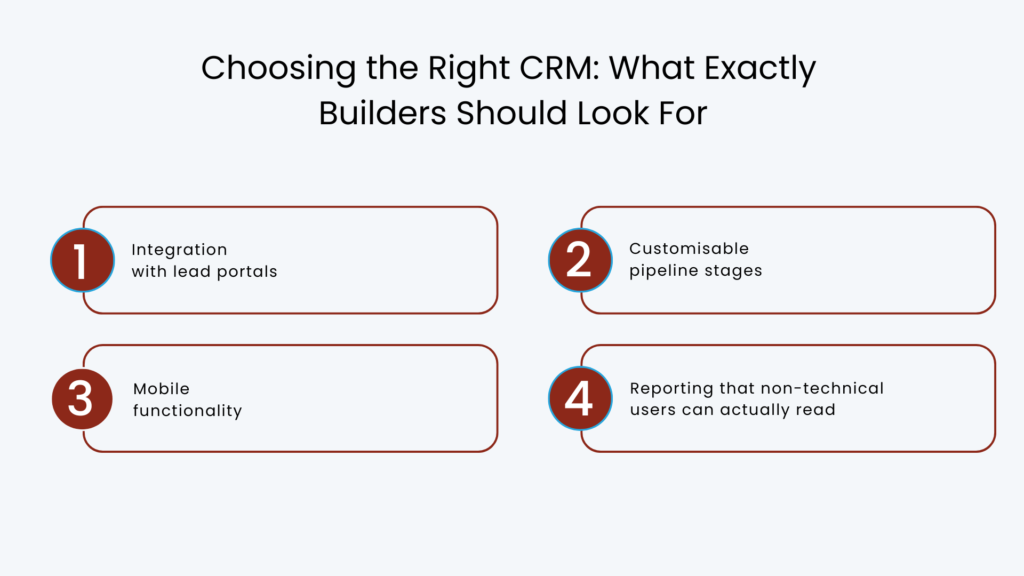
Not every CRM on the market is suited for real estate, and not every real estate CRM is built for the Pune context. Before committing to a platform, builders and agency heads should evaluate a few non-negotiable criteria.
Integration with lead portals
If the CRM does not pull leads automatically from 99acres, Housing.com, MagicBricks, and your own website, your team is doing double data entry from day one. That is a problem that compounds quickly.
Customisable pipeline stages
Pre-construction projects, ready-to-move inventory, and plotted developments all have different sales processes. The CRM should reflect that, not force your business into a one-size-fits-all flow.
Mobile functionality
Site visits happen in the field. Managers travel. A CRM that only works well on a desktop is a CRM that half your team uses inconsistently. An exceptionally well-functioning mobile-friendly CRM must be preferred.
Reporting that non-technical users can actually read
If your sales head needs an IT person to pull a conversion report, the system is not working for you. Dashboards should be clear, accessible, and actionable.
Conclusion
Pune’s real estate market rewards speed, consistency, and smart decision-making. A CRM for real estate business in Pune is not a luxury addition to an already-functioning operation, instead, it is the infrastructure that makes consistent performance possible.
The builders and agencies pulling ahead in this market are not doing so because they have larger teams or bigger marketing budgets. They are doing so because their processes are tighter, their follow-ups are more reliable, and their decisions are grounded in real data.
If your business is still managing leads through spreadsheets and hoping the right rep remembers to follow up, the gap between you and your competition is growing. The good news is it is entirely fixable.
Ready to see what the right CRM can do for your projects? Explore Builderopedia’s CRM solutions built specifically for real estate businesses in Pune and beyond.
FAQs
1. What is a CRM for a real estate business in Pune?
It is a software platform designed to manage the full lifecycle of a property sale, from the first inquiry to final booking and beyond. Unlike generic CRM tools, a real estate-specific platform accounts for long sales cycles, multiple decision-makers, inventory management, and the kind of lead volumes that Pune’s market generates.
2. Can a CRM help with lead management from multiple portals?
Yes, and this is one of the clearest wins. A properly integrated CRM pulls leads from 99acres, MagicBricks, Housing.com, and your own website into one place, assigns them automatically, and ensures follow-ups happen on schedule regardless of source.
3. Is a CRM useful for smaller real estate agencies in Pune?
Absolutely. Smaller agencies often benefit more from a CRM because they have fewer people to manage follow-ups manually. A good CRM effectively multiplies the capacity of a lean team by automating the routine work and ensuring nothing is missed.
4. How long does it take to implement a real estate CRM?
Most platforms can be set up and operational within a few days to a couple of weeks, depending on the complexity of your lead sources and integrations. The key is choosing a platform with strong onboarding support so the team actually adopts it rather than reverting to old habits.
For more insights, updates, and expert tips, follow us on LinkedIn.