

The India GCC Ecosystem is poised to transform into something greater. As per the estimates of the industry mentioned in Economic Times Realty, the Indian GCC market is anticipated to touch $105 billion by the year 2030, owing to multinationals building their technology, operations, finance, engineering, and innovation centers in all major cities.
The GCC boom is more than just about the increased demand for office space. Expansions within the GCC region are now affecting the urban infrastructure, leading to the acceleration of the building industry, creation of demand centers for the residential sector, and changes in the way developers, contractors, and property companies conduct their businesses.
The opportunities are enormous, however, along with that comes an array of challenges. The challenge of managing increased project portfolio size, large numbers of leads, dynamic client expectations, and shorter sales cycles requires a lot more. As the growth continues, reliance on Excel sheets and other such practices can hardly suffice anymore.
This is the reason that digital transformation of the real estate industry is becoming more of a business imperative than an option.
India’s GCC Boom and Its Impact on Real Estate
Why GCCs Are Expanding Rapidly
India has emerged as a highly attractive location for Global Capability Centers owing to its highly competent workforce, high-end technological environment, and innovative business infrastructure.
The cities like Bengaluru, Hyderabad, Pune, Chennai, Gurgaon, and Noida have continuously attracted investments from international companies. The increase in investment for setting up GCC facilities has increased the demand not just for commercial spaces but also residential and hospitality projects.
Thus, there arises a diversified growth opportunity for the real estate sector.
Implications for Commercial Property
One of the main gains from GCC growth is commercial property.
The requirements of new tenants include:
- Grade A offices
- Smart buildings
- Sustainable infrastructure
- Flexible workspaces
- Facilities supported by technology
As more leases are signed, the challenge for developers is to increase their speed without compromising quality.
Emerging Real Estate Opportunities
The GCC growth wave is also influencing:
- Mixed-use developments
- Residential housing demand
- Rental housing ecosystems
- Transit-oriented projects
- Smart city initiatives
Developers that can identify emerging demand corridors and execute efficiently will gain a substantial competitive advantage.
But effective execution on a large scale demands operational efficiency.
The Untold Operational Challenges behind Rapid Expansion
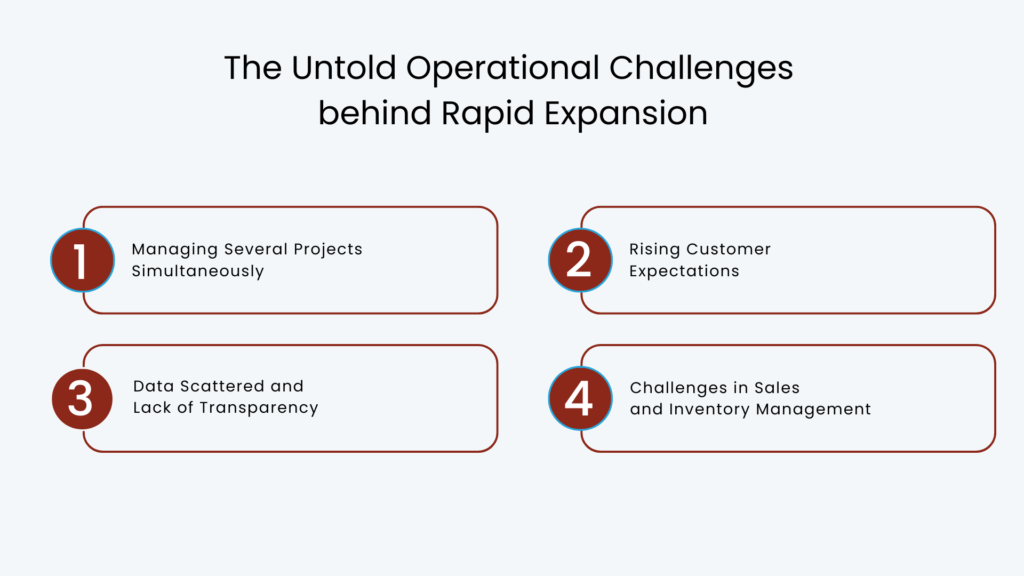
Managing Several Projects Simultaneously
Rapid growth typically implies the management of several projects simultaneously from various locations.
This process involves:
- Leads
- Inventory
- Sales actions
- Customer interaction
- Vendors
- Without proper visibility, coordination remains challenging.
Rising Customer Expectations
These are the days where the customers expect high standards, and that includes fast response time, transparency in communication, customized experiences, and constant interaction throughout their journey.
Late follow-ups and inconsistent communication could result in leakage of income and loss of interest on the part of the customers.
Data Scattered and Lack of Transparency
Whereas most real estate organizations work based on Excel spreadsheets, emails, chats, and other disjointed software tools,
When the number of transactions rises, data gets scattered across different departments.
This may cause:
- Duplicates
- Wrong follow-ups
- False reporting
- Incorrect forecasting
- Revenue leakage
- Disjointed data may affect decision-making.
Challenges in Sales and Inventory Management
Due to an increase in inventory and lead numbers, manual management of units availability, pricing, booking, and customers’ preferences is highly risky.
Any inefficiencies in the process could affect both the profit margin and the customer’s satisfaction.
Why Digital Transformation Is No Longer Optional
Centralized Data Management
Real estate organizations need a single source of truth.
The centralized real estate platform ensures that information silos are not created by integrating customer information, inventory information, project information, and the sales process under a single umbrella.
This promotes collaboration among various departments as well as cuts down operational hassles.
Automation in Sales and Operations
Automation helps businesses automate mundane processes like:
- Assigning leads
- Reminding of follow-ups
- Email communication
- Scheduling visits
- Onboarding customers
This frees up time for more business-generating activities.
Real Time Analytics and Decisions Making
Dynamic environments call for quick decisions. Analyzing real estate helps understand:
- Lead conversion rates
- Sales pipeline performance
- Inventory movement
- Marketing effectiveness
- Revenue forecasts
Leaders can identify risks early and respond proactively.
Customer Experience Improvement
Customer experience now represents a point of differentiation for companies.
The firms that provide personalized interaction, proper communication, and transparency are those that will earn customers’ trust and ensure conversions.
Digital transformation allows for creating a well-connected experience throughout the entire customer journey.
How Modern Real Estate Tools Facilitate Scalable Expansion
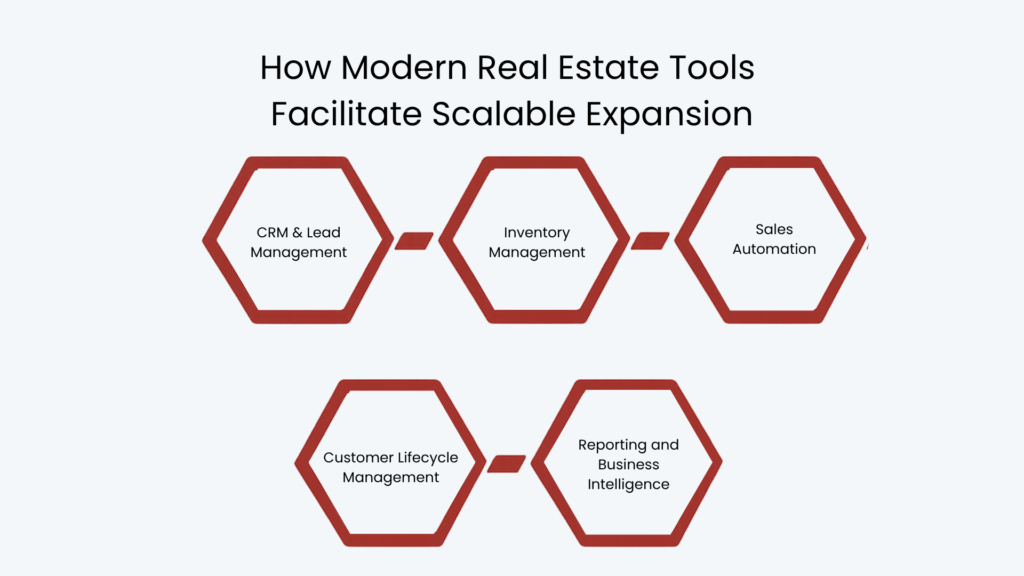
CRM & Lead Management
The modern real estate CRM platform is effective in capturing, nurturing, tracking, and converting leads.
Everything is quantifiable and trackable. The sales team gets clear information about:
- Lead sources
- Follow-ups
- Conversion potential
- Engagement with the customer
- This makes the lead management process more efficient.
Inventory Management
Inventory management is essential when working with multiple projects and many units.
With technological inventory management, it is easier for developers to:
- Keep track of availability
- Manage price changes
- Prevent booking clashes
- Enhance sales processes.
Sales Automation
The automation of real estate sales increases consistency in the sales process.
Some benefits include:
- Timely responses
- Consistent follow-ups
- Error reduction
- Higher conversion rate
This is especially true when handling high-volume inquiries resulting from growth in markets.
Customer Lifecycle Management
Successful real estate enterprises pay attention to the entire customer cycle.
Customer lifecycle management makes it possible for organizations to monitor customer interactions from:
- Inquiry
- Site visits
- Booking
- Documentation
- Possession
- Post-sales interactions
Reporting and Business Intelligence
Business intelligence tools convert operational data into actionable insights.
Leaders can evaluate performance, identify bottlenecks, and make data-driven decisions with greater confidence.
How BuilderOpedia Helps Realtors Prepare for the GCC-Led Growth Wave
Approach of Unified Platform
With growth, companies require a comprehensive technological environment that supports their operations, not just single applications.
BuilderOpedia offers a single platform for CRM, inventory management, sales automation, customer management, and reporting.
This allows the company to have a common operational system.
More Operational Visibility
Operational visibility becomes even more critical when you have to manage many projects and many people.
BuilderOpedia will help to gain better operational visibility that will allow fast decision-making and increase accountability.
Increased Team Efficiency
Through automation and standardization of business processes, efficiency is increased.
The sales team does not have to deal with administration but concentrate on making relationships.
Operational teams will experience better consistency due to automation.
Enablement of Scalability
But the greatest thing about BuilderOpedia is its ability to scale easily.
As GCC demands continue to escalate and project activity grows, companies need scalable systems.
The software offers a scalable platform that allows organizations to grow smoothly.
Areas Where Real Estate Professionals Need to Focus on
The coming decade will see growth favoring organizations with a strong commitment to operational excellence.
The areas where real estate professionals need to focus on include:
- Data consolidation
- Process automation
- Optimizing customer experience
- Data analytics
- Scalable IT infrastructure
All these aspects will grow in importance with rising market complexity.
Role of Technology in Competitiveness
The role of technology has moved from being a mere operation tool into a differentiator between players in the real estate market.
The developers who use PropTech tools, real estate ERP solutions, builder CRM tools, and automation will be well prepared to handle any changes in market dynamics.
Efficient scalability may be key to success in the next phase of Indian real estate transformation.
Conclusion
The current Indian GCC boom is about more than simply a business real estate opportunity. It is an indicator of the way forward in terms of how real estate needs to conduct its business going forward.
With the rising number of projects and changing customer needs, any company that still uses conventional means of spreadsheets and fragmented systems will find itself unable to cope.
The future lies with companies that adopt the digital transformation of real estate by implementing CRM, ERP, automation tools, analytics and customer lifecycle management technologies.
For developers, builders, and real estate businesses that plan on expanding with the help of the GCC boom, it is not a matter of whether you will implement technology. It is whether your current systems will be able to handle what you have coming your way.
BuilderOpedia is the way forward into the future of your real estate business.
Ready to prepare your organization for the next wave of real estate growth? Explore how BuilderOpedia can help unify your operations, automate workflows, and build a scalable foundation for the future.
FAQs
1. What are the factors behind GCC-led growth in the Indian real estate industry?
The growth in the GCC ecosystem in India has increased the need for office spaces, residential properties, infrastructure development, and technology-driven real estate.
2. Why is digital transformation necessary for real estate firms?
Through digital transformation, there will be higher efficiency, better customer experience, improved decision-making abilities, and scale through automation and centralization.
3. How does a CRM system help in developing a business within the real estate sector?
With CRM in the real estate field, it becomes easy to track leads, carry out automated follow-ups, have high conversion rates, and analyze the sales funnel.
4. What is the importance of ERP within real estate businesses?
ERP systems help in managing real estate projects effectively, inventory, finance, procurement, and operations.
5. Why are spreadsheets less significant among growing real estate businesses?
Spreadsheets cause data silos, manual efforts, lack of visibility, and complexity in management for growing real estate businesses.
6. How does sales automation improve real estate performance?
With sales automation, it becomes easy to automate repetitive actions, decrease response times, make follow-up consistent, and increase conversions.
7. How can BuilderOpedia assist in preparing your organization for GCC-led expansion?
BuilderOpedia aids in managing your CRM, inventory management, sales automation, reporting, and customer lifecycles efficiently.
For more insights, updates, and expert tips, follow us on LinkedIn.