

Every real estate business loses money quietly. Not through bad investments or failed projects, but through the small, everyday gaps that no one talks about. A lead that never got a follow-up. A site visit that was never scheduled. A hot prospect who went cold because the sales rep had no visibility into their last interaction.
This is called ROI leakage, and it is one of the biggest hidden threats to real estate profitability.
ROI leakage in real estate refers to revenue that slips through operational cracks. It typically shows up as:
- Leads that were never followed up on
- Deals that stalled with no next action assigned
- Sales data that exists in three different spreadsheets
- Reporting that does not reflect what is actually happening in the pipeline
The impact compounds over time, and most businesses only realize the scale of the problem when they start measuring it.
A well-implemented CRM for real estate business directly addresses these gaps. It brings structure to lead management, automates repetitive tasks, and gives sales teams the visibility they need to close deals faster. This article breaks down exactly how.
Understanding The Common Sources of ROI Leakage in Real Estate
Missed Follow-Ups
The B2B and real estate literature repeatedly demonstrates that most transactions take several interactions to close. However, the process of following up in a significant number of real estate firms remains completely reliant on personal discipline. As long as a salesperson is busy, overwhelmed, or forgetful, a prospective customer gets lost. A CRM system for real estate businesses helps avoid this situation through automated follow-ups based on specific behaviors of clients.
Poor Lead Tracking
With leads coming through several sources, including property websites, social networks, visitors to your office, and referrals, manual management of leads becomes too complicated. Without effective lead tracking, real estate salespeople risk wasting their effort by sending duplicate emails, directing prospects to wrong channels, and, most importantly, forgetting about the progress made.
Disconnected Sales Process
Many real estate firms work separately. Thus, an information chain becomes broken:
- Marketing creates leads but has no insight into what happens next
- Sales makes deals but does not have any information about marketing campaigns
- Management needs pipeline reports but receives out-of-date Excel spreadsheets
- Finance controls payments but knows nothing about where these deals currently are
These disconnections directly reduce conversion rates and slow down the entire sales cycle.
Misreporting
Good decision making in the real estate industry needs correct information. If reporting is manual and uncoordinated, decision makers will have incorrect forecasts, budget allocation problems, and fail to recognize potential risks. Misreporting is an issue that is both informational and financial in nature.
Why Is a CRM For Real Estate Business Essential?
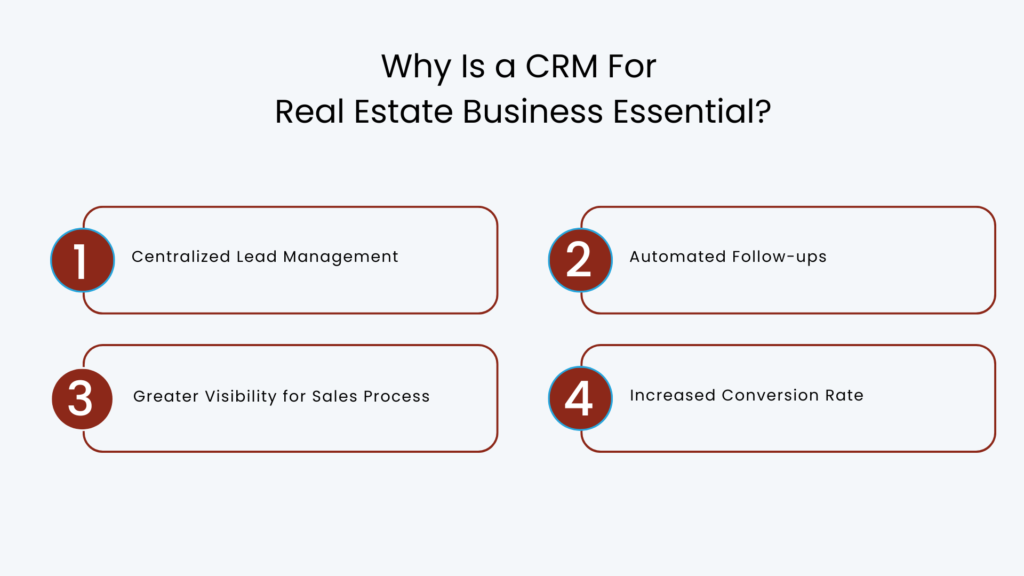
Centralized Lead Management
CRM software for the real estate industry becomes the central database for all leads. No matter how the lead reaches you via a property website, property portal, or by phone it is recorded in one database. Agents gain access to:
- History and communication with leads
- Budget range and property preferences
- Current place in the sales funnel
- Tasks related to the lead
Automated Follow-ups
Here automation can deliver quick wins through a CRM. Automated follow-ups and reminders occur behind the scenes without any need for the sales team to perform actions. For example, a lead that visited a property on Monday will receive their follow-up message within just two days.
Greater Visibility for Sales Process
Sales managers have instant visibility in the sales pipeline. They are aware of the number of leads in different stages, the deals that are stuck, and the agents who require assistance.
Increased Conversion Rate
Structured teams close deals more effectively. When all interactions are recorded, follow-ups are made timely, and decisions are made on the basis of data, conversion rates increase. Real estate companies that have adopted structured CRM workflow processes have reported shortened sales cycles and better closure of deals.
How Real Estate Agent CRM Software in Thailand Is Transforming Property Sales?
Challenges in the Local Market
Thailand’s property market comes with a whole set of difficulties that cannot usually be resolved using off-the-shelf software:
- Buyer personas include both local residents, expatriates, and foreign buyers
- Differences in language and communication style vary between different nations
- Website portals generate many leads from other countries demanding prompt responses
- Many projects are managed by developers simultaneously in various cities
A real estate agent CRM solution that is used in Thailand must accommodate multi-language capabilities and multi-channel lead generation, among others. Otherwise, agents risk losing potential clients due to quicker responses from competitors.
Advantages of Implementing CRM Software
There are a few advantages that have been pointed out by the real estate agents working in Southeast Asia when using CRM solutions developed specifically for them:
- Faster response time for leads
- Improved cooperation with channel partners
- Enhanced visibility into inventory
Real estate agent CRM software that operates in Thailand allows agents to streamline the sales process for several projects at once
Key Features Realtors Should Look for in a CR
Lead Capture Automation
The CRM should automatically pull leads from all active channels, including property portals, websites, social media campaigns, and walk-ins. Manual data entry is a bottleneck that reduces speed and accuracy.
A strong lead capture setup should handle:
- Automatic deduplication to prevent the same lead being assigned to two agents
- Source tagging so teams know which channel is generating quality leads
- Instant acknowledgment messages to improve first-impression response time
Management of Site Visits
Booking of site visits is crucial in the sale of properties. The CRM must have capabilities for scheduling and managing these visits, including confirming the same through messages, and noting down results after the visit. This function is supported by the Smart Site Visit Management by BuilderOpedia.
Tracking of Sales Pipelines
A well-designed pipeline stage will give insights into the deals’ progress. This can only be achieved if the CRM allows the creation of customized pipelines according to the type of property and the buyer journey, and with dashboards that make it easy to detect bottlenecks.
Mobile Capability
Real estate involves a lot of movement from agents in the field. There must be provision for accessing data on leads, updating visit information, and responding to queries wherever they are done.
Reporting and Analytics
Robust analytics help businesses measure what is working. Lead source performance, conversion rate by agent, sales velocity, and revenue forecasts are all critical metrics that a good real estate CRM should surface automatically.
How BuilderOpedia Helps Reduce ROI Leakage?
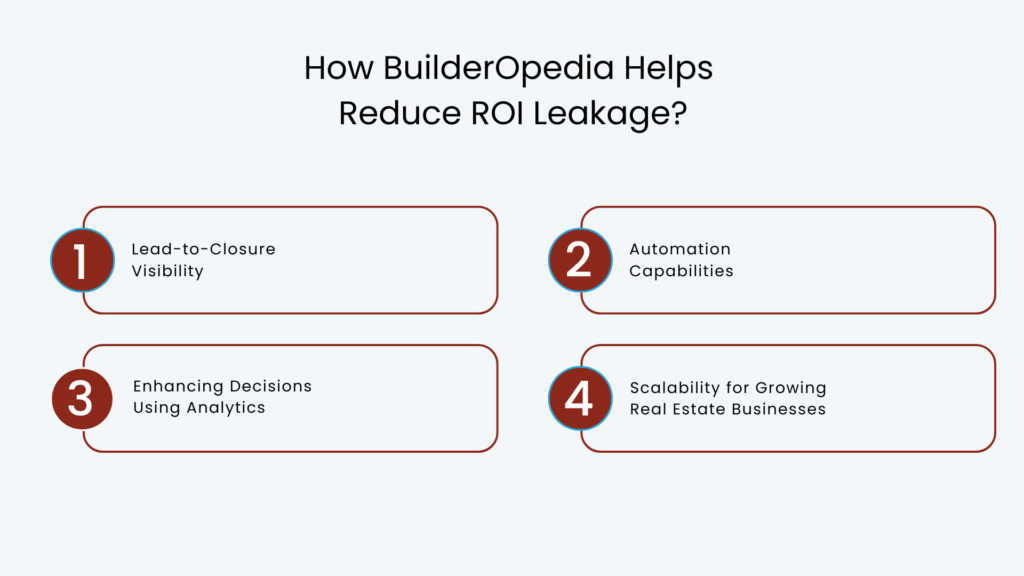
Lead-to-Closure Visibility
BuilderOpedia gives real estate businesses a complete view of every lead, from the first inquiry to final booking. Every interaction is logged, every stage is tracked, and every team member can see the same up-to-date picture. This eliminates the information gaps that cause leads to stall or disappear.
Automation Capabilities
From automated follow-up sequences to instant cost sheet generation and QR-code-based site visit booking, BuilderOpedia reduces manual work at every step of the sales process. Specific automation capabilities include:
- Triggered follow-up messages based on lead stage and inactivity
- Instant one-click cost sheet generation for interested buyers
- QR code-based site visit booking that removes scheduling friction
- Automated workflow routing to assign leads to the right agent
Agents spend less time on administrative tasks and more time building relationships with buyers.
Enhancing Decisions Using Analytics
Reporting tools on BuilderOpedia provide the management with real-time insight on sales, inventory, and productivity issues. Management will be able to know what projects require more focus, whether there are any agents that are meeting their quotas, and what is causing the sales funnel to block.
Scalability for Growing Real Estate Businesses
One of the most common challenges in real estate growth is that operational complexity scales faster than the team can handle. BuilderOpedia is built to grow with your business. Whether you are managing one project or twenty, the platform handles increased lead volume, additional users, and new integrations without requiring a system overhaul.
Conclusion
There is no need to accept ROI leakage as an inescapable phenomenon. It is a solvable problem, but in order to fix it, you should have the appropriate software solutions.
The CRM system implemented properly into real estate business solves all the major causes of income leakage: poor follow-up processes, inefficient lead management, unconnected sales processes, and faulty reporting. In a competitive market environment, these aspects are essential for the successful growth of a real estate business.
BuilderOpedia combines all these functions into one powerful software for real estate, which is used by reputable companies such as Max Estates, BPTP, EMAAR, and Adani Realty.
FAQs
1. Define ROI leakage in real estate and how CRM can help you to reduce this issue?
ROI leakage is the failure of achieving potential profit from internal problems like ignoring follow-ups, improper lead management, and mismanaged sales personnel. CRM in real estate can be used to address ROI leakage issues due to centralized information management, automation of communications, and pipeline visibility to the sales manager.
2. What are some critical roles of the CRM system for your real estate business?
Some of the most critical roles include automated lead management, site visit management, sales pipeline management, mobility, and reporting dashboards.
3. Does the CRM solution for real estate agents differ from those available in Thailand and elsewhere worldwide?
Maybe not in functionality, but surely in features like multi-language support, various demographic buyers, and compatibility with local property listing websites. CRM solutions are better suited for this purpose than general CRM systems.
4. Why does a real estate business need Salesforce ongoing support services?
CRM systems are updated regularly and require adjustments in terms of performance and configuration. The Salesforce ongoing support services offer all technical assistance to keep a CRM operational without having an internal IT department.
5. In what situations does a real estate company use an offshore Salesforce developer?
It is optimal to employ offshore Salesforce developers when there are regular development tasks that do not require a full-fledged dedicated development team.
6. How soon can one expect to get results after implementing a real estate CRM?
Usually, it takes up to 30–60 days to notice positive changes in terms of responding to leads and follow-up frequency. Sales cycles and lead conversion rates change during the first or second quarter.
7. What makes BuilderOpedia different from other CRMs?
BuilderOpedia is a customized CRM system that meets the requirements of real estate companies. This CRM includes all the basic components such as lead management, inventory management, automation, scheduling, and financial management.
For more insights, updates, and expert tips, follow us on LinkedIn.