
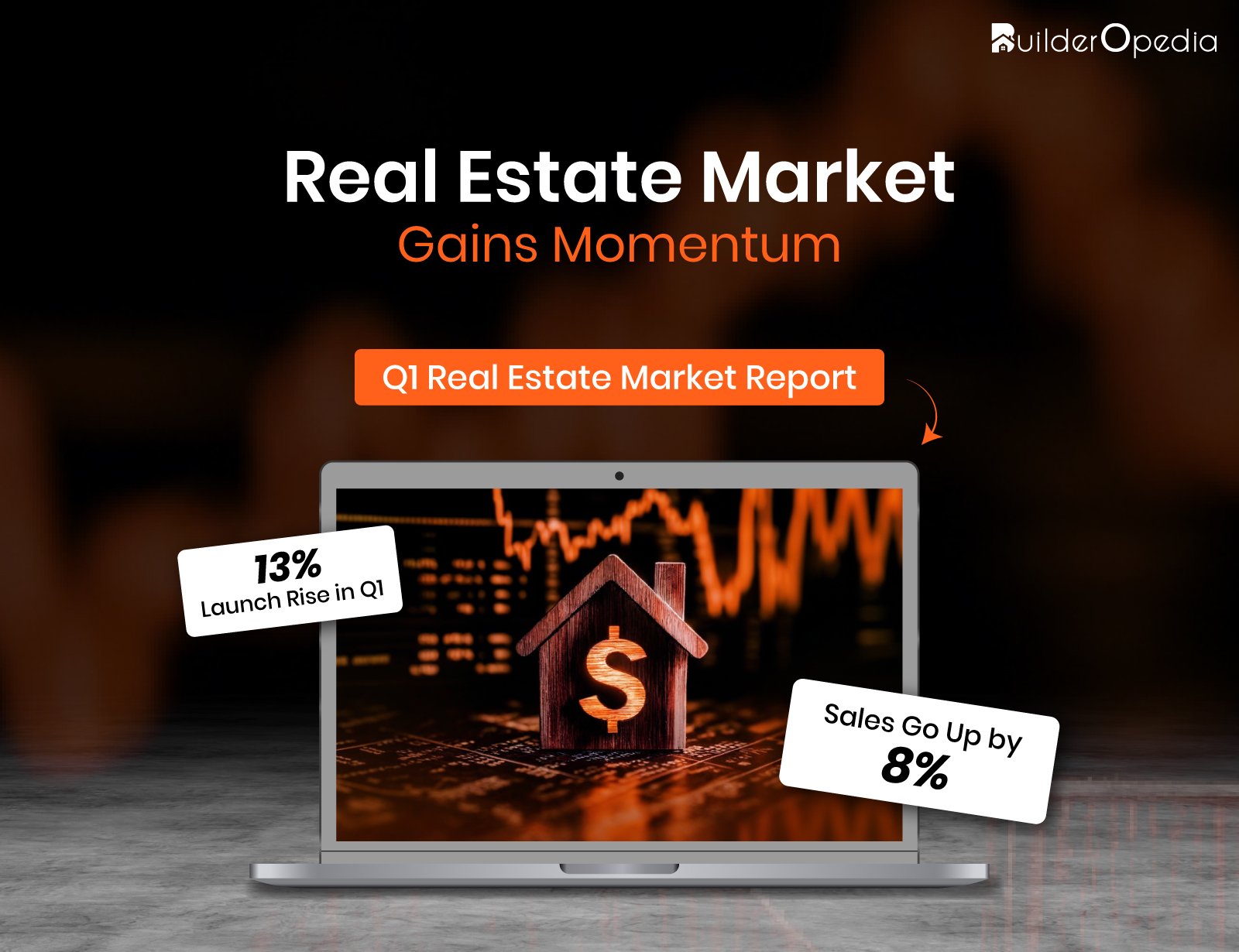
Although the year 2026 has just begun, the real estate market has set foot on a positive note. The first quarter of the year as per the latest Q1 Real Estate Market Report has presented a notable rise in the supply and demand of housing facilities – signalling steady growth and resilience despite working in an imbalanced economic setting.
Even as the number of new launches keeps increasing by about 13% year-on-year, the number of sales has shot up to almost 8% for the quarter. These numbers indicate that there is a huge change in the real estate market scenario because the market is growing as well as developing.
Moreover, this growth trend shows a balanced real estate ecosystem where the real estate developers are confident enough to increase supply, and the buyers showing sustained interest while being careful with their housing decisions.
Get a glimpse of the complete Q1 Real Estate Market Report in this post below. Check the emerging AI trends, how the market has shifted, and what lies in the future for real estate.
2026 Q1 Market Performance in Real Estate
For the first quarter of the year, which comprised the months of January through March, a total of 70,631 units were sold nationwide, registering an 8 percent increase from the previous year.
The total number of new launches reached 90,023 units in the first quarter, marking an increase of 13 percent from the same period last year and an even more impressive gain of 32 percent from the previous quarter.
| Metric | Value | Change |
|---|---|---|
| Total Sales | 70,631 units | +8% YoY |
| New Launches | 90,023 units | +13% YoY |
| Launch Growth (QoQ) | — | +32% |
| Supply vs Demand Gap | — | Supply growing faster than sales |
Several reasons have contributed to this supply surge, which include:
- Improved economic outlook → The stabilising inflation and steady interest rates have urged the developers to expand their pipeline.
- Strong absorption rates → Consistent demand in recent quarters has reduced the stock of unsold inventories.
- Strategic project launches → developers are focusing on high-demand segments, especially mid-income and premium housing.
Sales Growth Reflects Measured Buyer Sentiment
Despite an impressive 8% increase in sales, the rate at which this is happening is considered very low.
This is simply an illustration that while consumers are active, they are also exercising caution when making their investments in real estate. The change in consumer behavior can thus be characterized on the basis of the following:
- Consumers look for value in terms of location, quality, and returns.
- The consumers who take no risks are exercising caution when selecting projects with measurable performance.
- The uncertain state of the economy has resulted in financial prudence and planning.
| Segment | Share (Q1 2026) | Share (Q1 2025) | YoY Change |
|---|---|---|---|
| Premium (₹1 Cr+) | 71% | 59% | ↑ Significant |
| Affordable (< ₹1 Cr) | 29% | 41% | ↓ Significant |
Premium Housing Dominated the Industry
The most significant trends of the first quarter in 2026 has been the dramatic shift towards premium houses. Properties placed above 1 crore, accounted for higher market shares and contributed heavily to the total sales share. This indicates that buyers are now wanting to invest in higher-value homes.
The shift is being brought keeping in mind various factors like:
- Rising income of the urban buyers
- Increased demand for larger homes during pandemic
- Growing interest with aesthetic and lifestyle based houses
| Price Bracket | Growth |
|---|---|
| ₹1 Cr+ (overall premium) | +30% YoY |
| ₹1.5 Cr – ₹3 Cr | +67% YoY |
City-Wise Sales Performance
For 2026, the growth in launches and sales has not been uniform across states and cities. Different regions have contributed to the overall momentum in unique ways.
- Metro Cities → Still dominate with both demand and supply due to better infrastructure and employment opportunities.
- Emerging Markets → Tier II cities witness gradual growth owing to growing affordability and improved connectivity.
- Regional Variations → Some cities outperform others, driven by local economic factors and housing demand patterns.
| City | YoY Growth | Notes |
|---|---|---|
| Chennai | +61% | Highest growth |
| Delhi NCR | +30% | Strong infra + pent-up demand |
| Bengaluru | +18% | Stable growth |
| Pune | -14% | Linked to lower launches |
| Top 4 Cities Combined | ~77% of total sales | Each > 10,000 units |
Role of Demand-Supply Balance
A key highlight of the Q1 performance has been the balanced growth between demand and supply. Unlike previous years where supply was higher than demand, the current situations suggest otherwise.
- Developers are launching projects based on market signals
- Buyers are buying on a steady pace
- Price growth remains stable without sharp spikes
| Metric | Value |
|---|---|
| Sales from new launches (same quarter) | 26% |
| Launch Growth vs Sales Growth | 13% vs 8% |
Factors Contributing to the Market Momentum
Several micro as well as macro factors are contributing to the rise of housing in the real estate industry. Some of the most crucial factors are:
Economic Stability
The relative stability of the economy has helped improve buyer sentiment and encourage investments in real estate.
Urbanization Trend
Urbanization has kept driving up housing needs, particularly in metropolitan and suburban regions.
Shift in Lifestyle Preference
Lifestyle preferences have changed after the pandemic, leading to increased demand for larger homes, work-from-home facilities, and community-based housing.
Flexibility of Developers
Developers are becoming more flexible in using data-centric techniques to match market needs.
Challenges with Real Estate that Still Persist
Despite the positive start of real estate in the current year, few challenges still cannot go unnoticed. These include:
- Affordability concerns where the rising property prices restrict first-time buyers
- Economic uncertainties where the global events impact buyer sentiment
- Selective demand where buyers are more cautious, slowing down absorption in certain segments
Role of Technology & Innovation in 2026 Real Estate Market
Technology has always played a crucial role in the real estate industry in terms of data centralisation and messaging. However, this trend will continue to rise in 2026. As of now, virtual site visits and digital documentation and transactions have taken over.
Developers are also now leveraging this fast paced technology for:
- Identifying demand trends with the help of AI
- Optimising pricing strategies
- Improving customer engagement and retention
Looking Forward to Future Quarters
This encouraging development in Q1 lays a favorable foundation for the upcoming quarters in the year 2026. The continuation of this trend is expected to bring the following developments in the residential market:
- Continued growth in launches and sales
- An emphasis on creating premium and mid-segment properties
- A greater use of technology in the sales and marketing process
It should be noted that the rate of growth will vary depending on several external conditions, including interest rates, inflation, and economic state.
Implications for Consumers and Investors
There are various implications for consumers and buyers in the current market, while for investors, the expansion of the market is an indication of stability and profitability in the future.
- Choice: The greater number of projects means more choices for consumers
- Value: The developers are working hard to make sure that their projects provide value
- Necessity of thorough consideration: Consumers need to consider all projects thoroughly
Conclusion
The real estate industry has shown a positive impact in the first quarter of 2026, leading to a 13% rise in launches and 8% higher sales. While this was a crucial headstart, the market must continuously innovate to stay competitive.
However, it is to be appreciated that despite various issues like buyer affordability, economic setbacks, and selective demand – the industry has managed to create a good demand for the housing sector while keeping in mind all the buyers’ interest.
In the coming future and in the next quarters, the housing sector will experience more AI-driven automations, and developers continuously aim to match the buyer demands in the least amount of time. In totality, the future shines bright for real estate and is expected to align with the gaining momentum.
For more insights, updates, and expert tips, follow us on LinkedIn.