

In the world of real estate, success is not measured by just one parameter but many including closures, listings, enquiries, site visit, and negotiations. While they hold value, they only matter when they lead to final deal closures.
Despite this, many real estate agencies struggle to bridge the gap between generating leads and closing transactions. This is not because of the team inefficiency but due to the lack of a CRM for Real Estate Sales & Rentals.
The leads and enquiries often get lost in long email threads, social media chats, and mismanaged call logs in a spreadsheet. This lack of automation and a cloud-based real estate CRM leads to opportunities slipping away and also slows down the business processes and workflows significantly.
This is where the most important question arises – “Is a CRM The Missing Link Between Real Estate Sales and Closures?” The only answer to this question is YES. For all modern and new real estate businesses a CRM is not only an increasing necessity but also a strategic decision to grow, scale, and ensure seamless working operations.
Why do Gaps Exist in Lead Generation & Closures in a Real Estate Business?
Real estate is not a usual instant buying industry. The buyers here aim to establish long term relationships with the clients and compare opinions, prices, and locations before deciding to buy a property unit. They often re-visit the same properties multiple times to ensure that it is the best choice and worth investing.
This extensive style now leads to complexities and agents must be on their best by keeping track of each and every query, interaction, and past records. His helps them to analyse the prospect in detail and they accordingly take the conversation further.
However, the lack of a CRM for real estate sales & rentals often makes the agent lag behind in keeping proper track of customer interactions. This further leads to repeat conversations with the customers, poor tracking of site visits, lack of visibility in consumer conversations, and delayed responses.
- Missed Follow-Ups – When the data is maintained manually through spreadsheets and each part of the user conversation is added separately in the system it is only human that agents lack proper clarity and often miss on the follow-ups with a hot client.
- Lack of Visibility Into Conversations – When the data is being managed outside of a CRM and agents record their specific leads into separate spreadsheets, the management and teams lack clarity into the lead status and the scattered data often creates chaos.
- Poor Site Visit Tracking and Property Preferences – Real estate agents are unable to keep track of ongoing or upcoming site visits due to manual maintenance of data and this can lead to a lost client or a potential conversion costing the business a high revenue. Moreover, with man handled data it becomes difficult to run the analysis of user preferences and agents end up sending mismatched property preferences.
- Delayed Responses – Without a CRM for Real Estate agents are often just spending their time in maintaining the customer data and spreadsheets leaving them no time for lead generation or nurture leads that can convert. They often send delayed responses or cold responses which are not in favour of a business, especially in an industry like real estate.
How Does a CRM for Real Estate Sales & Rentals Bridge the Gap Between Sales and Closure?
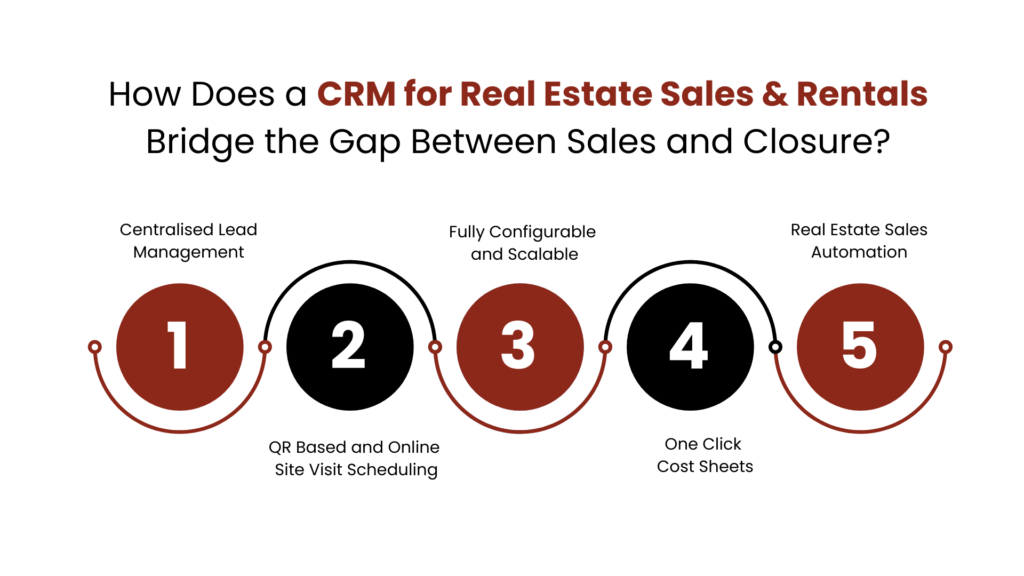
In today’s fast paced environment, a CRM for realtors and brokers is not a necessity or just a strategic move. It acts as a solid and powerful bridge that closes the gap between your property sales and closures within days or few weeks. It is typically the missing link between the two.
But the question here is why and how? To answer the why, the reason is simple. It automates 70-80% of the customer journey and smooths the entire process and workflow. To answer the how, again, the reason remains pretty simple. It simplifies lead generation, enables the businesses to keep track of even the minutest customer query and interactions, and provides end-to-end support.
Centralised Lead Management
With the incorporation of a real estate CRM in the daily business workflows, the processes run smoothly and without any interruptions. Here, every incoming query is automatically converted to a lead and is auto assigned to the right and available agent based on the past interactions and skill sets.
Each agent is instantly notified and they can respond to the query without any delay. Further, each of these events is carefully recorded in the CRM for real estate so that it is visible across teams including the management and leadership.
QR Based and Online Site Visit Scheduling
In a real estate business a physical site visit remains the most critical aspect of the buying journey. This helps the consumers learn more about the potential buying unit and they are able to make a better judgement about the buying decision.
With a CRM for brokers the site visit scheduling and management becomes super easy. The agent can either ask the user for a suitable time and send the notification via message, or the prospect can schedule the site visit directly using the QR code.
This way the agent will simply be notified about the visit details and they can reach there directly. This is beneficial to reduce no shows. Further, the management and internal teams will be able to track each part of the site visit, making it easier to analyse if the user will actually buy the unit or not.
Fully Configurable and Scalable
Not every business is the same and when it comes to the real estate market each team functions differently. But in a business like real estate where everything is dynamic and changing so quickly a CRM that is fully configurable is much needed.
As the business scales it is important that your CRM also scales and is able to adapt to your business needs. A well integrated CRM not only helps the business scale but helps it scale faster and the business runs smoothly.
One Click Cost Sheets
Generating cost sheets requires accuracy and must be absolutely error free. Doing it manually can be a tedious task and is time consuming. With a CRM software for real estate developers this becomes easy and the cost sheets are created based on real-time data and requires zero manual effort.
These cost sheets are ready to share with the customers and ensures faster deal closing because it can be shared to the customers in an instant without any delays which also gives the estate developers an edge over the competition.
Real Estate Sales Automation
Real estate sales automation is the process of utilizing a CRM solution specifically tailored for real estate businesses to automate repetitive sales activities, ranging from lead capture and management to lead scoring and follow-ups, so that salespeople can focus on closing sales instead of being tied down to administrative tasks. Contemporary real estate CRMs offer customer data consolidation, workflow automation, AI-powered analytics, high-priority leads, and rapid response capabilities to help sales teams avoid lost opportunities and close sales faster without being tied down to administrative tasks.
Is a CRM for Real Estate Sales & Rentals Really Necessary For Small Estate Agencies?
A CRM for property sales is not just suitable and necessary for large or mid size businesses but is equally a necessity for small businesses to scale and beat the competition. A CRM in real estate for brokers and agents is typically useful for the small estate agencies in the following ways –
- It helps them compete with larger firms and if not be on the top, it helps the bring automation to the system making it easier for them to capture leads from all portals and websites with the basic feature of property portal integration where all their listed property portals are available in a single CRM.
- A CRM for real estate sales helps the small firms deliver a highly professional and quality experience to the customers enabling more conversions and possible deal closures.
- With the help of a Cloud-based real estate CRM, these small real estate firms can easily track the performance and analyse the customer behavior which can help the sales and marketing teams pitch better and they can even send more personalized property recommendations.
Conclusion
A CRM for Real Estate Sales & Rentals is no longer a luxury or option, but a basic necessity for the businesses, be it small, mid, or large business. While most real estate agencies still work manually, they are unable to capture strong leads and drive closures. In this chaos and rapidly changing business environment, it is safe to say that a CRM for real estate acts as a link between sales and closures.
It is not only automating the business workflows and simplifying the complex lead generation processes, but is also enabling businesses to use predictive analysis and insights to deliver personalized recommendations and smarter customer experiences.
FAQs
1. What is a CRM for real estate?
If you are considering becoming a real estate agent or broker, you’ll likely benefit from using a good real estate CRM, or customer relationship management software, to help you manage, attract, and retain clients, streamline transactions – and close deals on time.
2. Is a CRM necessary for small real estate businesses?
Yes. A CRM is required for small real estate agencies as it enables them to compete with larger real estate agencies, generate leads from multiple portals, automate tasks, enhance customer experience, and monitor performance metrics without adding to their complexity.
3. Can a CRM automate site visit scheduling?
Yes. The latest real estate CRMs have the ability to automate site visit scheduling through their integration with calendars, QR code-based scheduling, and instant notifications. This eliminates the problem of no-shows and ensures a seamless buying experience for potential customers.
4. How does real estate sales automation work in a CRM?
Real estate sales automation involves the use of pre-defined workflows to automatically generate leads, assign them to sales agents, send follow-up notifications, score prospects based on their responses, and monitor the progress of deals without requiring sales agents to devote time to these tasks.
5. Can a CRM help manage both property sales and rentals?
Yes. A well-integrated CRM for Real Estate Sales & Rentals can manage both sales and rental operations by tracking tenant inquiries, lease agreements, renewal reminders, and sales pipelines within a single centralized platform.
For more insights, updates, and expert tips, follow us on LinkedIn.