

Managing relationships, following up with leads, and tracking the deals can make or break a deal in the real estate business. This means slip away deals and missed opportunities and that is why a real estate CRM matters. However, a complex CRM solution for real estate demands high level maintenance and agents spend most of their time managing their CRM rather than focusing on lead nurturing. Therefore, the businesses prefer to work with a simple real estate CRM.
A simple real estate CRM gives you just enough power to manage leads and deals efficiently without any overwhelming dashboards. A real estate CRM for agents and brokers helps them stay organised with lead management, be more responsive, and be proactive with their customer engagement.
With a simple real estate CRM the agents and brokers in the real estate agency are easily able to capture leads, schedule site visits, manage online appointments, take care of documentation, and provide ongoing client support. This helps the businesses stay sorted and with the CRM for real estate dealers the teams and management have complete transparency in the management system.
What Defines a Simple Real Estate CRM?
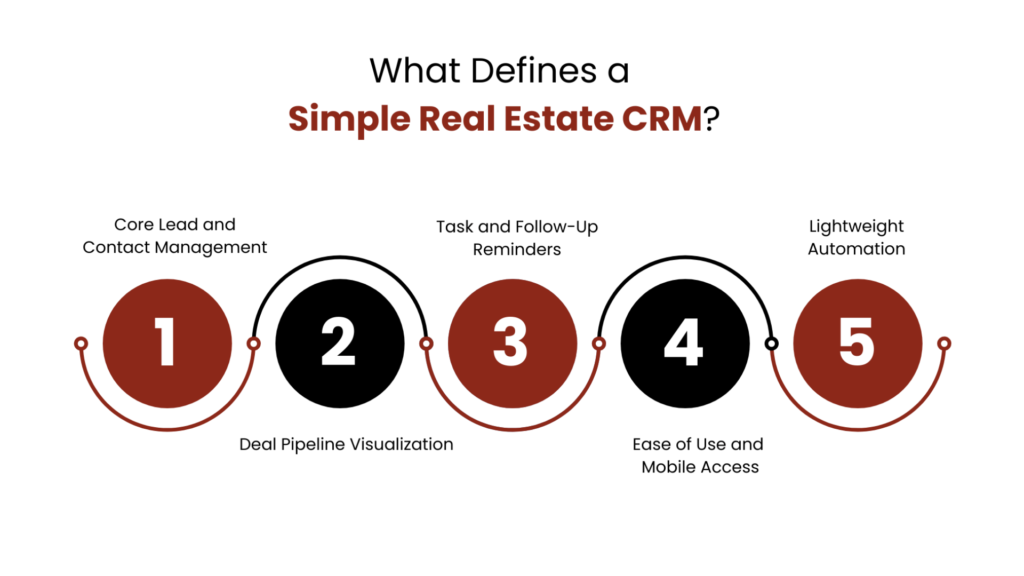
In definition, a simple real estate CRM means a software that will make the agent’s life easier with organised and managed processes rather than complex systems. The CRM software for real estate agents helps with managing leads and queries by automatically entering them into the system and assigning them to the right agent, provides AI powered guidance for smooth conversations and also allows these businesses to change or configure the system functionalities as per their specific needs.
Core Lead and Contact Management
A real estate CRM should act as a single, reliable place for all your leads and contacts. It must allow you to store client details, organize them by lead source such as websites, referrals, or open houses, and quickly find information when needed. Easy searching by name, property interest, or deal stage ensures no lead is ever lost or forgotten.
Deal Pipeline Visualization
A clear deal pipeline helps you understand exactly where each client stands in the sales process. From new inquiries to active follow-ups, negotiations, and closed deals, everything is visible at a glance. This clarity helps you prioritize actions, identify stalled deals, and focus on opportunities that are close to closing.
Task and Follow-Up Reminders
Follow-ups are critical in real estate, and a good CRM keeps you on track automatically. Built-in task reminders help you remember calls, emails, messages, and property discussions. With scheduled tasks in place, you can maintain consistent communication without relying on memory.
Ease of Use and Mobile Access
Real estate professionals work from multiple locations, so a CRM must be simple and fast to use. An intuitive interface reduces time spent learning the system, while mobile access allows you to update leads and check client details during site visits, meetings, or open houses.
Lightweight Automation
Simple automation can greatly improve efficiency without adding complexity. Automated reminders and basic follow-up sequences reduce manual work and ensure timely communication. This helps you respond faster, stay organized, and convert more leads while keeping the CRM easy to manage.
How Does Using a CRM for Real Estate Dealers Benefit the Businesses in the Long Run?
A CRM for real estate agents, brokers and dealers goes a long way when managed and implemented properly. Where most businesses think that a real estate CRM must be complex, they fail to understand that even the simplest of real estate CRM can do wonders with the right support and proper functionalities.
Improved Lead Response Time
When leads are stored in a single, well-organized system, it becomes much easier to respond quickly and accurately. Notifications and alerts ensure that new inquiries are seen immediately, reducing delays in communication. Faster responses help capture prospects’ interest while their intent is high, increasing the likelihood of meaningful conversations and successful conversions.
Better Organization and Clarity
A simple CRM replaces scattered notes, spreadsheets, and inbox messages with a clear and structured system. All client details, conversations, and deal stages are accessible from one place, making information easy to track and update. This level of organization reduces confusion, lowers stress, and allows professionals to concentrate on the most important tasks.
Consistent Client Communication
Maintaining regular communication is essential for building long-term trust with clients. CRM reminders and task tracking help ensure that follow-ups happen on time and without gaps. Consistent outreach makes interactions feel more professional and reliable, strengthening relationships and improving overall client satisfaction.
Increased Productivity
By automating routine tasks and simplifying daily workflows, a CRM helps professionals make better use of their time. Less effort is spent on manual data entry or searching for information, allowing more focus on client meetings and deal negotiations. As a result, more leads can be managed effectively without increasing workload pressure.
Scalability Without Hassle
A simple CRM is designed to adapt as a business grows, without adding unnecessary complexity. Whether lead volume increases or team members are added, the system continues to function smoothly. This flexibility allows real estate professionals to scale their operations confidently while keeping processes easy to manage and understand.
What to Look for When Choosing a Real Estate CRM Software for Adoption?

Adopting a real estate CRM is no longer optional but a necessity for the businesses. When choosing the CRM for real estate businesses are expected to look for certain attributes like usability, interface, technicalities and maintenance. If the idea is to adopt a simple real estate CRM software, the companies must choose a software that is budget friendly and does not require much maintenance.
Ease of Use and Mobile Ready Software
The major purpose of using a software for real estate is to manage leads effectively and not miss out on follow-ups or any leads. The ease of use and a mobile ready solution matters for the business efficiency, and it also helps the sales agents coordinate with their customers on the go.
All in One Property Portal Integration
Switching screens every now and then can be taxing for the agents and makes it difficult for them to keep track of leads as well. Therefore, with the real estate CRM software the agents see a unified view of all the property portals within the CRM and the lead data along with customer history is synced as well. This allows the businesses to manage the portals with ease while maintaining transparency in the system.
Real-Time Analytics and Reporting
Real-time analytics and reporting help real estate teams make informed decisions and improve deal outcomes. A CRM with clear dashboards allows users to quickly monitor deal stages, sales progress, and individual performance without digging through data. Campaign analytics and exportable reports provide deeper insights into marketing effectiveness, making it easier to measure return on investment and share meaningful performance updates with management.
Smart Automation and AI-Powered Features
Smart automation and AI-powered features help modern real estate teams move faster and work more efficiently. Automated lead capture ensures inquiries from websites or advertisements are instantly recorded and routed to the right agent, reducing response delays. AI-driven follow-ups, smart reminders, and automated scheduling support timely communication, helping agents stay engaged with prospects and improve conversion rates without manual effort.
Conclusion
It is safe to say that a simple real estate CRM is the need of the hour and a critical factor in business success. By focusing on essential features such as lead management, deal tracking, task reminders, and ease of use, real estate professionals can stay organized and responsive without unnecessary complexity.
For agents, brokers, and dealers, the right CRM supports daily workflows, improves client relationships, and helps close deals more efficiently. Simplicity ensures that the system becomes a trusted part of the business rather than an obstacle.
FAQs
1. How is a simple real estate CRM different from a complex CRM?
A simple CRM prioritizes ease of use and quick adoption, while complex CRMs often include advanced features that require extensive setup and training. Simple CRMs reduce maintenance efforts and allow real estate professionals to focus more on client engagement rather than managing the system.
2. Can a property management CRM handle growing real estate businesses?
Yes, a well-designed simple CRM can scale as the business grows. It can support increasing lead volumes, additional team members, and expanded operations without becoming difficult to manage or overwhelming for users.
3. Is a real estate CRM useful for solo agents as well as large teams?
Absolutely. Solo agents benefit from organized lead management and reminders, while teams gain visibility, transparency, and better coordination. A simple CRM adapts well to both individual users and growing teams.
4. How does automation help in a simple real estate CRM?
Automation helps by reducing manual tasks such as lead entry, follow-up reminders, and appointment scheduling. Lightweight automation improves response times and consistency while keeping the system easy to use.
5. What should businesses consider before adopting a real estate CRM?
Businesses should evaluate ease of use, mobile accessibility, integration with property portals, reporting capabilities, and overall maintenance requirements. Choosing a budget-friendly and low-maintenance CRM ensures better long-term adoption and results.
For more insights, updates, and expert tips, follow us on LinkedIn.