

India’s real estate CRM has seen tremendous growth in 2025 and the estate businesses have moved to a structural growth phase last year. The Indian real estate CRM witnessed a structural shift and the market showed resilience and depth supported by stable policies, strong user demands and steady economic growth.
One thing that stood out was the quality of demand and instead of short term speculation the real estate sector was driven by secure buyers, long term occupiers, and institutional capital. This change laid a stronger foundation for sustainable growth. Better governance, maturing capital markets and growing confidence in India’s long-term economic direction are reshaping real estate.
The Defining Shifts of 2025 – What Changes Did the Real Estate Market See?
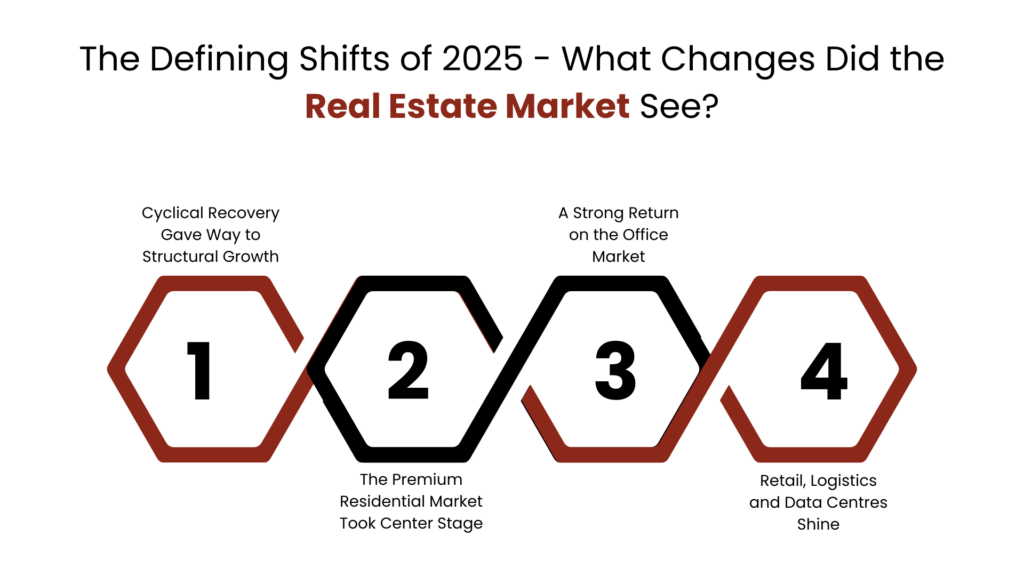
The 2025 real estate market saw a major shift in the business. The real estate business in India saw an upward trajectory and premium and luxury homes came out as the clear leaders. Homes priced above Rs. 1 crore accounted for over half of all sales in major cities, highlighting a shift in buyer aspirations and affordability. End-users, rather than investors, drove demand, which helped the market stay resilient even as prices rose.
Cyclical Recovery Gave Way to Structural Growth
Indian real estate recovered gradually for years following the pandemic, with sporadic increases in certain markets. But there was a noticeable change from cyclical behavior to deeper, structural expansion in 2025. Knight Frank India claims that strong governance, stable policy frameworks, and increased participation from financially secure buyers and institutional capital were the main causes of this shift rather than a brief period of market exuberance.
The Premium Residential Market Took Center Stage
The predominance of high-end and luxury housing in 2025 was one of the most noticeable trends. In major cities, more than half of all sales were of homes costing more than ₹1 crore. Larger living areas, sustainable features, connectivity, and branded homes were among the lifestyle factors that drove buyers more than investment zeal.
A Strong Return on the Office Market
In 2025, the office real estate market became a significant success. With gross office absorption predicted to surpass 80 million square feet, demand from multinational corporations, global capability centers (GCCs), tech companies, and consulting firms remained strong despite the uncertainty surrounding the global economy.
Retail, Logistics and Data Centres Shine
Experience-led formats helped retail real estate recover, and the expansion of e-commerce and manufacturing reforms helped logistics and warehousing. Data centers became more well-known as a result of growing cloud demand and digital adoption, which together broadened investor attention beyond traditional asset classes.
What to Expect From the Real Estate Market in 2026?
The real estate market is expected to trend in 2026. The office market is likely to maintain momentum, with GCCs and global firms continuing to expand. Flexible workspaces will evolve further, becoming more specialised and sector-focused. Tier-2 and Tier-3 cities are expected to play a bigger role in both residential and commercial real estate, driven by infrastructure rollout and economic decentralisation.
Sustained Power in High-End and Luxurious Housing
Rising incomes, increased global economic integration, and enduring interest from wealthy end users are all expected to sustain the demand for upscale housing. Additionally, some analysts believe that lowering interest rates may encourage first-time homebuyers, expanding the pool of potential buyers.
Sustained Office Market Momentum
With global firms continuing to expand their footprint in India, demand for office space from traditional headquarters to flexible and specialized workspaces is projected to stay robust. Flexible formats will likely evolve to meet changing corporate needs, including sector-focused hubs and innovation-oriented workspace ecosystems.
Growth in Tier-2 and Tier-3 Real Estate Markets
Tier-2 and Tier-3 cities are expected to play a bigger role in 2026. Infrastructure investments, rising incomes, and decentralisation of urban growth are driving demand outside traditional metros. These cities will increasingly attract residential, commercial, and industrial real estate development.
Need for Policy Support in Affordable Housing
While premium segments flourish, affordable and mid-income housing will require focused policy support to bridge the affordability gap. Without strategic interventions, this disparity could limit inclusive growth across the sector.
Automation in the Indian Real Estate CRM that Will Work in 2026
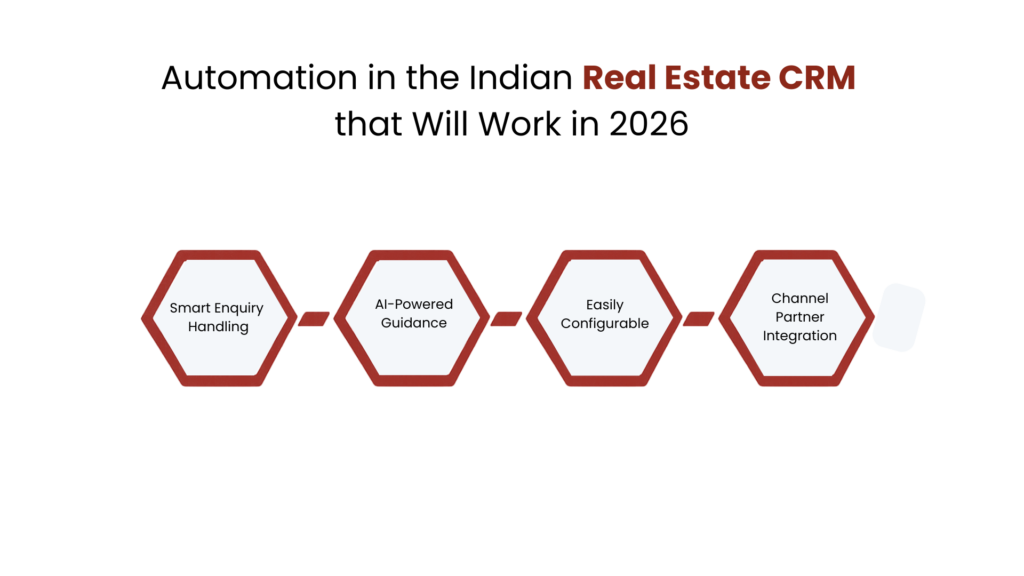
In 2026, the real estate businesses are automating their businesses and this automation is helping them achieve higher conversion rates, better internal workflows, and higher customer engagement. In 2026, businesses in real estate will upgrade their CRMs with latest technologies and updates.
Smart Enquiry Handling
With Indian real estate CRM automation the businesses can handle the lead management easily. Each incoming query is automatically converted to a lead and auto assigned to the right agent with an instant notification being shared to the agent. This leads to less delayed responses and enhances the customer journey.
AI Powered Guidance
AI automation is changing the way businesses function. The AI helps the businesses communicate to the customers by analysing their past conversations and all the data available in the system. This way, the customers receive personalized messages and the agents are able to understand the customers better.
Easily Configurable
Unlike most CRMs that are either not customisable or follow a minimal customisation approach, an AI CRM for real estate is different. The feature that makes this CRM desirable is that it is fully and easily configurable. Knowing that each team functions differently and may have different requirements, an AI CRM allows you to be innovative.
You can design and customize the CRM to suit the specific needs of your team and make the workflow smoother, smarter, and faster.
Channel Partner Integration
A feature that sets apart an agentic AI CRM for real estate is its channel partner integration. The companies can easily track all the brokers, partners, and deals from a unified platform. This eliminates the need to switch screens every time while working and track all enquiries, commissions, and approvals and makes the entire process transparent.
Conclusion
2025 was more than just a growth phase for the real estate businesses. Driven by strong demand, institutional participation, resilient office markets, and a shift toward premium housing, the sector set a foundation for sustainable, long-term growth.
The 2026 real estate market is set to leverage these structural and fundamental changes and will experience automation like never before. While challenges such as affordability persist, the overall outlook combines optimism with strategic maturity. What lies ahead is not just growth, but deepened trust, broader participation, and a fully evolved real estate ecosystem that supports both investors and end-users.
FAQs
1. Why was 2025 a turning point for Indian real estate?
2025 marked a shift from cyclical recovery to structural growth in Indian real estate. Demand was driven by end-users, long-term occupiers, and institutional investors rather than short-term speculation. Stable policies, improved governance, and economic confidence laid a strong foundation for sustainable growth.
2. Which real estate segments performed the best in 2025?
Premium and luxury residential housing led the market, with homes priced above ₹1 crore accounting for a majority of sales in major cities. Office real estate also rebounded strongly, while retail, logistics, and data centres emerged as high-growth asset classes.
3. What trends are expected to shape Indian real estate in 2026?
In 2026, sustained demand in premium housing, continued strength in office real estate, and rising prominence of Tier-2 and Tier-3 cities are expected. Infrastructure development and decentralised economic growth will further expand market opportunities.
4. Will Tier-2 and Tier-3 cities play a bigger role in 2026?
Yes, Tier-2 and Tier-3 cities are expected to see increased residential and commercial development due to infrastructure expansion, rising incomes, and improved connectivity. These markets will attract both developers and investors seeking new growth avenues.
5. Why is channel partner integration important in real estate CRM?
Channel partner integration allows businesses to manage brokers, commissions, approvals, and partner enquiries from a single platform. This improves transparency, reduces manual errors, and streamlines coordination across multiple stakeholders.
For more insights, updates, and expert tips, follow us on LinkedIn.