

The real estate industry has evolved over the decades and customers are no longer willing to wait for days for callbacks, look through endless property deals, or deal with distorted communication. They expect quick responses, personalised property recommendations, and a smooth end-to-end experience. In such a scenario, CRM automation has revolutionalised the way real estate businesses deal with sales & rentals.
This CRM for real estate sales and rentals is enabling businesses to automate the complete workflow from pre-sales to post-handover. They automate repetitive tasks, centralise customer data, improve customer engagement and enable the companies to view real-time engagement metrics.
Further, the estate agents are able to handle leads smarter as each incoming query is automatically converted to a lead and then auto-assigned to the right agent and an instant notification is shared to the agents so that they can respond immediately without any delays and without any mess up.
Why is a CRM for Real Estate Sales and Rentals Gaining Popularity?
The CRM for real estate sales and rentals has been gaining popularity and businesses are widely adopting the advanced CRM technology to automate the business for more leads, eliminate data silos, and improve conversion rates by almost 30%. This helps the businesses not only streamline their internal workflows but also helps them scale the business and maintain accuracy in data.
A real estate CRM is no more an option for businesses but has become an essential part of the businesses. To stay ahead of the competition it is important for the real estate agencies to adapt to the latest technologies and get the first mover advantage.
How Does a Real Estate CRM for Sales and Rentals Helps Businesses Scale?
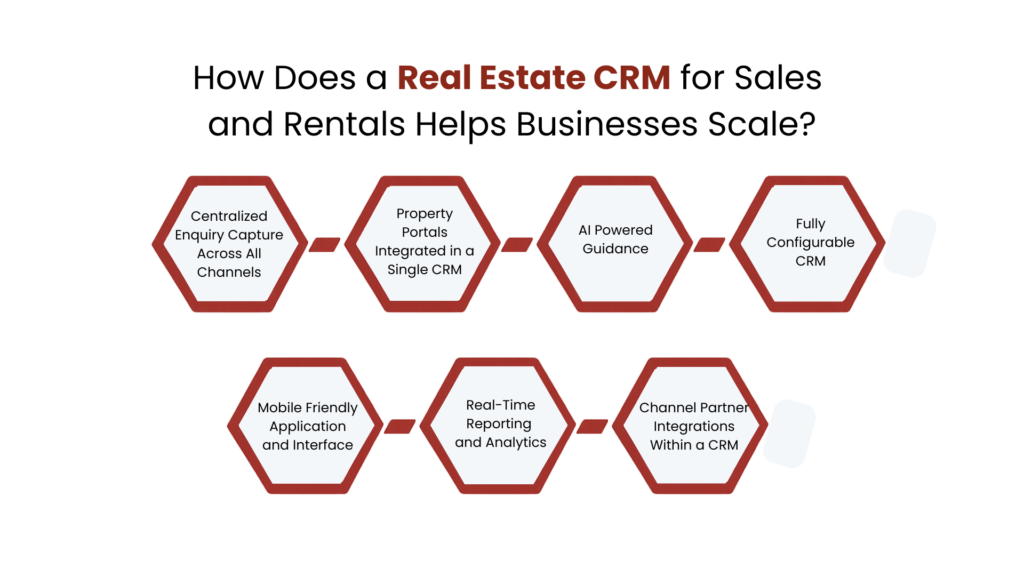
The real estate CRM now serves as the growth engine for real estate businesses and serves as a critical factor in helping the businesses scale. It automates everything from enquiries to property portals to channel partners to the end support.
Automated Lead Capture and Smart Distribution
One of the most significant ways CRM automation is revolutionizing real estate sales and rentals is through automated lead capture. Enquiries from websites, property portals, social media, messaging platforms, or email are instantly captured and stored in the CRM. The complete customer data is stored in the CRM and then the lead is automatically assigned to the right agent.
This saves time with manual follow-ups and capturing leads manually and the agents can focus on nurturing the high potential leads.
Property Portals Integrated in a Single CRM
CRM automation centralises all property listings, customer profiles, interaction histories, and transaction details into a single platform. Every interaction calls, emails, messages, site visits, and documents are automatically recorded against the customer profile.
With all the property portals integrated into a unified CRM the businesses and agents get access to all the property portals at once and they do not have to switch screens and tabs.
AI Powered Guidance
With the help of AI guidance the agents can find the right opportunity in uncertainty. The AI technology will analyse each past interaction and each lead, and then accordingly suggest the next best action in time. This way, the agents are confident in their actions, react quicker to the incoming leads, and know exactly what to do.
Fully Configurable CRM
To stay relevant and competitive in the real estate business, the estate agencies must opt for a CRM that is not only aligned to the business goals, but is also scalable and grows alongside your CRM. This way the businesses do not have to pay to upgrade the system every time.
Mobile Friendly Application and Interface
Mobile-accessible CRMs enable agents to manage leads, update statuses, and communicate with clients while on the move. Whether at a site visit or client meeting, agents have real-time access to data. This flexibility improves responsiveness and productivity.
Real-Time Reporting and Analytics
Reporting and analytics provide insights into lead sources, sales performance, and conversion trends. Managers can track agent productivity and identify bottlenecks in the sales pipeline. Data-driven insights help optimize strategies and forecast revenue more accurately.
Channel Partner Integrations Within a CRM
A real estate agent is not only responsible to manage the property listings, but must interact with the multiple agents and brokers as well. When this is done with manual efforts, the communication is often distorted and there is just a lot of chaos. A real estate management software lets you coordinate with all your partners and brokers in a single place. It lets you manage your commissions, enquiries and approvals from one screen and the transparency in the system makes the coordination even more smooth.
How is a Real Estate CRM Software Beneficial for the Client Agent Relationship?
A business succeeds because of its client relationship and to maintain these relationships in modern times where customers expect fast response and personalized messages. In these cases, a CRM for real estate sales and rentals is a serious advantage to the businesses.
Enhanced Customer Experience And Personalisation
Today’s customers expect personalized interactions. CRM automation enables real estate businesses to deliver this at scale. Using stored data and behavioral insights, the CRM can personalize communications, property suggestions, and follow-ups.
Personalized Property Recommendations
By tracking client preferences such as budget, location, and property type, the CRM helps agents recommend the most relevant listings. This reduces unnecessary property viewings and improves decision-making. Clients appreciate tailored options instead of generic suggestions.
Better Follow-Ups and Relationship Nurturing
CRM systems schedule timely follow-ups and engagement reminders even after deals close. This helps agents maintain long-term relationships and generate repeat business or referrals. Consistent engagement strengthens the client-agent bond over time.
Reduced Errors and Missed Opportunities
Automation minimizes manual data entry and tracking errors. Important client requests, documents, or deadlines are less likely to be overlooked. This reliability enhances the agent’s credibility and improves overall client satisfaction.
Conclusion
The real estate businesses are evolving with time, and so are the customer expectations. Clients expect faster responses, quick actions and speedy buying experiences. This is enabled with a CRM for real estate sales and rentals. It automates the entire business workflows by auto capturing and auto assigning leads to the agents, automating the site visits, and the complete documentation and financial workflows. This allows the agents to take quick actions on the existing leads, and allows them to focus on high-revenue tasks. Additionally, the CRM automation is revolutionizing the estate businesses by bringing the best automation features combined with your existing CRM.
FAQs
1. What is a CRM for real estate sales and rentals?
A CRM for real estate sales and rentals is a centralized platform that manages leads, customer data, property listings, site visits, transactions, and follow-ups. It automates workflows from inquiry to post-handover, helping agents respond faster and close deals more efficiently.
2. Why is CRM becoming essential for real estate businesses?
Modern buyers and tenants expect fast responses and personalized interactions. CRM systems help real estate businesses meet these expectations by centralizing data, automating communication, and improving conversion rates while reducing operational inefficiencies.
3. How does automated lead capture help real estate agents?
Automated lead capture instantly records inquiries from websites, property portals, social media, and messaging platforms. Leads are auto-assigned to the right agents, ensuring no inquiry is missed and agents can focus on high-potential prospects instead of manual data entry.
4. How does AI-powered guidance support real estate agents?
AI analyzes past interactions, lead behavior, and engagement patterns to suggest the next best action. This helps agents respond at the right time, prioritize leads effectively, and improve decision-making throughout the sales or rental process.
5. Why should real estate businesses invest in CRM automation today?
CRM automation enables faster responses, higher conversions, better customer experiences, and operational efficiency. In a competitive real estate market, it provides a clear advantage by streamlining processes and supporting sustainable business growth.
For more insights, updates, and expert tips, follow us on LinkedIn.