

The success in the real estate industry is no longer driven only by location, pricing or inventory. In the modern tech enabled world, a real estate and property management CRM that enhances the digital presence of a company and fuels a smooth customer experience journey is the key to growth.
The complexities and increasing competition in the real estate businesses has made spreadsheets, manual processing, and disconnected tools obsolete.This has not only resulted in business slow downs but often takes the shape of exhausted employees, unnecessary or non-convertible leads, repeated conversations, and declining sales and revenues.
Therefore, staying relevant in the market and creating a wider presence than the competitors is important in order to uplift the real estate business market. However, staying relevant does not mean sending more messages or cold calling more leads. Relevancy also comes with appropriate messaging rather than quantity, ensuring a smooth customer journey at a faster rate, and also providing proper support after the sale.
Growing Concerns & Complexities in the Real Estate Market
The property sales and real estate business may be flourishing for a company, but is it running as smoothly as it should? The response may surprise you, but it is not. Most real estate businesses still function and operate on a manual basis which not only means long follow-up processes, but also means delayed response time and missed opportunities.
Companies who try uplifting the real estate businesses with manual customer coordinations and spreadsheets are often left behind and struggle to fix the distorted systems and with no real-time tracking data about the lead or the estate agents, they are unable to take measures to scale the business.
How a Real Estate and Property Management CRM Contributes to Business Upliftment?
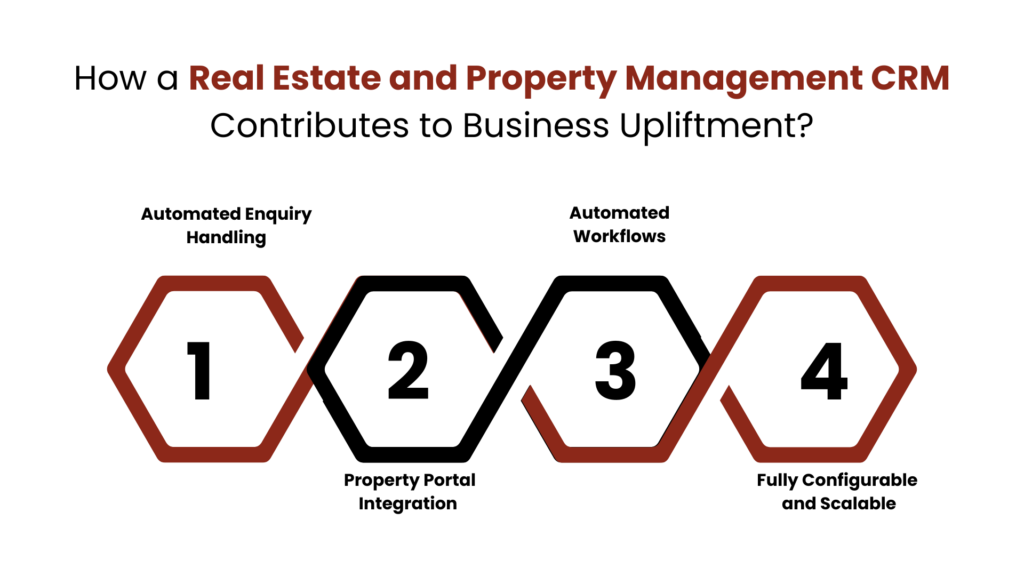
Most estate agencies and real estate agents think that adopting a real estate and property management CRM software will only help them connect with leads or communicate better with them. But what they fail to understand is that it is a much larger experience which is aimed to improve the overall business efficiency and prevent lead leakage for maximum revenue.
Thinking on a larger scale, a property management CRM software is built to enhance the customer journey from pre-sales to post-handover and this includes every step starting from customer enquiry to handling legal documentation post handover.
Automated Enquiry Handling
Most real estate agents face the issue of tracking leads and when they do it becomes difficult to follow-up with multiple leads and estate agents eventually lose or forget about these leads. However, this is no more the case with a well managed real estate CRM. With a CRM for property management and real estate every customer enquiry is automatically converted to a lead and auto-assigned to the right agent.
Once the lead is assigned an instant notification is sent to the agent and they are able to respond to the customer immediately without any delay and an instant connection can be built with the customers.
Centralized Lead Management & Property Portal Integration
With a CRM that is designed for real estate and property management businesses, managing leads becomes easy and with centralized access to everyone in the system, tracking also becomes easier.
Additionally, the estate businesses can manage all the property listings at one place, sync their own data and capture and manage leads in an instant. This reduces the time spent on sorting through leads across property portals and leaves room to focus on other high priority business activities like enhancing the customer experience.
Automated Workflows
When the daily workload is automated, business days feel lighter and breathable. It reduces the agents’ workload and frees them from answering routine queries, approval process becomes much shorter and rapid, and a consistency is maintained in the business since the work is ongoing amongst multiple teams and multiple sites at once.
Fully Configurable and Scalable
When your real estate business grows, your CRM needs to scale and uplift as well. This means that with business expanding your CRM should be able to adjust with the business. This is made possible effectively by a real estate and property management CRM.
The property management CRM that is fully configurable can be altered as per your business needs, and you can build a CRM that suits your requirements in the best possible way. This allows your CRM to behave exactly how you want it to behave and will upgrade as your business grows.
Contribution of a Real Estate and Property Management CRM in Enhancing Customer Journey & Experience
Customer satisfaction and experience is at the core of any business and a business will achieve maximum sales when the customer is valued and satisfied. This does not simply come from fast replies and follow-ups. While these two factors are crucial for a smooth customer journey, there are other factors that contribute too.
Installing a real estate CRM software handles automation at an advanced level and is focused on giving a perfect customer journey. It handles their pre-sales to post-handover journey including the documentation, legal management, and transfer & KYC.
Document Generation
A Real Estate and Property Management CRM simplifies document generation by automatically creating booking forms, agreements, receipts, and legal documents using pre-defined templates and customer data. This eliminates manual paperwork, reduces errors, and speeds up the transaction process. For customers, it means quicker access to accurate documents, fewer revisions, and a smoother, more professional buying or renting experience.
Legal Support Workflows
Legal support workflows in a CRM aim to streamline approvals, compliance checks, and document reviews by organizing them into structured, trackable steps. Sales, legal, and operations teams stay aligned through automated notifications and status updates. This reduces delays, ensures regulatory compliance, and gives customers better visibility into progress, improving trust and confidence throughout the transaction journey.
Transfer & KYC
A CRM centralizes Transfer and KYC processes by capturing, tracking, and verifying customer identity and property transfer documents in one system. Automated reminders ensure timely submission of required documents, preventing last-minute delays. Customers benefit from a transparent, hassle-free verification and ownership transfer process, making the final stages of the journey faster and stress-free.
Final Views
In totality, the real estate and property management CRM has changed the business outlook for real estate agencies. It has made businesses smarter with automations that feel human like. Also, when this automation is done extensively but thoughtfully at different business stages, it is not just the teams that benefit from this but also the customers.
The teams benefit wih faster workflows and shorter approval and sales cycles, and automated lead handling. On the other hand, the customers benefit from this automation because they get everything faster just as they want and they do not have to wait for days or weeks to receive the final possession.
FAQs
1. What is CRM management in real estate?
In the real estate business, a CRM is a specialized software that helps real estate agents, brokers, and developers manage and nurture client relationships, streamline sales, automate tasks, and organize property data in one central place to boost sales and improve customer service from lead generation to post-sale.
2. Do I need a CRM for real estate?
A property management CRM is aimed at improving the overall business efficiency and preventing lead leakage for maximum revenue. Thinking on a larger scale, a property management CRM software is built to enhance the customer journey from pre-sales to post-handover and this includes every step starting from customer enquiry to handling legal documentation post-handover. The need for a CRM is businesses’ personal choice but considering the growing competition it is advised to have one.
3. What are the features offered in a real estate CRM Software
A real estate CRM incorporates various business features including automated enquiry handling, property portal integrations, channel partner integrations, AI powered guidance, site vist management and much more.
4. How does a Property Management CRM help after sales?
After sales, the CRM helps manage tenant data, leases, rent schedules, maintenance requests, and service tickets. It ensures timely communication with residents and quick resolution of issues. Property managers gain visibility into asset performance and service history. This leads to higher tenant satisfaction and better long-term asset value.
5. How does a CRM improve customer experience in real estate?
The CRM improves customer experience by ensuring timely communication, personalized follow-ups, and transparent updates at every stage of the journey. Customers receive consistent information about site visits, documentation, payments, and possession timelines. Automated reminders and notifications reduce confusion and delays. This creates a smooth, reliable, and professional experience that builds trust.
For more insights, updates, and expert tips, follow us on LinkedIn.